A workshop organised in Prague by Calla and Bankwatch member group Centre for Transport and Environment (CDE) brought together experts from local governments, scientists, medical practitioners and active citizens. The workshop “Diagnosis: Uranium dreams and nightmares” offered the unique chance to learn about the uranium industry in Namibia from Bertchen Kohrs, president of EarthLife Namibia, who is working to protect local communities and the environment from the harmful impacts of uranium mining.
, | 15 November 2015
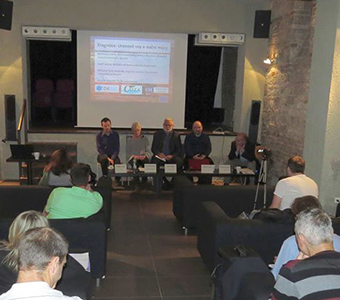
A workshop organised in Prague by Calla and Bankwatch member group Centre for Transport and Environment (CDE) brought together experts from local governments, scientists, medical practitioners and active citizens. The workshop “Diagnosis: Uranium dreams and nightmares” offered the unique chance to learn about the uranium industry in Namibia from Bertchen Kohrs, president of EarthLife Namibia, who is working to protect local communities and the environment from the harmful impacts of uranium mining.
by Hugo Charvát, Centre for Transport and Environment
Namibia, a large country with only 2.2 million inhabitants is the driest country in Sub-Saharan Africa. The country, with a third of its territory being desert or semi desert, has a wealth of mineral deposits, among others uranium. Producing seven percent of the world’s uranium, Namibia is now number five on the global market.
The minerals are mainly exploited by foreign companies, but foreign investments do not seem to trickle down very far. With a roughly 30 per cent unemployment rate in Namibia, poverty is widespread among locals while the cost of labour is very low.
Locals also suffer from the harmful impacts of uranium mining. The blasting of rock and soil that is common in open-pit uranium mines generates radioactive and toxic dust. Workers in the uranium mines suffer from the effects of long term exposition to low-level radiation. The lack of a proper legislative framework on the nuclear industry and a lack of monitoring by Namibia’s government facilitate these issues.
But the impacts of uranium mining influence both developing and developed countries. Bertchen Kohrs’ stories from the Namibian experiences was complemented by experts from the Czech Republic who explained how our country is facing the consequences of chemical extraction methods using underground leaching. It will take dozens of years and cost almost three billion euros to restore around 350 million cubic metres of underground water contaminated by more than 4 million tons of sulfuric acid.
Nonetheless, fixed on the idea of the supposedly clean and domestic nuclear energy, the Czech government is considering opening new drillings to extract 3 000 tons of uranium.
Speakers on the workshop and their presentations:
- Bertchen Kohrs, Epidemiologist, founder and longtime President EarthLife, one of the largest NGOs in the country: Surface mining of uranium in Namibia: health and environmental impacts,
- Josef Jadrny, Deputy Governor of the Liberec Region for the Environment: The disastrous legacy and perspectives of Podjestedi,
- Miroslav Suta, expert consultant on environmental and health risks: The consequences of exposure to uranium for workers at the uranium industry,
- Edvard Sequens, energy expert, Calla: Czech uranium dreams. The prospect of a new uranium mines in the Czech Republic and its political, economic and civic context.
Never miss an update
We expose the risks of international public finance and bring critical updates from the ground – straight to your inbox.
Theme: Development

