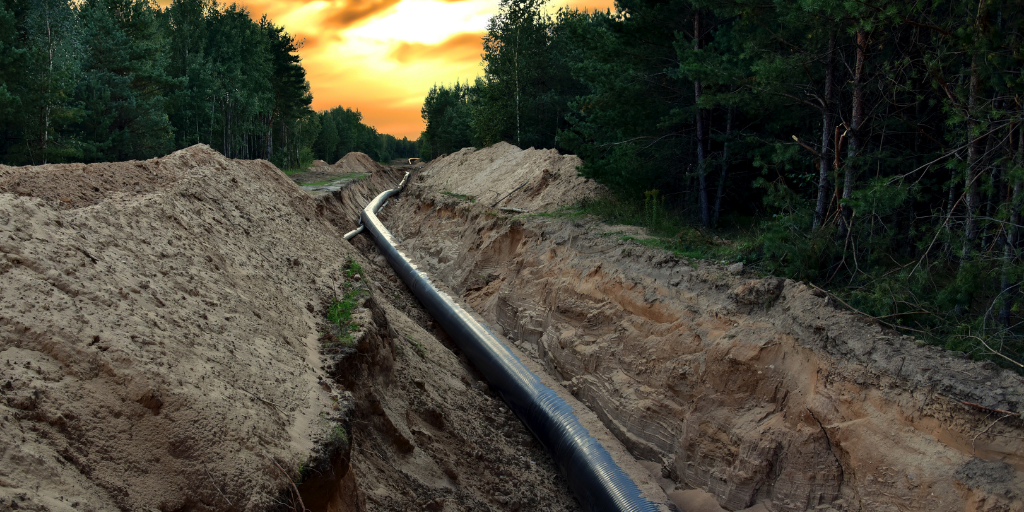
36 civil society organisations have today sent a joint letter (1) to the European Commission President Ursula von der Leyen, calling on the EU to stop promoting the use of fossil gas in the Western Balkans.
The region is currently much less gas-dependent than the EU, which is struggling to free itself from fossil gas imports after Russia’s invasion of Ukraine.
Serbia and parts of North Macedonia and Bosnia and Herzegovina use Russian gas, mainly for heating. Albania, Kosovo and Montenegro do not have gas networks at all (2).
Despite the fact that the Western Balkans have committed to phase out fossil fuel use by 2050 (3), the Commission has in recent years actively encouraged increasing fossil gas consumption in the region, mainly via the Southern Gas Corridor from Azerbaijan (4), despite the Shah Deniz gas field project being 20 per cent owned by Russia’s Lukoil (5).
Today’s letter calls on the Commission to ramp up sustainable energy investments that are being neglected in the region, instead of continuing to promote fossil gas.
Denis Žiško from the Aarhus Center in Bosnia and Herzegovina, said, ‘Promoting increased fossil gas use in the Western Balkans at this stage of the global climate emergency is irresponsible and counterproductive. Our low gas dependency is a plus, not a minus, as we move towards electrification of heating and transport. New infrastructure built now will end up either as stranded assets or as a fossil gas lock-in that will hinder renewables development in the region’.
Nevena Smilevska of Eko-Svest in North Macedonia, said, ‘Irrespective of whether it is from Russia, Azerbaijan or elsewhere, increasing our import dependency is the last thing we need – a fact underlined by this winter’s gas price hikes and Russia’s invasion of Ukraine. As the EU finally realises that its own energy security cannot be based on fossil gas imports, so too must the Commission urgently stop promoting this dead end in the Western Balkans’.
Nataša Kovačević of CEE Bankwatch Network, said, ‘Tackling electricity distribution losses, increasing the use of heat pumps and rooftop solar, innovative heat storage technologies and deep renovation of residential buildings need much more high-level attention from the European Commission to make up for the years lost promoting fossil gas’.
Contacts
Pippa Gallop, Southeast Europe Energy Advisor, CEE Bankwatch Network
+385 99 755 9787
Natasa Kovacevic, Campaigner for Decarbonisation of District Heating in Western Balkans
natasa.kovacevic@bankwatch.org
+382 67 030 033
Notes for editors
- The letter can be found here.
- Serbia uses fossil gas for district heating, but use for power and individual households is relatively low. North Macedonia has increased its fossil gas consumption for power and heat in recent years. In Bosnia and Herzegovina, only four towns and cities are connected to the gas network, while Kosovo, Montenegro and Albania hardly use gas at all and do not have functional distribution networks. The Trans-Adriatic Pipeline crosses Albania but so far provides no gas to the country.
- Sofia Declaration on the Green Agenda for the Western Balkans, 10 November 2020. The Declaration includes a pledge to adopt the EU Climate Law, which makes climate neutrality by 2050 a legal obligation.
- E.g. The European Commission’s 2020 Economic and Investment Plan for the Western Balkans overtly promotes gas. It claims – without providing any evidence – that new gas pipelines could later be used for renewable gas.
In February 2022 alone:
-
- The EU Ambassador to Serbia helped launch works on the new Serbia-Bulgaria gas pipeline, partly funded by a European Investment Bank loan and an EU grant.
- EU representatives issued numerous statements promoting gas at a Southern Gas Corridor Advisory Council meeting in Baku. e.g: Commissioner Olivér Várhelyi: ‘(…) Azeri gas can help diversify energy resources and reduce emission levels by at least 55%, by phasing out coal completely from the energy mix of the Western Balkans’ and ‘We are ready to cooperate in energy transition in #WesternBalkans: gas has key role in phasing out coal+transition to decarbonised economies (…).’
- EC Delegation representatives and the EBRD met with Nermin Džindić, Energy Minister of the Federation of Bosnia and Herzegovina. The EC Delegation reportedly said that: ‘The direction of transition for the EU (…) comprises a medium term solution of building the Southern Interconnection gas pipeline and in the long term implementing renewable energy projects’.
- Commissioner Várhelyi again singled out gas at the EBRD’s Western Balkans Investment Summit: ‘(…) we hope to receive applications for more strategic and mature projects, including gas projects providing alternative to gas supply from Russia.’
5. Lukoil, Lukoil completes the deal on acquiring interest in Shah-Deniz project, 18 February 2022.
Never miss an update
We expose the risks of international public finance and bring critical updates from the ground – straight to your inbox.

