The heating and cooling sector in central and eastern Europe requires urgent transformation if the region is to end its dependence on dirty, expensive fossil fuels. The EU’s Modernisation Fund was set up with this exact goal in mind.
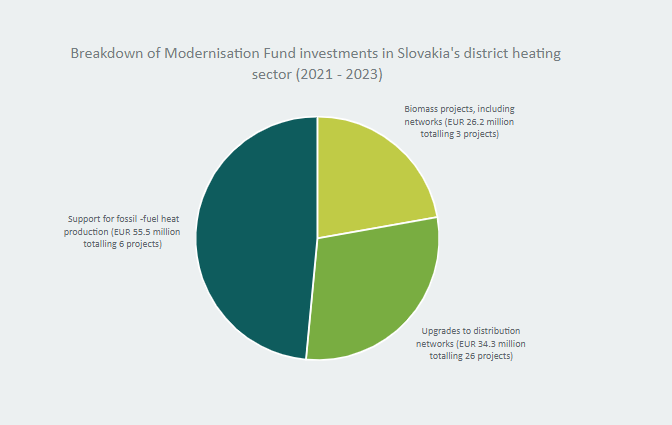
Yet, our analysis of 37 projects financed by the Modernisation Fund in Slovakia between 2021 and 2023 reveals a significant portion of the fund is still being used to sustain fossil gas. A staggering EUR 55 million – almost half the amount earmarked for district heating projects in Slovakia – has been allocated for systems running on fossil gas, despite the EU’s target to cut emissions by 55 per cent by end of the decade.
Investing in fossil fuel dependence directly undermines the EU’s emissions reduction goals under the Fit for 55 legislative package. Tightening the rules governing the Modernisation Fund must be made a priority if the fund is to truly support, rather than hinder, Europe’s energy transition.
District heating in Slovakia
Slovakia’s district heating and cooling sector supplies heat to 1.8 million people, accounting for more than 30 per cent of the country’s heating consumption. To modernise the sector, Slovakia has already adopted five state aid schemes totalling EUR 1.35 billion.
These schemes, which cover all aspects of the district heating and cooling sector, including industrial systems, are supposed to avoid increasing fossil gas consumption – at least in theory. The funding is intended to support networks, energy storage, smart technologies, and high-efficiency combined heat and power units using a range of fuel types, including gaseous fossil fuels (solid fossil fuels are exempted), all renewable energy sources, and hydrogen.
However, in the first call for funding, which consisted of four rounds (the final two rounds were cancelled by the new government), only upgrades for combined heat and power units running on fossil gas were approved.
No support was given to new combined heat and power units, with the exception of one new high-efficiency combined heat and power unit, which will replace an existing coal-fired combined heat and power unit with one running on fossil gas.
Modernisation Fund proves a mixed bag
Slovakia has received EUR 116 million from the Modernisation Fund to modernise its district heating systems. It materialised in the form of 32 signed and published grant agreements. Unfortunately, six of these projects directly support gas-based combined heat and power units. In other words, nearly half of the funds (EUR 55.5 million) allocated to the heating sector supported fossil fuels.
The remaining 52.5 per cent is earmarked for projects aimed at building new and modernising existing district heating and cooling networks (typically powered by fossil fuels) and replacing fossil-gas boilers with biomass boilers.
Interestingly, EUR 26.2 million has been allocated to three biomass projects and associated networks, with the remaining EUR 34.3 million in non-fossil fuel investments going towards upgrading networks, incorporating smart technologies, and improving energy storage.
However, the fact remains that most of the district heating and cooling systems in these upgraded networks continue to rely on fossil gas-powered combined heat and power units (see table below).
Signs of reform?
Within the period analysed, no projects supporting geothermal energy or heat pump technologies were funded. However, the most recent disbursement in June 2024 saw EUR 35 million allocated to a new state aid scheme, adopted in March 2024, which will support renewable energy sources and hydrogen in district heating and cooling systems.
The call for this scheme, expected to be published later this year, could lead to the rollout of the very first projects dedicated to geothermal energy and heat pumps.
District heating projects supported by the Modernisation fund in Slovakia (2021-2023)
| Type of project supported | Number of projects | Amount in EUR million | Percentage of total allocated projects |
| Total funds allocated to the district heating and cooling sector | 32 | 116 | 100% |
| Support for combined heat and power units running on fossil gas | 6 | 55.5 | 48% |
| Biomass projects, including networks | 3 | 26.2 | 22.5% |
| Upgrades to networks | 23 | 34.3 | 29.5% |
I would like to thank Jana Cicmanova for compiling the data and Milan Zvara for his feedback on the analysis.
Never miss an update
We expose the risks of international public finance and bring critical updates from the ground – straight to your inbox.

