Bishkek residents seek mediation to restore trolleybus service
Residents of Bishkek have asked the European Bank for Reconstruction and Development (EBRD)’s Independent Project Accountability Mechanism (IPAM) to facilitate dialogue with urban authorities over concerns about the city’s trolleybus services.
19 August 2025
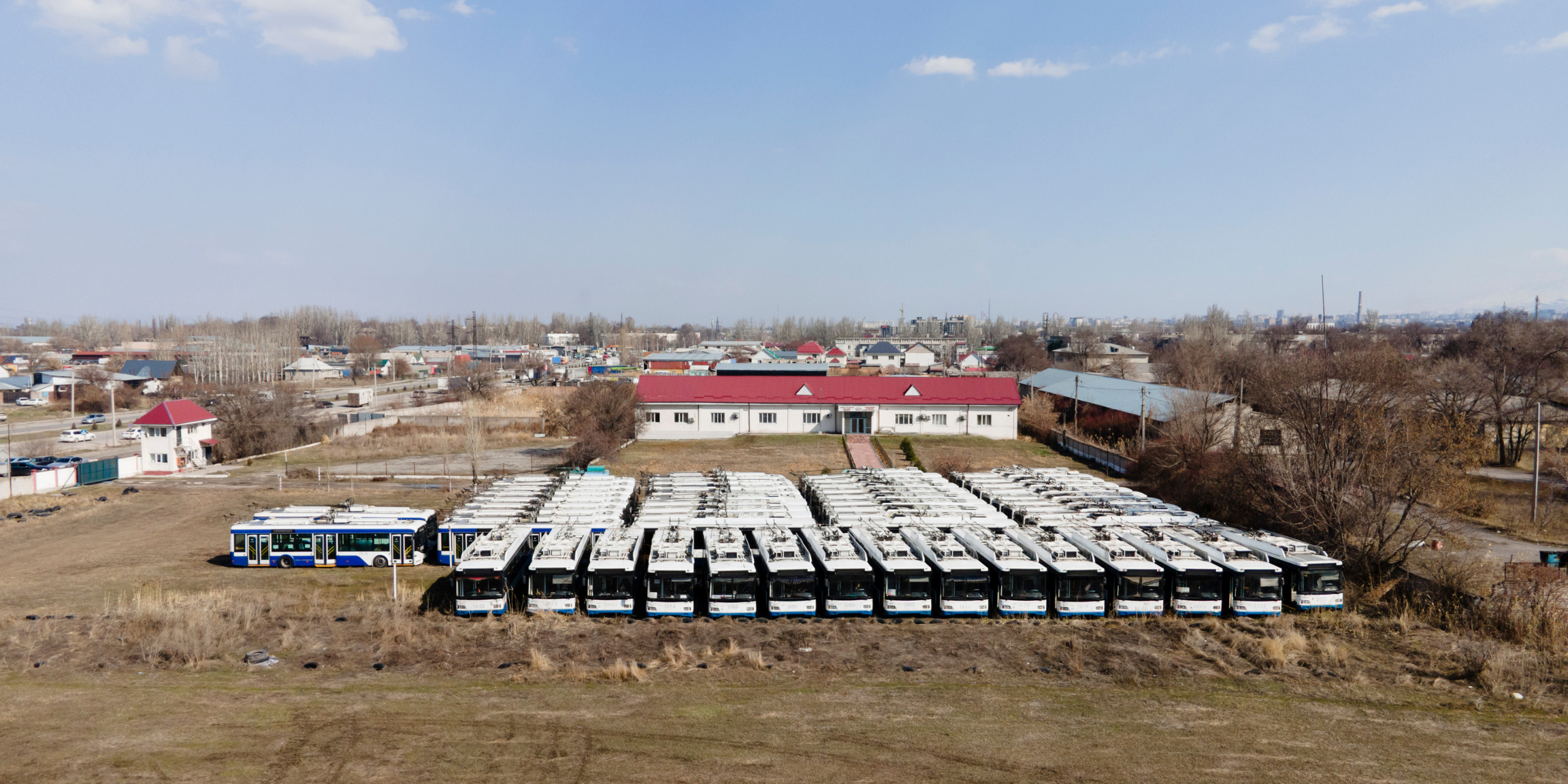
EBRD-financed trolleybuses in storage in Bishkek (2025) (photo: Danil Usmanov).
The EBRD has invested around EUR 24 million in loans and grants to support Bishkek public transport projects. These include a new e-ticketing system, the preparation of a public transport development strategy, infrastructure upgrades and 130 new trolleybuses. Of these, 52 were purchased in 2017 and 2018.
Although the EBRD recently repaid two of its previous trolleybus projects (approved in 2011 and 2015), it still maintains an active financial interest in Bishkek’s public transport sector. In 2020, the Bank approved an additional EUR 25 million loan along with an EUR 8 million grant to rehabilitate a bus depot, purchase new buses running on compressed natural gas (CNG), and implement the city’s Green Cities Action Plan.
Trolleybuses were once the iconic mode of transport for citizens of Bishkek, the capital of Kyrgyzstan. Emissions-free and more spacious than both CNG buses and the city’s overcrowded ‘marshrutka’ minivans, the fleet of 183 trolleybuses provided a reliable and comfortable mobility option across 11 routes throughout the city.
Unfortunately, in spring 2024, the city authorities began dismantling the trolleybus system with plans to transition to electric buses.(1) A year later, however, only two electric buses had entered pilot service, leaving Bishkek’s locals facing an acute shortage of public transport. This gap has resulted in worsening air quality (2) and increased health risks. And these impacts are disproportionately felt by vulnerable groups, including older people, women and children, and people with disabilities, whose mobility needs cannot be met by the city’s insufficient public transport fleet.
After numerous petitions and letters from local, national, and international stakeholders, legal action in Kyrgyz courts, and unsuccessful attempts to communicate with international financiers, a coalition of Bishkek citizens and civil society groups has decided to request mediation. The group – which includes youth and women leaders, human rights organisations, environmental activists, and an association representing people with disabilities – has formally asked the EBRD’s IPAM to launch a problem-solving process through which they hope to negotiate with local authorities for the return of at least the newest 52 trolleybuses.
Problem-solving supports voluntary dialogue between parties aimed at resolving environmental, social and access-to-information concerns without attributing blame or fault. Facilitated by the IPAM and an independent mediator, the process enables an open exchange of information and helps all parties reach a mutually satisfactory agreement through alternative, consensus-based resolution approaches.
To ensure focus and efficiency, the IPAM’s problem-solving process can last up to one year. A degree of flexibility is allowed until an action plan is agreed, at which stage the IPAM then monitors the implementation of the approved actions. If problem-solving fails to commence or a consensus is not reached, the IPAM can initiate an investigation to assess whether the EBRD has followed its own environmental and social standards.
A representative of BishkekSmog: ‘Air pollution continues to negatively affect the health and well-being of the more than one million people living in Bishkek. And the problem is only getting worse due to smog, the city’s “silent killer”. With around one-third of emissions coming from transport, we’re calling for open and constructive dialogue with Bishkek City Hall to restore the city’s trolleybuses – our most environmentally friendly, emissions-free mode of transport.’
A representative of the Association for Human Rights for People with Disabilities: ‘Unfortunately, it’s currently extremely difficult for people with disabilities to get around in Bishkek. Trolleybuses were equipped for accessibility, but they are no longer in service. Bus drivers never lower the ramps and completely ignore people with disabilities and pensioners. As a defender of the rights of people with disabilities, I often accompany them around the city and, for us, the absence of trolleybuses is a huge loss and a major obstacle to mobility.’
A representative of Bir Duino Kyrgyzstan: ‘In Kyrgyzstan, activists and civil society leaders are working within an ever-shrinking civic space. As watchdogs, they continue to demand justice, effective use of development aid, transparency, and good governance – including in development bank projects.’
Fidanka Bacheva-McGrath, Strategic Area Leader for Cities for People at CEE Bankwatch Network: ‘It’s in the interests of requesters, local authorities and international financiers to find a sustainable solution to Bishkek’s public transport system. Although two EBRD loans have been repaid, the trolleybuses purchased in 2018 can still contribute to the achievement of Bishkek’s Green City Action Plan as well as its climate mitigation and air quality objectives. To be “money well spent”, Green City investments need to deliver long-term benefits and create space for discussion on the mobility needs of communities.’
Egor Muleev, transport expert at the Leibniz Institute for Regional Geography: ‘It’s difficult to say why the decision was made to replace one electric bus system with another. It certainly wasn’t based on engineering knowledge, economic appraisals, or aesthetic considerations. What is clear, however, is that City Hall received loans from two international banks and should adhere to the initial agreements to support the city’s sustainable transition. Hopefully, the IPAM will maintain focus on sustainable development in the decision-making process and influence future steps towards delivering environmentally friendly transport solutions in Bishkek.’
Alessandro Ramazzotti, researcher at the International Accountability Project: ‘Residents of Bishkek have consistently expressed a preference for clean and reliable public transport. That’s why it’s essential that all stakeholders engage in the mediation process with integrity, respect the expressed needs of communities, and safeguard the long-term public benefit of previous investments.’
For more information, please contact fidankab@bankwatch.org or bishkek.smog@gmail.com.
NOTES FOR EDITORS:
(1) Read more about the decision to remove Bishkek’s trolleybuses: The last trolleybus of Bishkek: mayor’s decision defies logic and undermines foreign investments in green transport – Bankwatch.
(2) Learn more about air pollution in Bishkek and the city’s trolleybuses: https://bishkeksmog.info/.
Never miss an update
We expose the risks of international public finance and bring critical updates from the ground – straight to your inbox.
Institution: EBRD
Theme: public transport
Location: Kyrgyzstan
Tags: EBRD | Kyrgyzstan | cities for people | public transport