Romania stands at a dangerous crossroads. Last week, a law initiated by the senator Daniel Zamfir in 2022 and already then rejected by the Senate, passed by a crushing majority (262–33) in the decisive Deputies Chamber.
Ioana Ciuta, president of Bankwatch Romania | 20 October 2025
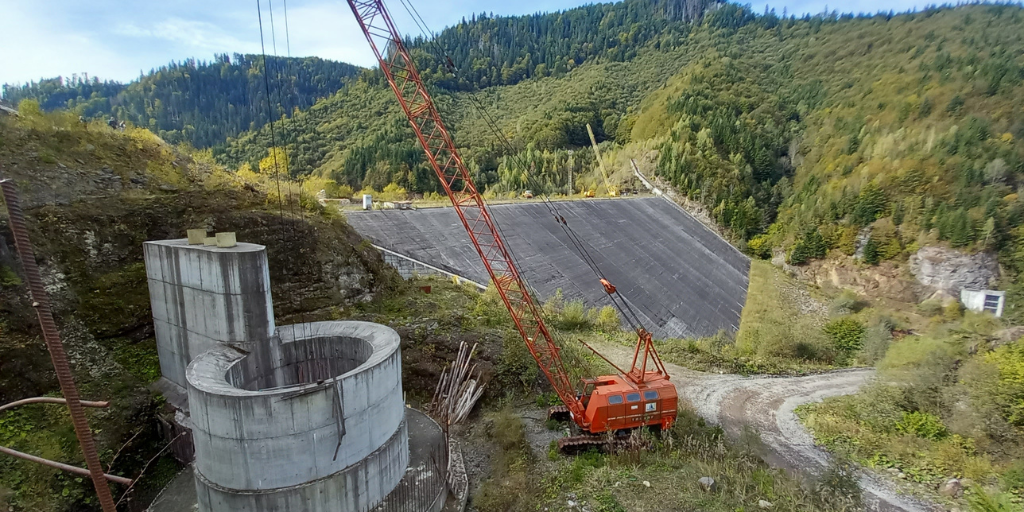
Răstolița hydropower project. Photo: Andrey Ralev, CEE Bankwatch Network
This law allows for the destruction of 27 protected areas, including two national parks, in order to finalise the construction of outdated hydropower projects. The law applies to projects whose construction began prior to June 2007 – when Romania set up its Natura 2000 network – having thus a retractive application, which the Constitution forbids.
Several of these hydropower projects were started over 40 years ago during the Ceaușescu era, without any environmental impact assessment, and have been halted in recent years either by court decisions – at the initiative of NGOs, such as Bankwatch Romania and Declic – or due the insolvency of their promoter, state owned company Hidroelectrica, between 2012 and 2016.
This new law – in clear contravention of EU environmental safeguards – tries to legalise the shrinking of protected areas to enable the projects to proceed, as well as abolishing the obligation to carry out environmental assessments for the projects. This would result in mass deforestation in some of Romania’s untouched mountain forests. It permits the damming and draining of rivers, which will drive rare fish species to extinction and degrade freshwater resources upon which millions depend.
A now-familiar authoritarian playbook
The recent adoption of the so-called ‘Zamfir Law’ represents far more than an environmental catastrophe in the making – it signals a fundamental assault on democratic principles, the rule of law, and civil society itself. What we are witnessing is a coordinated attack that follows a now-familiar authoritarian playbook: override court decisions, pass legislation that violates constitutional protections and EU law, then silence dissent by delegitimising and threatening those who dare to oppose it.
These are not theoretical concerns. These are hydropower projects whose environmental permits have been suspended or canceled by courts due to serious legal violations. They rely on outdated technology and would make a negligible contribution to electricity generation, despite being claimed by various politicians to be ‘strategic projects of overriding public interest’, which would allegedly solve a no-longer-existing energy crisis. The energy security argument is a smokescreen. There is no impact study demonstrating that completing these projects would reduce electricity bills.
Meanwhile, Hidroelectrica itself is installing a 64 MW (256 MWh) storage unit at the Iron Gates II hydro power plant, using EU funds, and showing that less damaging alternatives exist.
Constitutional violations
This law fundamentally contradicts the Romanian Constitution’s guarantee of environmental protection and violates the established principle that Parliament cannot arbitrarily diminish protections already in place for natural areas. Environmental organisations have called on President Nicușor Dan to refer the law to the Constitutional Court before promulgation.
Romania is not in a state of emergency that would justify such exceptional measures. The energy impact of these targeted projects would be insignificant at the national level, below 1 per cent of the current electricity generation – completely disproportionate to the irreversible destruction they would cause.
Not just environmental destruction, but also the rhetoric of repression
What makes this situation even more alarming, what transforms it from an environmental crisis into a democratic emergency, is the response from the law’s architects when civil society organisations dared to raise these concerns.
Senator Zamfir’s reaction should give the chills to anyone who values democratic freedoms. In a public statement, he declared ‘war’ on Environment Minister Diana Buzoianu, calling her an ‘NGO minister’ and accusing her of coordinating with what he termed ‘eco-terrorists’ engaged in ‘public jihad’. The Ministry of Environment, according to the Zamfir Law, has 60 days to remove the ‘protected area’ status from sites affected by hydropower projects, something the environment minister called ‘a disgrace’.
Zamfir however dismissed legitimate environmental concerns as protecting ‘little fish, little frogs, and little birds’. But he didn’t stop at inflammatory rhetoric. He issued a direct threat, promising to expose the ‘saboteur minister’s interests’ and demanding to know who finances Bankwatch Romania, Agent Green and Declic, and why they ‘attack all the country’s energy projects’.
This is the language of authoritarian regimes. This is how governments prepare the ground for ‘foreign agent’ laws that stifle civil society and crush dissent. We have seen this script in Russia, Hungary, Georgia, Slovakia and elsewhere: first delegitimise critics as foreign-controlled traitors, then legislate them out of existence.
The former Energy Minister’s comments in Parliament reinforce this pattern. He dismissed evidence-based concerns about environmental assessments as ‘nonsense’ and ‘well-paid propaganda’. The messages are unmistakable: criticism is unpatriotic, civil society organizations are foreign agents, and those who defend the environment are ‘small people’ standing in the way of national greatness.
An urgent call to the European Commission
The European Commission must take immediate notice. This law directly violates the Habitats Directive and Birds Directive, which establish Natura 2000 sites that cannot be arbitrarily degraded, as well as the Water Framework Directive requiring protection of water ecosystems. Romania’s Parliament has passed legislation that is incompatible with EU law and has done so in defiance of court decisions that already suspended environmental and permits for many of these projects.
The Commission has tools at its disposal, which must be deployed now, before this precedent becomes normalised.
Senator Zamfir asks who finances Bankwatch Romania, Declic, Agent Green, and other environmental organisations. The answer is transparent and public: we are funded by Romanian citizens, European institutions, and international foundations committed to environmental protection and democratic governance. Our funding sources are disclosed. Our work is subject to legal oversight. We are accountable to the public and to the law.
The real question is this: who benefits from destroying Romania’s protected rivers and forests? Who gains from inefficient hydropower projects? In recent years, Romanian politicians have repeatedly joined hands to destroy nature and have hidden their obscure interests behind populist facades.
Romania faces a choice. It can uphold its Constitution, respect its European obligations, and maintain space for civil society to function freely. Or it can continue down a path where laws are passed in defiance of constitutional protections, where criticism is met with intimidation, and where civil society is delegitimised as a prelude to repression.
The European Commission must act now. Launch infringement procedures. Invoke Rule of Law mechanisms. Make clear that destroying protected areas and threatening civil society are incompatible with EU membership.
The Romanian Constitutional Court must recognise this law for what it is: an unconstitutional assault on established environmental protections. Romanian citizens must not be fooled by rhetoric about ‘little fish’ and ‘foreign agents’. When governments can arbitrarily destroy protected areas and intimidate those who object, no right is secure.
The coming weeks will determine whether constitutional protections and the rule of law prevail, or whether power, unbound by legal constraints, will triumph over principle.
Bankwatch România, Declic Community, Agent Green, EcoLegal Association, and Eco-Civica Foundation are transparent civil society organisations working to protect Romania’s environment and democratic institutions. Our funding sources are publicly disclosed, our work is legally compliant, and our commitment is to the Romanian people and future generations.
Never miss an update
We expose the risks of international public finance and bring critical updates from the ground – straight to your inbox.

