Community energy has emerged as a quiet undercurrent in Estonia, but has yet to firmly establish itself in the broader energy debate. Still, a number of pioneering communities across the country have already taken control of their energy production and consumption. Aiming to replace fossil fuels with cleaner and more affordable alternatives, they have adopted practical solutions that combine local needs, renewable energy and cooperative collaboration.
Kertu Laherand, Just Transition Campaigner | 15 April 2026

At a time when the energy crisis, climate goals, and security issues are becoming increasingly intertwined, community energy presents a strategic yet significantly underutilised opportunity for central and eastern Europe to build a more resilient energy system. As the EU transitions to clean energy, community-based energy solutions are becoming an increasingly important grassroots driver, one that links climate goals with local development and social cohesion.
Estonia’s Energy Sector Development Plan (ENMAK) adopted earlier this year, has taken the first steps towards mapping the potential obstacles and opportunities for community energy at the national level. Unlike in many other EU Member States, the development of community energy in Estonia has yet to become a separate strategic goal, largely due to a lack of state support.
Supporting community energy initiatives and promoting their wider adoption would bolster the functioning of Estonia’s local energy sector, the transition to renewable energy, and its overall resilience. At the local level, this strategy would in turn help communities cope with a variety of challenges, from ensuring energy security to creating new opportunities in areas like transport and the energy supply of public buildings.
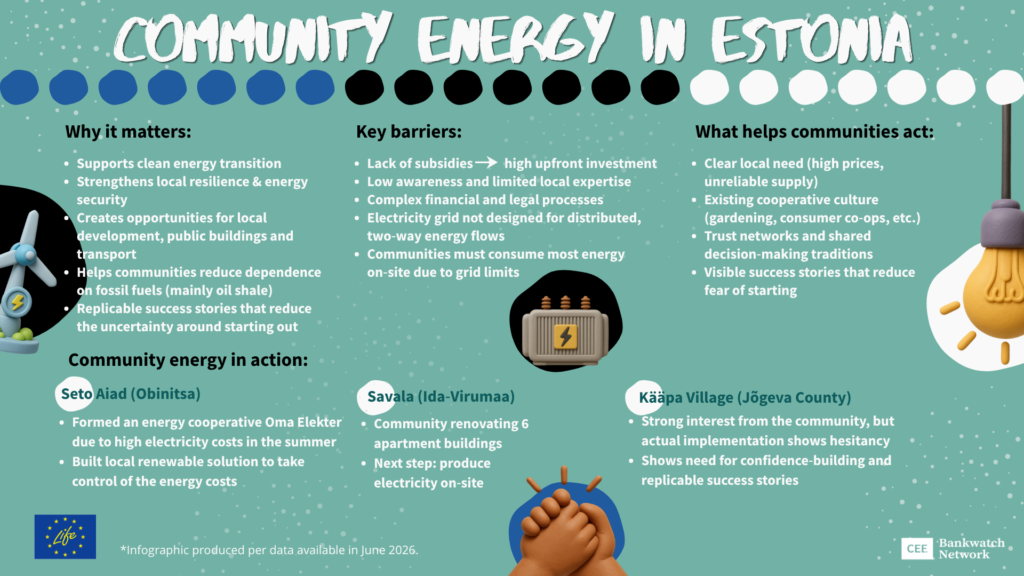
What motivates Estonian communities to generate energy together?
Despite the scarcity of subsidies, a few trailblazing communities in Estonia have taken the initiative to produce energy locally. Energy cooperatives are today rarely formed out of convenience, but out of necessity. When an existing solution no longer works or becomes too expensive, alternatives have to be found. The effects of high electricity prices, an unreliable heat supply, or poor infrastructure – all of which are keenly felt during a harsh winter – tend to motivate communities to come together and act.
The experience of Seto Aiad, a gardening cooperative in the village of Obinitsa in the southernmost part of Estonia, is an example of how economic pressure can provide the impetus for action. Faced with high electricity costs for keeping their cold storage facility running during the summer, the members were left with no other option but to establish an energy cooperative. With an eye on long-term sustainability, this local initiative is taking a far more climate-friendly approach than simply relying on transporting oil shale energy, much of which is lost on its journey from the other end of the country in Ida-Virumaa, the country’s just transition region.
Even within Ida-Virumaa itself, which has been mass-supplying electricity to households for the past century, the transition to community energy has begun. In the village of Savala, the community is now working together to renovate six apartment buildings, with the logical next step of generating the electricity consumed on-site.
However, these pioneers often face significant challenges. There are no guarantees, and collaborative investment in the community and local life has yet to sufficiently take root in wider society. Leaders of the Kääpa village energy cooperative in Jõgeva County in the east of the country have found that, even when the community does show interest and the idea of shared energy seems exciting and sensible, people become much more cautious during the implementation phase.
And this is precisely why success stories that can be later replicated in other villages and regions are so crucial, as they build confidence and reduce the fear of getting started. Community energy has the potential to play a significant role not only in gardening and consumer cooperatives, but also in other forms of collective action where networks of cooperation and trust already exist. Where people are accustomed to making decisions together and sharing responsibility, energy cooperation is a natural next step.
Looking to the future
Beyond inspiration and determination, the wider adoption of energy cooperatives requires systemic support. Currently, the development of community energy is being held back by a lack of awareness, limited infrastructure and financial complexity. Until Estonia introduces the targeted subsidies that are widely available elsewhere in Europe, energy cooperatives will continue to have to make a large initial investment using their own funds, which rules out many potential participants from the outset.
Another major bottleneck is Estonia’s electricity grid, historically designed for one-way electricity transmission of power from large producers to consumers. But this structure does not sufficiently support distributed and community-based production or allow for flexible electricity distribution. As a result, current initiatives often have to focus on ensuring that as much of the energy produced as possible is consumed locally.
Community energy is more than just a niche solution in Estonia – it’s a transformative opportunity to shape a fairer, cleaner and more resilient energy system. To support this shift, steps need to be taken on multiple fronts. At the national level, the government can send a clear signal by making community energy a strategic priority, creating simple and understandable support measures, and adapting the grid and regulatory framework to better suit distributed electricity generation. Even modest, targeted start-up grants or financial guarantees would help cooperatives overcome the most challenging initial phase.
Local governments can also take the lead by mapping regional opportunities, launching pilot projects, and bringing together interested parties, including residents and businesses. At the community level, the most important thing is to start a conversation about how shared needs can be met collectively while keeping an open mind. From this point of strength, communities can seek out partners and expert advice. As the above success stories show, growth only occurs when people dare to learn and experiment together.
Never miss an update
We expose the risks of international public finance and bring critical updates from the ground – straight to your inbox.
Institution: Estonian Green Movement
Theme: community energy
Location: Estonia
Project: After recovery towards cohesion | Just transition
Tags: European Green Deal

