Amid this geopolitical turmoil, we at Friends of the Earth-CEPA (CEPA) have been assessing Slovakia’s potential to support long-term solutions to energy poverty through EU funding mechanisms. Our analysis reveals a staggering EUR 986 million that could be mobilised annually to finance energy poverty solutions in Slovakia.
A lifeline for vulnerable households left on the table
To reach this total, Slovakia must first address the chronic underutilisation of its existing resources. The Environmental Fund derives its revenues primarily from the EU Emissions Trading System (ETS), as well as from other environmental fees. However, its annual reports indicate a consistently low rate of expenditure, averaging only 37% annually between 2012 and 2024.
In theory, this means that Slovakia should have more than EUR 2.539 billion available through the Environmental Fund to finance environmental measures, such as energy efficiency improvements for low-income households.
Yet questions remain regarding the practical use of these resources. Historically, the Ministry of Finance has prioritised fiscal objectives over the climate goals of the Ministry of Environment, which has typically received insufficient support. This reflects the tendency of Slovak governments to favour the economic benefits of retaining funds in bank accounts to strengthen the country’s lending position, rather than directing them towards environmental spending.
The cost of inaction
The impact of this strategy is clear from the most recent data. In 2024, Environmental Fund revenues reached EUR 489 million, while expenditures amounted to only EUR 332 million – meaning just 68% of the available allocation was spent.
Slovakia should be using 100% of these annual revenues to meet its clean energy transition needs, rather than to improve its fiscal or lending position on international financial markets. In 2024 alone, this would have made an additional EUR 156 million available for environmental spending.
Looking at the broader trend, the average annual unspent amount between 2012 and 2024 was EUR 195 million – resources that could have been channelled directly into social climate solutions.
The Modernisation Fund’s untapped potential
Our calculations reveal a EUR 1.14 billion investment gap in the Modernisation Fund. Based on publicly available data, this represents a major surplus that remains unspent or unallocated compared to projected revenues. This gap is driven by different assumptions in ETS price projections over time, as well as the relatively slow pace of the Fund’s implementation – with less than one-third spenthalfway through the 2020–2030 period. The figure also represents almost 89% of Slovakia’s agreed EU contribution to the Social Climate Fund between 2028 and 2032.
There is already a positive precedent. The Ministry of the Environment has approved the allocation of EUR 186 million from the Modernisation Fund to the Renovate House programme, which is the first shortlisted measure under Slovakia’s social climate plan. More energy poverty and transport poverty solutions should follow.
At the same time, the Ministry of the Environment is preparing funding allocations for other areas, although these remain unclear despite our efforts to obtain further details through information requests. As a result, the final available amount could be lower.
It should also be noted that the social climate plan has yet to be published. However, a study prepared by technical assistance experts has already shortlisted several measures for potential support under the Social Climate Fund.
From fossil fuel subsidies to energy efficiency and renewable support
The national energy and climate plan lists dozens of subsidies in the energy sector, including support for fossil fuels. Most of these have no defined end date. They include highly problematic exemptions from excise duty for heat production from coal, combined heat and power (CHP), and fossil gas. Other fossil fuel subsidies include support for CHP within the system operation tariff, as well as regulated prices for gas supplied to households.
In its December 2024 review of expenditure and revenue in the energy sector, the Value for Money Division at the Ministry of Finance identified significant potential for savings in the energy sector, estimated to range between EUR 155.1 and 223.5 million per year. From a climate perspective, the most important measures include phasing out direct and indirect fossil fuel subsidies and aligning environmental taxes more closely with EU averages.
Additionally, the current government’s approach of placing price caps on gas, electricity and district heating – costed at EUR 385 million for 2026 – contradicts EU energy and climate policy, State aid rules, and initiatives such as the Affordable Energy Action Plan and the 8th Environment Action Programme. Several aspects of this approach are problematic:
- The price-cap scheme ‘targets’ around 90% of Slovak households, reflecting weak prioritisation of support.
- Under the broader definition of energy poverty proposed by the Institute for Forecasting of the Slovak Academy of Sciences, around 18% of households (330,000) are energy-poor, including those without access to electricity, making them ineligible to avail of the scheme.
- It undermines the ‘energy efficiency first’ principle, as it removes incentives to invest in building renovations or replace gas boilers.
- It fails to prioritise the most vulnerable households, including those relying on solid fuels such as biomass.
- Households are given no incentive to transition away from coal and waste-based heating to more sustainable or legally compliant solutions, despite the availability of support programmes such as Green Solidarity.
Finally, the response to the 2022–2023 energy crisis showed that windfall taxation of excess profits in the fossil fuel sector can provide an additional source of funding to absorb geopolitical shocks and protect vulnerable households.
Increasing household resilience
Rather than subsidising fossil fuel consumption, these resources could be redirected towards long-term investments in household energy resilience, including:
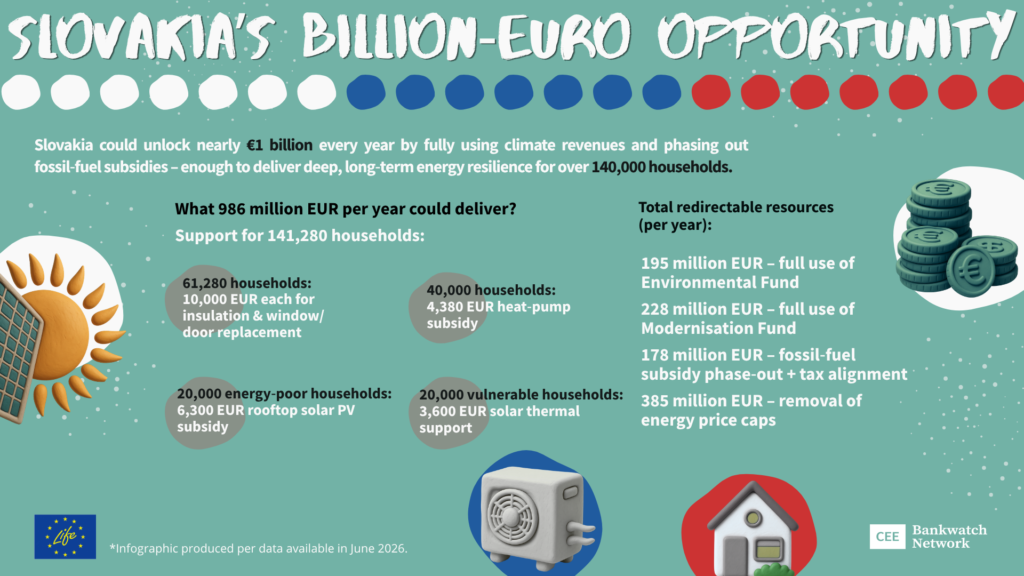
- EUR 195 million annually through full utilisation of the Environmental Fund;
- EUR 228 million annually through full utilisation of the Modernisation Fund, assuming stable ETS prices;
- EUR 178 million through the abolition of indirect fossil-fuel subsidies and implementation of other recommendations from the Value for Money Division;
- EUR 385 million through the removal of fossil-fuel, electricity, and district-heating price caps; and
- additional income from a properly calibrated windfall tax.
Collectively, this totals an enormous EUR 986 million annually, in addition to potentially hundreds of millions from windfall taxation. This is almost four times more (386%) than Slovakia’s annual allocation under the Social Climate Fund between 2028 and 2032.
In principle, ETS revenues – combined with the measures listed above – could significantly strengthen support for households, provided the Slovak government reconsiders its current ETS position. These massive annual revenues could be used to finance long-term energy efficiency and renewable energy solutions for 141,280 households. For example:
- Up to 61,280 households could receive EUR 10 000 each under the Renovate House programme to replace windows and doors, and insulate roofs or ceilings;
- A further 40,000 households could receive a EUR 4 380 subsidy for heat pumps through the Green to Households programme, reduce long-term heating costs;
- Around 20,000 vulnerable households could receive a EUR 3 600 subsidy for solar thermal collectors under the Green Solidarity programme, cutting their hot water expenses;
- And finally, 20,000 energy-poor households could receive a EUR 6 300 subsidy for rooftop solar photovoltaic systems under Green Solidarity, reducing their electricity bills.
The above examples illustrate the scale of support that could be mobilised for households if Slovakia pursued a more ambitious and socially targeted climate and energy policy. A comprehensiveenergy poverty strategy would also need to include measures related to sustainable and affordable housing, alongside other structural social and energy reforms.
Never miss an update
We expose the risks of international public finance and bring critical updates from the ground – straight to your inbox.
Institution: EU
Theme: energy poverty
Project: After recovery towards cohesion
Tags: European Green Deal

