The national building renovation plans must outline how the requirements set out in the revised Energy Performance of Buildings Directive, adopted in 2024, will be achieved. But progress has been slow. So far, only 15 Member States have submitted their plans, with infringement procedures initiated against the remaining countries, including Latvia. The first draft of Latvia’s national building renovation plan has been shared with stakeholders and is expected to be submitted to the Commission shortly. The plan outlines a trajectory for renovating residential and non-residential buildings in order to fully decarbonise the building sector and contribute to achieving climate neutrality by 2050.
Although the plan is still in its initial, semi-completed stage, it lays out a potential scenario for the number of buildings that will need to be renovated each year until 2050. It also estimates the amount of public and private funding required to achieve this objective.
Massive investment at stake
The estimated investment required to meet the renovation targets for Latvia’s building stock by 2050 stands at a staggering EUR 32.33 billion. This is an enormous sum for a country whose annual GDP is approximately EUR 43 billion – a figure set to rise even further when taking inflation into account. To date, only around 4% of apartment buildings in Latvia have been renovated, despite at least 26,600 buildings requiring renovation. At this current pace, it would take around 150 years to fully decarbonise Latvia’s building stock.
The goals set at the EU level are clearly ambitious. This is true not just in monetary terms, but also logistically. According to Latvia’s draft plan, a severe shortage of construction labour is expected as the country attempts to renovate 98,000 residential buildings and 39,000 non-residential buildings within the remaining 24 years. Unsurprisingly, discussions are taking place regarding the utility of creating a plan with such targets when it remains completely unclear how they can actually be achieved.
Mobilising on all fronts
Given the existential nature of the climate crisis, Latvia’s building renovation plan must align with the 2050 climate-neutrality goal. However, achieving this requires a massive mobilisation of collective effort.
While many procedural improvements can be made at the national level to speed up delivery, a dedicated EU-level financing programme for building renovation is also vital. Such a programme should pool funds from various sources – including joint loans and revenues from polluting activities – given the extreme difficulty of mobilising such vast sums through the national budget alone.
A short-sighted response to the implementation of these seemingly unrealistic goals would be to argue for lower EU renovation targets. Building renovation serves a range of critical purposes beyond reducing greenhouse gas emissions. It extends the technical viability of buildings, improves the safety of residents, reduces dependence on imported fossil fuels, strengthens local economies and lowers vulnerability to global energy shocks. Renovation is also essential for adapting buildings to increasingly frequent extreme weather conditions linked to climate change, including heatwaves and severe storms.
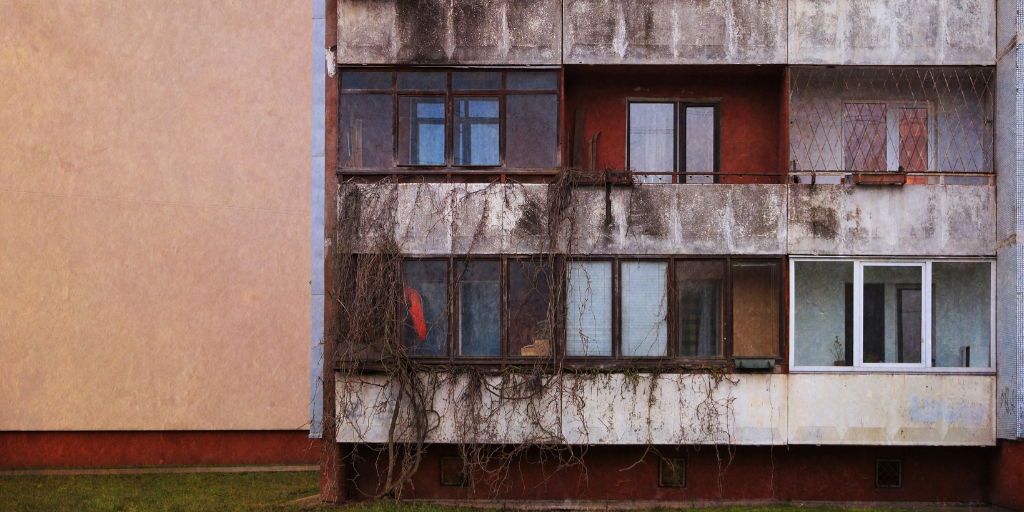
Crucially, renovating the extensive building stock built in Latvia during the Soviet era – where economically justifiable – is a massive ask, regardless of the 2050 climate-neutrality goal. Multi-apartment residential buildings constructed during the Soviet occupation account for 72.2% of the total floor area for this type of housing. Some of these buildings have already reached the end of their service life. Without renovation, a housing crisis is inevitable.
Redefining the economic picture
Building renovation planning should also be considered in the broader context of reliance on imported fossil fuels. Policymakers must account for both the costs of this dependence and the economic benefits of reducing these imports. In 2025, the EU spent approximately EUR 396 billion on fossil fuel imports, equivalent to around EUR 880 per capita.
By comparison, the European Commission estimates that the transition to a clean energy system will require EUR 660 billion in public and private funding annually by 2030. Evidently, the bulk of the investment required to shift to clean energy by 2030 will be close to the amount currently spent each year on imported fossil fuels.
Unlike spending on imports, however, energy efficiency and renewable energy technologies represent a permanent investment in the local economy. According to the International Energy Agency, the EU saved EUR 51.4 billion in 2025 alone simply by reducing fossil fuel imports.
These indirect benefits should be estimated and projected in monetary terms at a national level to understand the true, long-term economic picture and prioritise building renovation accordingly.
A shift in public sentiment
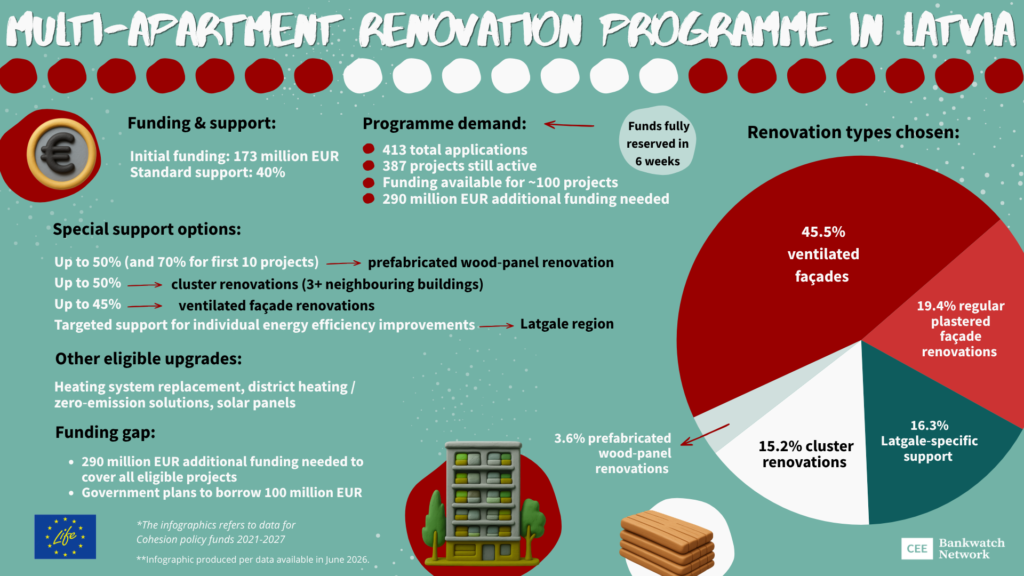
To add some positive news, the historically sceptical public attitude to apartment building renovations in Latvia is changing course, as demonstrated by the overwhelming demand for support under a recent EU-funded programme launched by the Ministry of Economics. Following the scheme’s launch in April 2025, the entire available budget of EUR 173 million was reserved within a record six weeks, with the rapid uptake partly driven by simplified administrative procedures.
The programme received 413 applications, of which 387 remain active. However, the existing budget is only enough to cover roughly 100 projects. To fund all the eligible renovation projects, including those currently on the reserve list, an additional EUR 290 million is urgently needed. To this end, the Ministry is now scrambling to secure extra funds, exploring options such as reducing the intensity of financial support to extend assistance to a larger number of buildings, and a potential EUR 100 million international financing loan, which would allow state agency Altum to provide financing.
Given these frantic efforts, however, and the overall lack of coordination at government level, building renovation clearly has yet to receive the urgent political attention and prioritisation it so desperately requires.
Never miss an update
We expose the risks of international public finance and bring critical updates from the ground – straight to your inbox.
Institution: Green Liberty
Theme: Building renovation
Location: Latvia
Project: After recovery towards cohesion
Tags: European Green Deal

