Located below the Bjelasica mountain in northern Montenegro, the town of Kolašin is experiencing a rapid transformation. The expansion of the local ski resort, which attracted around 80,000 visitors during the 2025/2026 winter season, is accelerating tourism growth and new construction. As the town grows, local authorities face a critical challenge – ensuring that new heating infrastructure supports sustainable renewable solutions and avoids locking the town into fossil fuel-based systems for decades.
Natasa Kovacevic, District Heating Decarbonisation Campaigner for the Western Balkans | 4 August 2026
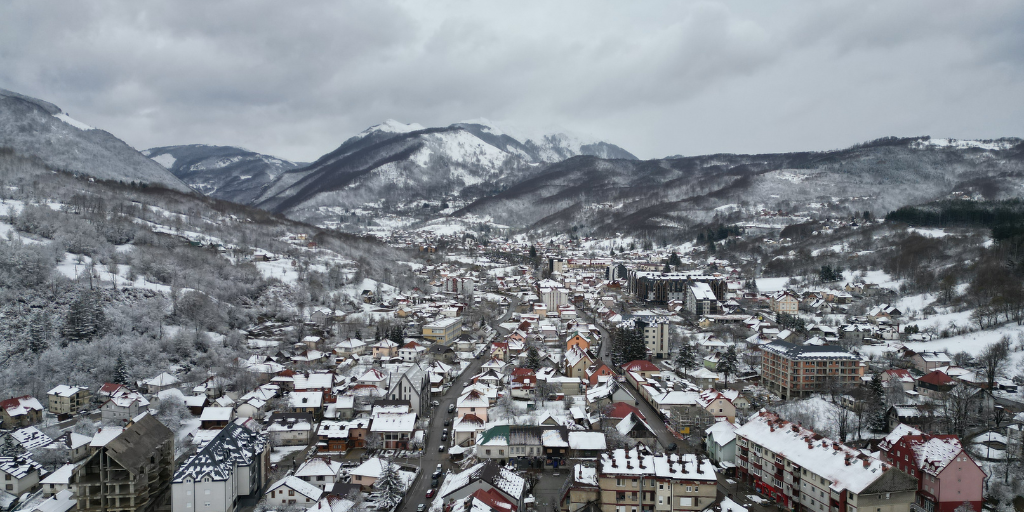
A snowy panorama of Kolašin, Montenegro. (Photo: Davor Sedlarevic).
Small towns often wait for large investments, national programmes, or international partners before taking action to transition away from fossil fuel-based heating. Yet successful initiatives frequently begin much earlier, with local leadership, technical curiosity, and a willingness to explore practical solutions. This is precisely the path currently being taken by Kolašin, a mountain municipality in northern Montenegro.
Since the opening of Montenegro’s first highway section and ski centre enlargement, Kolašin has experienced one of the country’s fastest urban development booms. It has been described as the largest construction site in the north of Montenegro and one that is not easy to keep under control. This rapid growth makes timing particularly important, as new hotels, apartment buildings and public facilities continue to emerge, and the heating systems being planned today will shape the town’s emissions, air quality and energy costs for decades to come.
A frontrunner in climate action
Kolašin has been a signatory of the Covenant of Mayors since 2010, committing itself to local climate and energy action. In 2024, the municipality adopted its Sustainable Energy and Climate Action Plan (SECAP), a strategic document that sets out measures for reducing greenhouse gas emissions, improving energy efficiency, increasing the share of renewable energy, and strengthening resilience to climate change. Among the priorities identified in the SECAP are the gradual phase-out of fossil fuels in municipal buildings and the assessment of opportunities for developing sustainable heating solutions.
Recognising that the municipality currently lacks the financial capacity to construct an entire district heating network from scratch, local authorities have chosen a more pragmatic approach. Rather than focusing on large-scale infrastructure immediately, they’ve begun identifying the public buildings where heating-related challenges are most significant and where renewable solutions could demonstrate both technical and economic viability.
Bankwatch supported exchanges of experience
Seeking technical guidance and examples of proven renewable heating solutions, Kolašin’s municipal authority reached out to Bankwatch in 2025. To facilitate knowledge exchange and expose local decision-makers to successful regional practice, Bankwatch supported the municipality’s participation in the TOPS District Heating Summit in Zlatibor in summer 2025. The delegation included the Deputy Mayor and the President of the Municipal Assembly, demonstrating strong political support for exploring sustainable heating solutions.
A key moment during the visit was the tour of Hotel Olimp, where a water-to-water heat pump system has been operating successfully since 2012 as a proven solution capable of operating reliably in a mountain climate comparable to that of Kolašin. Seeing the system in operation helped municipal representatives move beyond theoretical discussions and begin considering how similar solutions could be adapted to their own public buildings and, potentially, to a small district heating network.
Analysis provides initial proposals
An important step in this process came in summer 2025, when the municipality completed a report assessing the condition of heating installations and proposing improvement measures for public facilities. The analysis highlighted two particularly challenging buildings in the town centre.
The first is the Culture Centre and Museum, a protected heritage building still heated with light fuel oil. During the previous heating season, the facility consumed almost 16,000 litres of fuel oil, while its main boiler, installed in 2003, has long exceeded its optimal operational lifespan.
The second is the iconic Spomen Dom (Memorial House), a landmark of Yugoslav modernist architecture that was selected by the World Monuments Fund’s Modern Century initiative as one of 30 outstanding modern architectural sites worldwide. It was also featured in the Museum of Modern Art’s (MoMA) landmark exhibition Toward a Concrete Utopia: Architecture in Yugoslavia, 1948–1980. Although designed with a central heating system, the installation has been out of operation for years, forcing the building to rely on individual electric storage heaters, a technically inefficient and financially burdensome solution.
Following the initial technical report, Kolašin is examining integrating heat pump technologies, improving building-level energy efficiency and evaluating the long-term feasibility of a municipal district heating network.
For the Culture Centre and Museum complex, the report assesses a hybrid system based on air-to-water heat pumps providing the primary renewable heat source.
For Spomen Dom, the municipality is considering a ground-source heat pump solution utilising geothermal probes installed beneath surrounding green areas. The study also explores the longer-term possibility of establishing a small municipal energy centre that could eventually provide renewable heating not only to public buildings but also to nearby residential and commercial consumers.
Next steps
The process is now entering a new phase. During July and September 2026, a series of meetings is taking place in Kolašin with municipal representatives, technical experts, national institutions, and potential partners. These meetings are focusing on refining the technical concept and discussing financing opportunities. Engagement with Montenegro’s Ministry of Energy, Environmental Protection Fund (Eko Fond), and other stakeholders is expected to support the identification of institutional and financial pathways for project development.
To continue these efforts, a dedicated district heating workshop and conference is planned for autumn 2026. The event will present the current status and development pathway of Kolašin’s heating transition, bringing together key stakeholders, including local and national institutions, international experts and potential financing partners, to discuss technical solutions, financing models, and the next implementation steps. Building on the experience of Žabljak’s district heating initiative, also supported by Bankwatch, the conference will focus on identifying practical technical and financial models and defining clear next steps for advancing Kolašin’s heating transition.
More national and international support needed for the next phase
The story of Kolašin is not primarily about the size of the investment being considered. It is about creating the conditions for a successful transition: identifying the right starting point, building technical evidence, engaging stakeholders, and developing a project that can attract future support. Across the Western Balkans, many small municipalities face similar challenges: needing a new district heating system or having an ageing existing one, limited investment capacity, and increasing pressure to reduce emissions. Kolašin’s experience shows that local governments can take the first steps by developing realistic, well-prepared projects, but turning these initiatives into implemented solutions will require stronger support from national governments, development banks, national and EU funds.
Never miss an update
We expose the risks of international public finance and bring critical updates from the ground – straight to your inbox.
Theme: fossil fuels | district heating | district heating projects | renewable energy | energy transition | sustainable heating solutions
Location: Montenegro
Project: District heating
Tags: district heating | district heating projects | energy transition | fossil fuels | renewable energy | sustainable heating solutions

