Ukraine’s public investment management (PIM) system faces a fundamental challenge: communities and ministries often know what they need, but lack the time, data, expertise and money to turn those needs into strong investment projects.
Mykola Kobets, National Campaigner, Ukraine | 18 August 2026
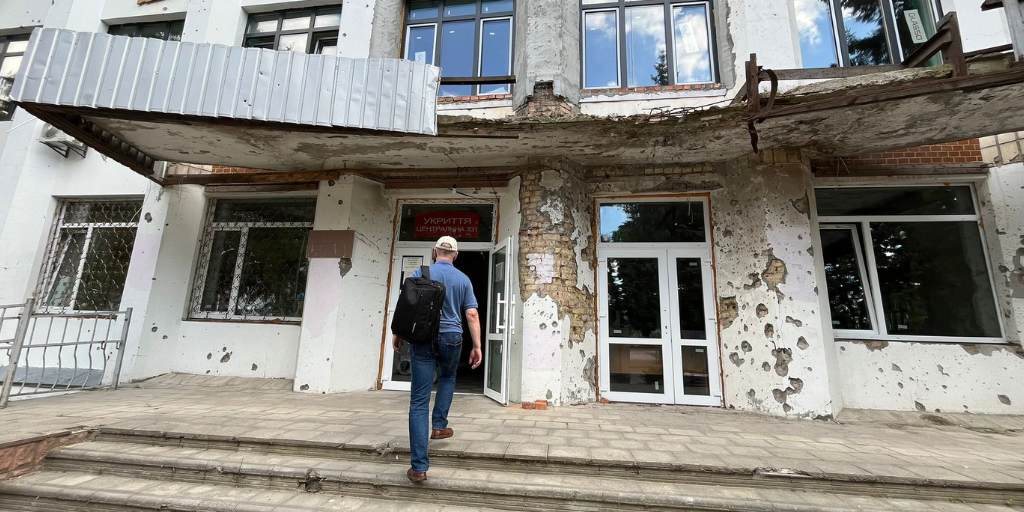
A destroyed building in Borodianka, Kyiv oblast, Ukraine. (Photo: CEE Bankwatch Network).
Project preparation facilities (PPFs) provide funding and technical expertise to turn investment ideas into projects ready for financing. However, there is a risk that Ukraine’s PPFs could become another gateway through which only the strongest applicants pass, rather than a mechanism to help promising projects develop. PPFs must engage with project developers early on, helping them create sustainable proposals that meet environmental and social standards.
Beyond financial constraints
The Fifth Rapid Damage and Needs Assessment (RDNA5) estimates Ukraine’s recovery and reconstruction needs at almost USD 588 billion over the next decade. At this scale, the country can’t afford to finance poorly justified solutions, underestimate operating costs, or discover environmental conflicts after key decisions are made.
Project sponsors often view funding as their biggest problem, but donors and development banks need projects that address genuine needs, feature realistic costs, present clear governance models, and have capable sponsors.
Looking at public investment portfolios across local and national levels, a clear gap emerges: too many project ideas remain mere wish lists, while far fewer become viable investment projects.
Building the system
This is why Ukraine urgently needs a mechanism to support public investment project preparation. PPFs don’t simply produce documentation; they turn real needs into projects that can be properly assessed, compared and financed.
Ukraine’s nascent framework brings together the Ukraine Government PPF (supported by the World Bank via the PREPARE Ukraine Project) and Ukraine FIRST, administered by the EBRD and EIB. An interagency working group coordinates project allocations to prevent donor duplication. In April 2026, the Ministry of Economy, Environment and Agriculture issued methodological guidelines for project development, with the working group assigning six initial projects from the state’s Single Project Pipeline to PPF programmes.
A logical chain is gradually taking shape: national and sectoral priorities → Single Project Pipeline → identification of preparation needs → PPF support → access to financing. Yet a key question remains: who will truly benefit?
Risk of inequality
The biggest risk is that the system will favour well-equipped sponsors. While prioritising large infrastructure projects is to be expected, much of Ukraine’s reconstruction will occur locally – spanning water supply, district heating, waste management, local energy, healthcare, education and transport.
Small and medium-sized communities often lack specialists to prepare pre-feasibility studies, financial models or environmental screenings. If PPFs only serve large, ministry-backed initiatives, existing inequalities will deepen, meaning resourced sponsors will advance, while vulnerable communities are left behind.
Reaching out to communities
This is where regional development agencies could play an important role. If given a clear mandate, basic funding, training and access to the system’s tools, they could provide a regional entry point for communities seeking support.
For instance, they could help with choosing the right technical solution, make sure the site and necessary information are in place, carry out initial environmental and social checks, assess whether the organisation that will run the project has the capacity to do so, and develop a project proposal for submission to a sectoral or national investment programme.
Without this kind of support, better-resourced hromadas with their own project offices will gain the advantage, while communities with the most acute needs will remain outside the system. This isn’t only a matter of fairness. Weak local projects ultimately mean a weak national portfolio.
Ensuring transparency
The same principle should apply to decisions about which projects receive PPF support. PPFs have limited resources, so many applicants will inevitably be turned down. What matters is whether people can understand why decisions were made – and whether they can trust in the process.
For selected projects, the public should be able to see how they fit national or sectoral priorities, what social benefits they are expected to bring, how far they have progressed, what preparation they need, and how they could be eventually financed. Projects that are rejected or put on hold should receive plain feedback explaining what needs to improve and whether the sponsor can reapply.
It’s also important to track what happens once the studies are complete. How many prepared projects are submitted for financing and approved? How many change after the environmental or economic analysis takes place? How many are dropped because the analysis shows they aren’t viable? That’s not a failure of the PPF. Better to identify these important details before committing public money.
Building in safeguards
Environmental, climate and social considerations need to be part of the process from the beginning. In line with the World Bank’s Environmental and Social Framework, the PREPARE Ukraine Project has published an environmental and social management framework, an environmental and social commitment plan, and a stakeholder engagement plan. This can be a solid foundation.
But standards matter only if they influence decisions. Alternative analyses, climate resilience, biodiversity impacts, access to services, resettlement, working conditions and consultation with affected people should all be considered before technical solutions become irreversible. Otherwise, environmental and social impact assessments risk becoming a box-ticking exercise carried out after the most important decisions have already been made.
This is where a screening tool based on the ‘do no significant harm’ principle should be used. Communities also need practical support, such as simple templates for early-stage screening, access to environmental and social specialists, funding for data collection, and meaningful consultations.
The need for this support is immediate. Ukrainian civil society organisations are already helping communities to develop strategic plans rather than waiting for technical donor assistance from donors. Groups like Ecoclub and Ecodia provide comprehensive planning, new tools for self-assessment and project implementation, and guidance on sustainability. Ultimately, by empowering local communities to build rigorous, sustainable proposals today, Ukraine can ensure its recovery is both equitable and lasting.
Never miss an update
We expose the risks of international public finance and bring critical updates from the ground – straight to your inbox.
Institution: European Bank for Reconstruction and Development | EBRD | European Investment Bank | EIB
Theme: Reconstruction of Ukraine | public investment management system | PIM | project preparation facilities
Location: Ukraine
Project: The post-war Reconstruction of Ukraine
Tags: project preparation facilities | public investment management system | reconstruction of Ukraine

