Despite EU commitments to halt biodiversity loss, Hungary’s recovery and resilience plan has diverted funding from wetland restoration, highlighting structural flaws in the EU’s green-funding allocations.
Zsuzsanna Ujj, Biodiversity campaigner, National Society of Conservationists – Friends of the Earth Hungary | 8 December 2025
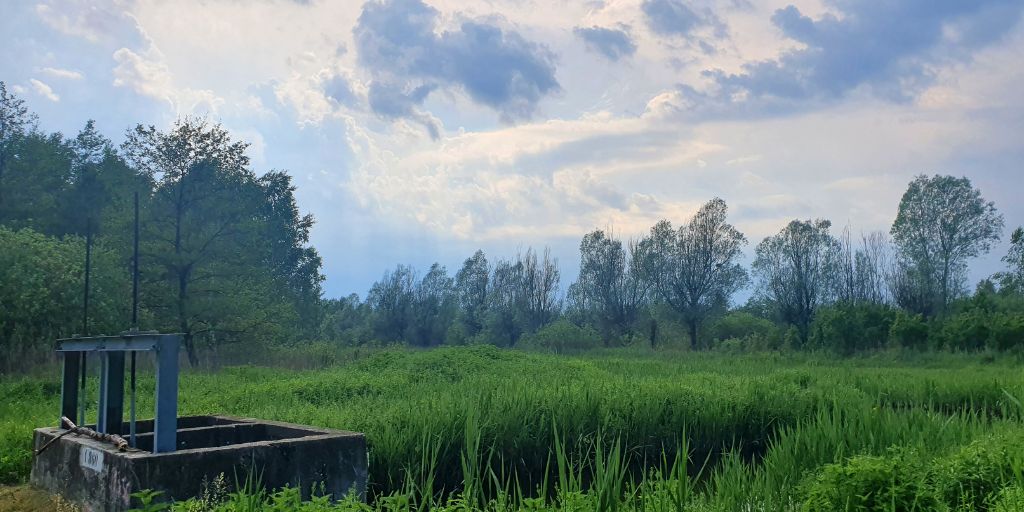
Restoring neglected sluices is vital for water retention and controlled drainage (photo: Zsuzsanna Ujj).
Back in 2020, the EU proclaimed that the 2021–2027 Multiannual Financial Framework would mark a turning point for nature. In May of that year, the European Council agreed that at least 10% of the total EU budget expenditure should contribute to halting and reversing biodiversity loss. This same ambition was meant to infuse the EUR 672.5 billion Recovery and Resilience Facility, the centrepiece of the EU’s post-COVID-19 stimulus.
EU Member States were explicitly instructed to align their national recovery and resilience plans with the EU Biodiversity Strategy for 2030, which calls for 30% of land and sea to be placed under protection along with an annual EUR 20 billion for nature. Yet in Hungary, the ambitious goals of the Recovery and Resilience Facility were narrowed into a single, solitary conservation project – one that’s recently been scrapped.
A token gesture for nature: The Hanság wetland project
When Hungary submitted its first recovery and resilience plan in May 2021, its almost complete neglect of biodiversity was shocking. Across 10 central and eastern European countries, a measly 0.26% of the total EUR 87 billion Facility grant was earmarked for biodiversity measures. In Hungary, that sliver – EUR 6.4 million – went to just one project, dwarfed by the EUR 456 million allocated to water management.
That sole project centred on the Hanság, a lowland basin in northwestern Hungary spanning between 400 and 700 km2 – once one of central Europe’s largest contiguous wetlands. But after two centuries of agricultual drainage, the Hanság is now a series of fragmented wetland habitats.
The project manager – the Fertő–Hanság National Park Directorate – had planned to reverse this decline in several of the basin’s key protected areas, some of which had already been restored, the most famous being the Osli marsh, a 500-hectare refuge where nature is now thriving. The project aimed to build on this success by restoring water retention across 5,000 hectares of Natura 2000 sites. By renovating roughly 75 km of canals, repairing several sluice gates and rebuilding weirs, the plan was to mimic natural flood pulses and support the return of reed beds, wet meadows and stretches of open water.
These efforts would have supported priority species like the white-tailed eagle, Eurasian bittern, otter, and fire-bellied toad. Once restored, the wetlands would also have created a buffer against the increasing risk of drought, preventing the impacts of further drops in groundwater levels on nature and local communities.
The winter 2022 edition of the national park’s magazine, Kócsagtoll (Egret Feather), celebrated the securing of a EUR 7.2 million funding call for the project through the Recovery and Resilience Facility, with park director Matthaea Kulcsárné Roth noting that an intervention of this scale would not have been possible without the support of the Facility. Construction had been slated to take place between 2024 and 2026.
Cancellation without explanation
Regrettably, in early 2025, Hungary quietly tabled a major revision of its recovery and resilience plan that ditched the Hanság project entirely. And although the water management component still exists, funds for biodiversity submeasures have disappeared. As things stand, the European Commission has yet to approve the implementation of Hungary’s legislative reforms in several key areas. This means the disbursement of Hungary’s allocations under the Facility – a EUR 5.8 billion grant and a EUR 4.8 billion loan – has practically stalled.
In this uncertain funding environment, the Hanság project was among the first projects to be abandoned. The cancellation of funds leaves the Hanság wetlands exposed to climate- and human-induced habitat decline, along with the loss of vital ecosystem services. The national park’s annual report reveals the encroachment of invasive goldenrod – a fast-spreading meadow plant – the disappearance of grasslands and peat ecosystems, and a reduction in groundwater levels. Key species, such as the strictly protected European mudminnow, remain in grave danger.
Why is biodiversity losing the funding race?
The Hanság project is a textbook example of the structural flaws in how EU money is allocated: the pressure to spend quickly creates a funding environment in which complex and sophisticated nature-based projects lose out. Wetland restoration requires hydrological modelling, long-term monitoring and adaptive management – processes that can take 5-to-10 years to complete. By contrast, energy projects like solar farms and grid upgrades can deliver measurable results within 18 months, with clear performance indicators.
Crucially, funds for biodiversity under the Recovery and Resilience Facility are not ring-fenced, leaving the 10% biodiversity target reliant on political goodwill rather than serving as a legally binding obligation under the Facility Regulation. In practice, this means Member States can reallocate expenditures at will – as demonstrated in Hungary, where EUR 6.4 million in essential biodiversity funding has been diverted to general energy and water-management measures.
National priorities trump EU strategy
Hungary’s government has consistently prioritised large-scale water infrastructure – over soft, landscape-scale conservation. The cancellation of the only habitat-restoration project in Hungary’s recovery and resilience plan is not an isolated failure; it’s a symptom of a broader structural problem.
In 2024, the European Court of Auditors noted that EU green spending is often disconnected from actual costs and results. To prevent a repeat under the 2028–2034 Multiannual Financial Framework, the EU must adopt legally binding, ring-fenced biodiversity spending targets. Once allocated, funds must not be diverted. Mandatory ex ante biodiversity audits should also be conducted before any plan is approved. Without such safeguards in place, the EU’s 2030 pledge to protect 30% of the region’s land and restore 25,000 km of its rivers will remain mere rhetoric.
But there are signs of hope. After a century of absence, two crane couples have decided to nest and raise their chicks in the Hanság once again – a clear result of the national park’s tireless efforts. Yet the Hanság’s dry creeks during summer months provide a stark warning: biodiversity cannot compete in an open market for EU funds. It must be guaranteed a seat at the table – before the last crane flies away.
Never miss an update
We expose the risks of international public finance and bring critical updates from the ground – straight to your inbox.
Theme: biodiversity, EU funds, Hungary, wetlands, Recovery and Resilience Facility
Location: Hungary
Project: EU funds and biodiversity
Tags: EU funds | biodiversity

