As Estonia prepares for the EU’s next long-term budget and financial instruments, it is equally important to assess how these new support measures are designed and reviewed. In collaboration with national authorities, we at the Estonian Green Movement are actively seeking solutions to ensure that support effectively reaches vulnerable households. To assist in this process, the Centre of Applied Social Sciences at the University of Tartu has developed a data-driven model that gives these households a fairer chance of accessing support.
Lukas Lepik, Energy Transformation Campaigner | 5 March 2026
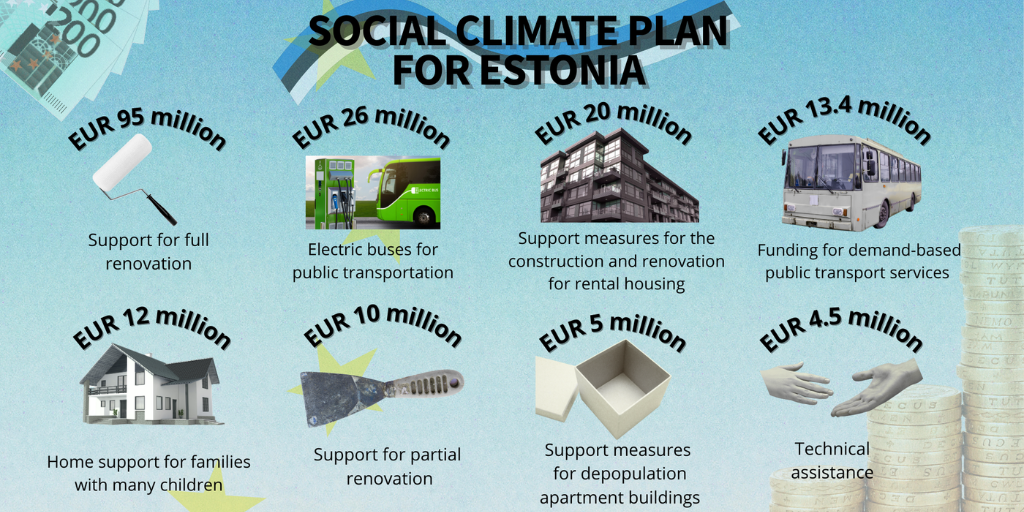
Like other EU Member States, Estonia has submitted its social climate plan to the European Commission. The plan, which has recently undergone changes based on the Commission’s recommendations, is expected to focus primarily on building renovation and energy efficiency measures, while also addressing the broader complexities of energy and transport poverty.
The Estonian Green Movement is currently working closely with national decision makers to answer a fundamental question: How can the Social Climate Fund – one of the EU’s first major instruments linking climate policy with social justice – best reach vulnerable households?
To find an answer, we hosted a round-table discussion on 13 January 2026 in Tartu. The event brought together regional and national representatives to identify and evaluate successful solutions and innovative measures adopted in countries across central and eastern Europe.
Regions left behind
While Estonia has made major strides in the renovation of multi-apartment buildings in recent years, the benefits have not been distributed equally. A clear gap remains in regions with high levels of energy poverty, such as in Ida-Virumaa – Estonia’s just transition region – as well as in the south-east of the country.
Our recent round-table event focused on these weaker regions, identifying two key bottlenecks: first, regional authorities urgently require greater technical assistance and knowledge; second, the current ‘first-come-first-served’ approach to funding often leaves regional authorities with less administrative capacity behind. Participants also agreed that future measures must be intentionally designed to target vulnerable households.
In these regions, the high proportion of older people are typically reluctant to invest in large-scale building renovations. Additionally, many of the regions’ five-storey multi-apartment buildings contain as few as 10 households, making the individual financial outlay required to renovate a property prohibitively high, which also discourages residents from the idea of renovating in the future. However, regional officials noted that the existence of a renovated roof is often a sign that an apartment association is cooperative and potentially open to a deep renovation.
While Estonian cities offer examples of neighbourhood-based initiatives successfully tackling building renovations – notably the SOFTAcademy project in Tallinn – regional authorities indicate that these urban models are difficult to replicate in rural areas.
Finally, the language barrier must also be taken into account. According to 2021 statistics, 73% of the population in Ida-Virumaa are native Russian speakers. All of the regional authorities agreed that information must be accessible in Russian to be effective. Success in these areas also depends on informal engagement and sharing information among the local community. Establishing a ‘friendly connection’ at the regional level is not only possible but essential for building trust.
A fairer way to fund renovations
Researchers at the Centre of Applied Social Sciences at the University of Tartu recently released the results of a new data-driven model aimed at improving how renovation subsidies for apartment buildings are allocated in Estonia. Already tested in Tallinn’s Annelinn and Karlova neighbourhoods, the model seeks to direct financial support towards households experiencing the highest rates of energy poverty.
According to the model’s creator, Mariia Chebotareva, Estonia’s existing renovation support scheme focuses solely on the technical parameters of buildings and fails to reflect the socio-economic status or financial capacity of households. The new model seeks to address this gap by combining socio-economic data with building-level technical parameters. Using specific datasets, the model generates a ranking of apartment buildings based not only on their energy efficiency, but also on the risk of energy poverty among households.
This innovative model is a first for Estonia. If implemented, it would replace the existing performance-based approach – aptly described in the Estonian language as a ‘race of nimble fingers’ – with a more socially just system. Though the researchers note that accessing and integrating the data required will be a challenge, simplifying the system for regional authorities could help them better identify and support those most at risk.
Making EU money work
Ensuring that EU funds deliver equitable benefits to the regions and people of Estonia is crucial. The model introduced by the Centre of Applied Social Sciences has the potential to become a ‘best practice’ in Estonia and inspire similar models across central and eastern Europe. At the Estonian Green Movement, we’re committed to making sure that EU policy translates into real benefits at the local level – and that those who need the most support are not overlooked. As the cost of living in Estonia continues to rise, the design and implementation of future measures is now more important than ever.
Never miss an update
We expose the risks of international public finance and bring critical updates from the ground – straight to your inbox.
Institution: Estonian Green Movement
Theme: social climate plan
Location: Estonia
Project: After recovery towards cohesion
Tags: European Green Deal

