The EBRD-backed development of the 400/110/35 kV Brezna substation for Montenegro’s transmission grid is opening several crucial questions – where is the red line beyond which a project’s impact on local communities makes it unacceptable? Can this even be assessed when all the institutions and financiers involved fail to identify even the obvious impacts? And why are the project’s backers so reluctant to provide environmental documentation to the affected people?
Save Brezna citizen initiative, Gornja Brezna, Montenegro | 6 August 2026
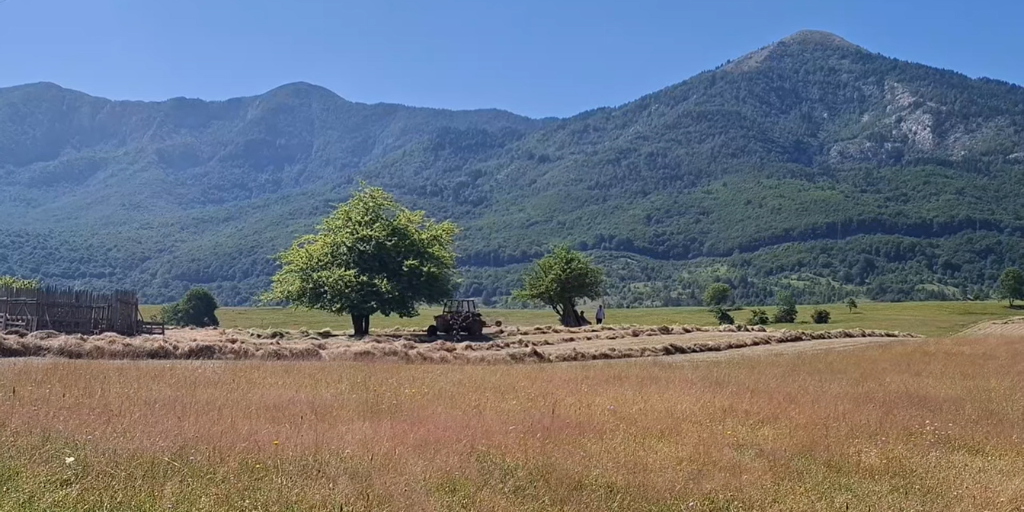
(Photo: Save Brezna).
While integrating more renewables into the grid is one of the most important steps for mitigating climate change, their siting, as well as the siting of the supporting infrastructure, is key for building acceptance of the energy transition in local communities.
Montenegro’s state-owned transmission system operator Crnogorski elektroprenosni sistem (CGES) seems to have forgotten this when planning the 400/110/35 kV substation near the peaceful mountain village of Gornja Brezna.
A substation might not sound like a major issue, but this is no ordinary neighbourhood facility. What was initially planned as a single project, started in 2016 and 2017 when a substation measuring 125 by 80 metres was built at the site for the needs of the Krnovo wind farm. The expansion now planned would more than double this to 300 by 250 metres – the equivalent of nine football pitches.
And that’s just the substation itself, without even counting the three existing transmission lines and at least seven planned ones connected to it.
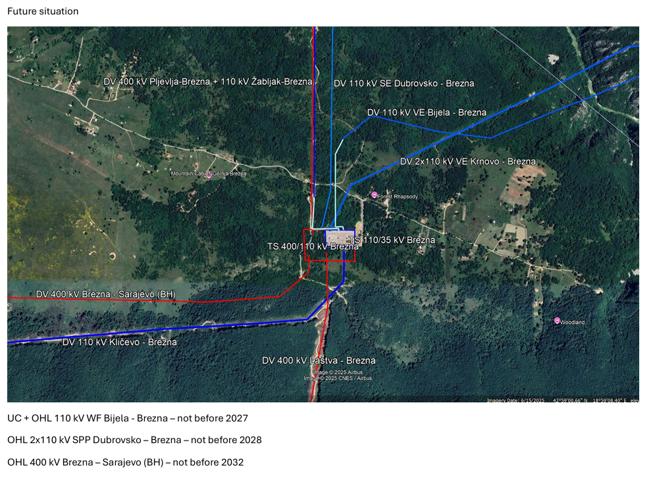
CGES may argue that the location is convenient from a narrow grid-planning perspective because several existing and planned transmission lines, which are important not just for Montenegro, but also for the wider Western Balkan region, converge there. But this is precisely why a full alternatives assessment and cumulative impact assessment were indispensable before the final decision was taken on the location. It remains unclear whether all reasonable steps have been taken to find a site that does not impact the environment, the community in the village and the nearby rural tourism facilities.
Since finding out what awaits them, the local community has formed the Save Brezna initiative. They are challenging the expansion of the substation on all available fronts, including a complaint to the EBRD’s independent project accountability mechanism (IPAM).
A long history of EBRD and EU support
In December 2011, a Western Balkans Investment Framework (WBIF) technical assistance grant was approved for CGES. It entailed the preparation of a feasibility study, preliminary design, and an Environmental and Social Impact Assessment (ESIA) for the potential construction of a 110 kV overhead transmission line from Vilusi to Herceg Novi and the associated 400/110/35 kV Brezna substation. The lead financier on the project was the EBRD, so the bank was aware from the very beginning that a new greenfield substation was planned.
The documents commissioned through the grant were apparently completed in 2018. But before that, as mentioned above, in 2016 and 2017, Krnovo Green Energy built the 110/35 kV part of the substation because it needed it to connect its wind farm to the grid. From this point onwards, the planned greenfield 400/110/35 kV substation became an existing 110/35 kV substation with a planned extension to 400 kV.
The EBRD is the project’s main financier, with a EUR 28 million loan signed in 2024. The Bank is also supporting other directly linked projects. Back in 2013 the EBRD signed a loan for the construction of the 400 kV Lastva-Pljevlja transmission line that goes through Brezna and recently started test operations. Then in 2015 the Bank signed a loan for the 72 megawatt (MW) Krnovo wind farm, for which the existing substation was built in Brezna.
The EBRD is also currently considering support for a 400 kV interconnector from Brezna to Sarajevo in Bosnia and Herzegovina (BiH), for which a technical assistance grant from the Western Balkans Investment Framework (WBIF) was already awarded in 2023. This means that they should have been well aware about some of the impacts of the above projects, both individually and cumulatively.
Understated impacts – an honest mistake or an intentional omission?
Considering the obvious potential for cumulative impacts from the many projects connected to the Brezna substation, the EU-financed ESIA should have paid specific attention to this issue. However, the document is not publicly available. And a Non-Technical Summary (NTS) available on the EBRD’s website fails quite obviously even to identify basic facts about the substation project.
The first untrue claim in the NTS is that ‘There are no residential or business facilities in the vicinity of SS Brezna. The closest settlement to the SS Brezna is Gornja Brezna (at a distance of approx. 2 km from SS Brezna)’. A quick check on any online map shows that the village is a lot closer to the substation. Actually, if a circle with a two-kilometre radius is drawn around the substation, more than half of the houses are within that area, with the closest ones only around 200 metres away. Independent mapping conducted by Save Brezna gives a clearer picture – around 150 buildings, owned by 75 different families, are within a two-kilometre radius.
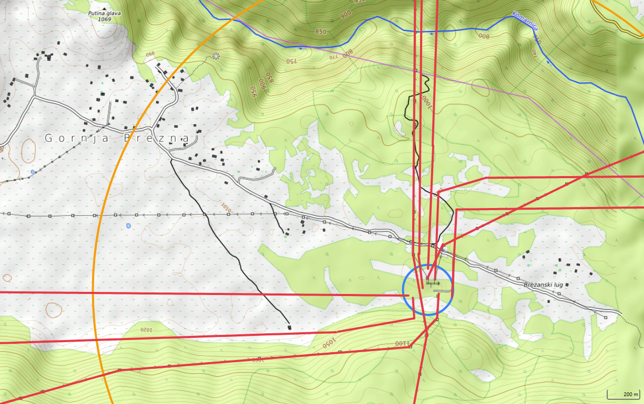
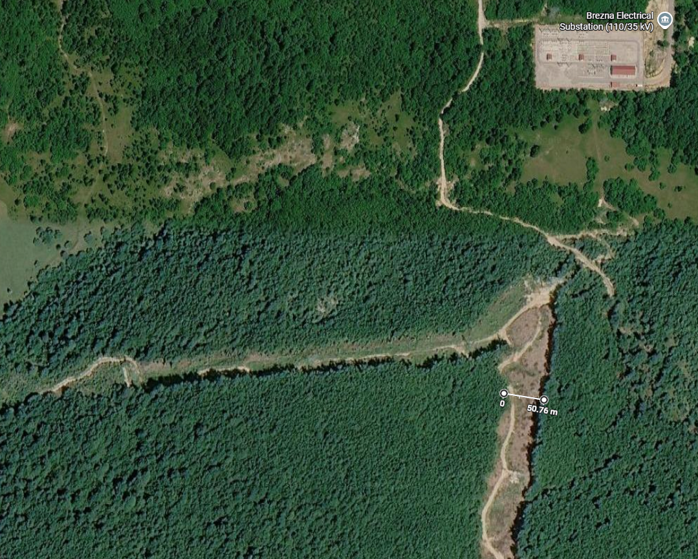
Another major issue not dealt with conclusively in the NTS is ground stability. The NTS acknowledged that the existing Brezna substation had already encountered soil and foundation movements and more complex ground conditions than initially assumed, but stated that the results of additional investigations would only become available in February 2024. It has not been updated to include them.
Moreover, CGES procurement and remediation records from 2025 and 2026 show that geological investigations, revision and ground remediation issues at the existing site have continued. This means the problem is still unresolved, with no information available to the public on the results or next steps. In these circumstances, treating the 400 kV expansion as a low-risk technical upgrade without full disclosure, independent review, proper geological and geotechnical assessment and serious assessment of alternatives is unacceptable.
Cumulative impacts a key issue
The NTS also completely fails to identify the cumulative impacts of the existing and planned transmission lines linked to the substation. The section on cumulative impacts in the NTS claims that ‘no current or future projects of a similar type and size have been registered in close proximity or in the area directly affected by this construction. Therefore, no cumulative effects due to interaction with other projects are expected.’
This is completely inappropriate since a large high voltage substation is obviously not going to exist as standalone infrastructure. To assess cumulative effects, the projects around it do not need to be of a similar type or size – rather any existing or approved projects that increase the pressure on the environment need to be analysed.
In addition to the cumulative impacts of the EBRD-financed projects above, the CGES network development plan also includes a 400 kV interconnector from Brezna to Gacko in BiH, and a plan to connect the highly controversial planned Komarnica hydropower plant to the Brezna substation.
Multiple medium voltage 110 kV lines also converge at Brezna with planned lines to the 200 MW Dubrovsko solar plant and 118 MW Bijela wind farm. The spatial plan of Pluzine, the municipality where Brezna is located, also identifies more than 20 locations for further development of solar and wind power. Most of these are near Brezna and even if only some of them materialise, they will add to the cumulative impacts.
With all this in mind, the immediate area of the substation, which includes the Gornja Brezna village, will become a connection hub for medium and high voltage transmission lines creating a dense network of cables hanging over people’s properties. It will surround Gornja Brezna from all sides, completely changing the scenery of the area.
The lines will also cause a high concentration of habitat loss, ecosystem fragmentation and impacts on birds. This is not to be underestimated considering that the edge of the Komarnica canyon – a potential area for the expansion of the Durmitor National Park and UNESCO site, and now an officially proposed Natura 2000 site – is just one kilometre from the substation and many of the transmission lines will go through it.
ESIA, where art thou?
Fifteen years since the WBIF’s grant for the ESIA, it is clear that a national-level EIA for the whole project or any of its parts has not been carried out, but it is unclear what kind of environmental assessment was carried out under EBRD requirements. The latest available public information comes from documents published on the EBRD website on the upgrade of the substation – namely the Board Report and the NTS.
The Board Report clearly states that the WBIF grant resulted in a feasibility study, ESIA and preliminary design for the Brezna substation, that were completed in 2018. Moreover, it adds that an update of the Environmental and Social Impact Assessment and Preliminary Design was completed in December 2022. In addition, the report claims that additional environmental and social due diligence was carried out by a third-party consultant and included a visit of the site, review of the environmental and social studies already available and an environmental and social assessment of the project against the EBRD’s performance requirements.
The NTS is also clear that it is based on an Environmental and Social Assessment of the Project carried out in 2018 and 2023. This is no surprise since the summary has to sum up a wider assessment.
In March 2026, CGES published a Q&A website on the project where they also confirm that through the preparation of a feasibility study financed by the EU, an Environmental and Social Impact Assessment (ESIA) report has been developed in accordance with European standards. They also mention that an Environmental Impact Assessment (EIA) in line with national legislation will be carried out after completion of the detailed design and prior to the commencement of construction works.
The Board Report contradicts this and claims that the site is not in a sensitive area or subject to ongoing Environmental local permitting following screening by the environmental authority, implying that the WBIF-financed ESIA is the only environmental assessment taken into account.
But when the Save Brezna initiative tried to get the full assessment from the EBRD, they got a response that an Environmental and Social Impact Assessment was not required for the Brezna project as a Category B project and as such does not exist.
As well as contradicting the Board Report, this is not sufficient to prove compliance with the EBRD’s 2019 Environmental and Social Policy, which was in force when the Bank’s loan for the project was approved in 2024. The Bank had to ensure that the project complied with national law, which required at least an initial assessment (screening) of whether a full EIA was necessary. And the Bank’s own categorisation stated that Category B requirements varied:
A project is categorised B when its potential environmental and/or social impacts are typically site specific, and/or readily identified and addressed through effective mitigation measures. The scope of environmental and social appraisal will be determined by EBRD on a case-by-case basis.
It therefore remains unclear what exact kind of document the NTS was based on, and whether the full document is any less deficient than the NTS in its assessment.
How about the national-level EIA?
CGES’s statement that a national-level EIA is yet to be done seems too late. Based on all available information, the 400 kV substation should have been assessed as one project when it was initially planned, together with at least some of the associated transmission lines which give it a purpose.
In a spatial planning document issued by the Ministry of Sustainable Development and Tourism, it is clearly explained that according to the approvals to connect the Krnovo wind farm to the grid from 2011 and 2012, the Brezna substation is to be built in two phases – the first to be completed by Krnovo Green Energy, and the second by CGES.
However, since the first phase has already been built, the scope of the expansion project needs to be reconsidered in a way that also considers that a substation does not operate in a vacuum. The national legal threshold in Montenegro that could trigger an assessment according to the criteria used to determine whether the project is subject to an EIA is for the substation to have a voltage of 220 kV or above – and a 400 kV substation clearly fits this threshold.
It is also still unclear when this EIA might happen. From the available information on the Environmental Protection Agency website, no decision that the project does not need an EIA has not been issued, but it is not clear whether the EIA process has started. One of the key purposes of the assessment is to evaluate the impacts at an early stage and offer appropriate alternatives while all options are still open. So doing a national-level EIA after this project has already been through salami-slicing, with some of the cumulative impacts already happening on the ground, would not be very meaningful.
Recent efforts by Bankwatch staff to obtain the existing environmental assessments, studies and decisions from CGES resulted in a response that they are not at liberty to disclose them because they are part of an ongoing investigation by Montenegro’s Public Prosecutor’s Office. The same documents were requested from national authorities, but for now they have not responded. But these documents are by default public, and they should have been published before any investigation even started. So, the question remains – where are they?
Some core failures are no longer disputed – but what happens next?
The EBRD management, in the assessment report by IPAM, confirms that the project’s baseline social data is wrong and that there are households within 200 metres of the substation. IPAM’s assessment identifies Brezna as an established residential area and an emerging tourism destination, with plans for eco-tourism development. It also confirms that the stakeholder consultation was limited, and interestingly, that no cumulative impact assessment was deemed necessary during the 2024 appraisal of the project.
Considering all the available information, it seems that the EBRD Board approved the project based on contradictory, incomplete or even false information. The Board Report claims that an ESIA exists, and yet it is nowhere to be found. If indeed some kind of environmental and social assessment was conducted, as well as supplementary due diligence, it is unclear how no one realised that the project will have a direct impact on this community. It is also unbelievable that no one considered the cumulative impacts of a large substation that is bound to be connected to multiple high voltage transmission lines. And if no cumulative impact assessment was done, how can the NTS claim that there are no cumulative impacts?
IPAM is currently considering whether the case meets the criteria to initiate a full Compliance Review. But for the people of Gornja Brezna this is not a simple question of compliance, it is a case that will decide whether the community will continue to exist. For Montenegro it is an even bigger dilemma – if not for the benefit for its citizens, who is the green transition happening for?
The EBRD needs to seriously reconsider how it assesses projects if such obvious information is falling through the cracks. The affected local communities have to be properly consulted in every project the Bank supports, and before that they need to be supplied with all the relevant documents so that they can take part in decision making in an informed manner. Many things have gone wrong in this project already, but they can still be mended.
While the EBRD did not publish an ESIA for public comments, it is also obvious that some kind of environmental and social assessment was done. This should be made available to the local community as it contains only environmental information – there is no issue of commercial sensitivity here. It would therefore have been much more helpful if the EBRD explained to Save Brezna what kind of study was done and provided a copy of it.
Before the project moves forward with any construction, the Montenegrin government and the EBRD must properly reconsider the real scope of the project, disclose all environmental and social documents, prepare a full ESIA with a genuine cumulative impact assessment, and organise meaningful public consultations.
The ESIA must include real alternatives for the siting of the additional 400 kV substation capacity, including relocation outside the inhabited village area. Relocation is not an extreme demand; it is the logical consequence of a project that was planned, financed and advanced without properly identifying the affected community, without assessing cumulative impacts, and without giving people a meaningful opportunity to influence the decision while alternatives were still open.
If the current location cannot withstand full disclosure, an independent site-suitability review, cumulative assessment and public scrutiny, the 400 kV expansion should not be built there.
The importance of the project does not seem questionable to anyone, including the Brezna community, but its location definitely is. The green transition has to be a social transition as well, and people must not suffer disproportionately high impacts simply because they were never considered.
Never miss an update
We expose the risks of international public finance and bring critical updates from the ground – straight to your inbox.
Institution: European Bank for Reconstruction and Development | EBRD
Theme: energy transition | just transition | renewable energy | environmental justice | social justice | public participation | Environmental Impact Assessment | Environmental and Social Impact Assessment | grid infrastructure
Location: Montenegro
Project: Coal in the Balkans | Just transition
Tags: Environmental Impact Assessment | Environmental and Social Impact Assessment | energy transition | environmental justice | grid infrastructure | just transition | public participation | renewable energy | social justice

