The European Bank for Reconstruction and Development (EBRD) continues to back one of its most controversial clients in one of Europe’s most troubled democracies. Human rights, labour laws, and the environment are all at stake.
Mariam Patsatsia, Campaigner | 30 September 2025
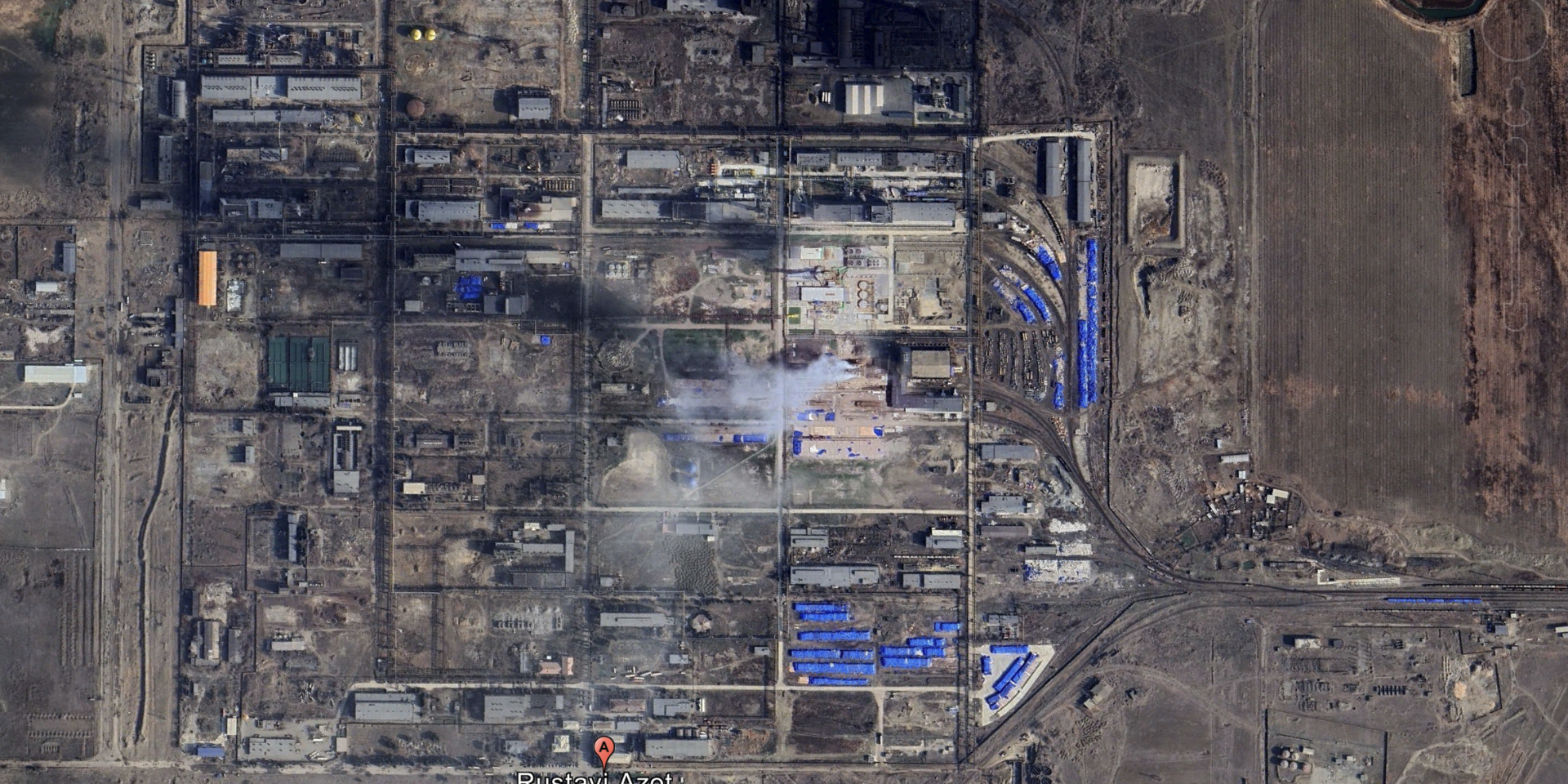
Satellite image of the Rustavi Azot industrial plan from February 2025.
On 11 June, the European Bank for Reconstruction and Development (EBRD) approved a USD 65 million loan to Rustavi Azot, a Georgia-based chemical manufacturer and subsidiary of the Indorama Corporation. The financing is earmarked for a new low-density ammonium nitrate plant, energy-efficiency upgrades, and working capital expenditure.
On paper, the deal has been categorised as a low-risk category B project, promising gains in air quality, energy efficiency, wastewater treatment and greenhouse gas emissions. In reality, however, Indorama and Georgia make for a deeply troubling pairing, casting serious doubts on any assurance of positive outcomes.
An uneasy alliance
Indorama Corporation, the Singapore-based multinational, has a long record of alleged human and environmental rights violations across multiple jurisdictions, from Africa to South-East Asia.
In Uzbekistan, Bankwatch has documented how loans issued by the EBRD and the International Finance Corporation (IFC) for Indorama’s operations in the cotton sector have led to the loss of local farmers’ livelihoods, mass lay-offs, exploitative labour practices, reprisals against workers, union-busting tactics, and inadequate environmental and social impact assessments. The EBRD’s Independent Project Accountability Mechanism (IPAM) is currently investigating whether the controversial Indorama Agro cotton project in Uzbekistan complies with the Bank’s environmental and social standards.
Georgia, meanwhile, is hurtling down a path towards outright authoritarianism. Its parliament, widely seen as illegitimate, continues to impose regressive legislation, which has led to the rapid erosion of human rights, the unravelling of institutions, and civic space shrinking at an alarming rate. These significant developments have repercussions for the development sector and the investment decisions made by multilateral development banks.
In Rustavi, one of the most polluted industrial cities in Georgia and home to the Rustavi Azot plant, ECO Centre – a Georgian environmental civil society organisation whose pivotal role in advocating for improved air quality led to several industrial facilities in the Rustavi zone adopting self-monitoring systems – was forced to shut down after the adoption of the draconian foreign agents law last year. Its closure has effectively extinguished community oversight – just when it was most needed.
A history of exploitation
Rustavi Azot itself has a turbulent history. Before Indorama acquired it in 2023, the plant was embroiled in several scandals and rights violations, including mass layoffs, crackdowns on organised labour, violations of freedom of association, and forcing permanent employees to switch to short-term contracts. While some workers have since been reinstated, with Rustavi Azot under Indorama committing to negotiate a new collective bargaining agreement, a number of grievances remain unresolved. These include unequal pay, unsafe working conditions, and allegations of unfair dismissal of older workers seeking lawful retirement benefits. This February, employees went on strike again over wages.
The company also appears to have a deeply unbalanced and exclusionary working environment. Recently, Indorama celebrated its ‘beloved chairman’ with a week-long series of festivities. In Rustavi, there were tree plantings, visits to care homes, a table tennis tournament, a cricket match, and a multicultural dinner party with Indian and Georgian dances. But amidst these oddly incongruous festivities, heavily promoted on the company’s social media channels, workers voiced their discontent.
In comments on the posts, employees expressed frustration over wages and having been left out of the celebrations. ‘The salaries of Azot employees are, to put it mildly, miserly and need to be seriously reviewed – that would be a good place to start,’ wrote one. ‘How can you hold this event in such a narrow circle that ordinary workers never even knew about it?’ another asked, suggesting the celebrations were reserved for a hand-picked few.
Cutting corners
Rustavi Azot has an equally grim environmental record. Even after installing the self-monitoring system under public pressure, the company repeatedly logged pollution levels above legal limits. An inspection in February 2024 found Rustavi Azot still in breach of environmental laws, failing to comply with previous orders and improperly handling hazardous waste.
The company’s approach to the environmental permitting process offers a glimpse into its murky business practices. Indorama plans to refurbish, modernise and expand production at its Georgian facility, but has opted to break the project into three separate components.
These consist of a screening decision for the EBRD-financed low-density ammonium nitrate plant, a standalone environmental impact assessment (EIA) for its EBRD-backed effluent treatment units and steam turbine, and another EIA for a set of more complex, environmentally sensitive initiatives, including new production facilities, expanded capacity and a 20-megawatt solar plant.
During the initial scoping process, the national authorities treated the latter two as part of a single, comprehensive EIA. Yet the company’s own consultant claims Indorama met privately with ministry officials to secure approval for splitting the project into separate assessments – one for the treatment units and turbine, and another for the more complex upgrades. On 15 August, the authorities found the latest EIA submission for the treatment units and turbine defective, giving the company two months to address the outstanding issues. On 23 September, they revised the decision and issued an environmental permit to the company, despite many critical issues remaining unaddressed in the final submission.
This is where EBRD’s due diligence also falters the most. The upgrades are hardly operationally and environmentally separable; by treating them in isolation, the EBRD risks ignoring the full cumulative impacts. In fact, this has already allowed the Bank to classify it as a lower-risk category B project that avoids the stricter scrutiny of a category A listing.
The higher-risk rating is more than warranted given the potentially significant environmental impacts associated with the production of hazardous substances, the direct impacts associated with establishing a new facility, the cumulative impacts due to its location within an existing industrial complex, and the presence of new and additional risks.
Though the loan agreement between the EBRD and the client was only signed on 24 July, the construction of the plant and effluent facilities had already been in full swing for several months, indicating the company never actually needed the loan in the first place.
Will the EBRD keep turning a blind eye?
Why the EBRD is so determined to back one of its most controversial clients remains unclear. But if the Bank insists on financing the operations of its Georgian facility, it should at the very least ensure its client adopts the following measures:
- Communicate actively with local unions to guarantee fair, good-faith collective bargaining.
- Adopt a zero-tolerance policy on discrimination, wage theft, and unequal pay.
- Complete a full facility audit in line with best available techniques.
- Implement a quantitative risk assessment, a major accident prevention policy, and on-/off-site emergency plans.
- Perform continuous emissions monitoring, regularly disclose water, air, and community health and safety data, and establish clear procedures for addressing exceedance.
- Provide public access to monitoring results and transparent publications protocols.
- Update and implement the existing stakeholder engagement plan on a regular basis.
- Comply fully with EBRD safeguards as well as national laws and regulations.
Public finance should not be used to whitewash the reputations of repeat offenders or to prop up investments in countries where civil society and institutions are under sustained attack. If the EBRD is serious about its safeguards, it cannot afford for this project to fail to meet its standards.
Never miss an update
We expose the risks of international public finance and bring critical updates from the ground – straight to your inbox.

