Since 2022, Friends of the Earth-CEPA has been working with the town of Partizánske, in Slovakia’s Upper Nitra coal region, to transform its ageing district heating system into one that is cleaner, more efficient and better prepared for the future.
Lenka Ilčíková, National campaigner | 10 November 2026
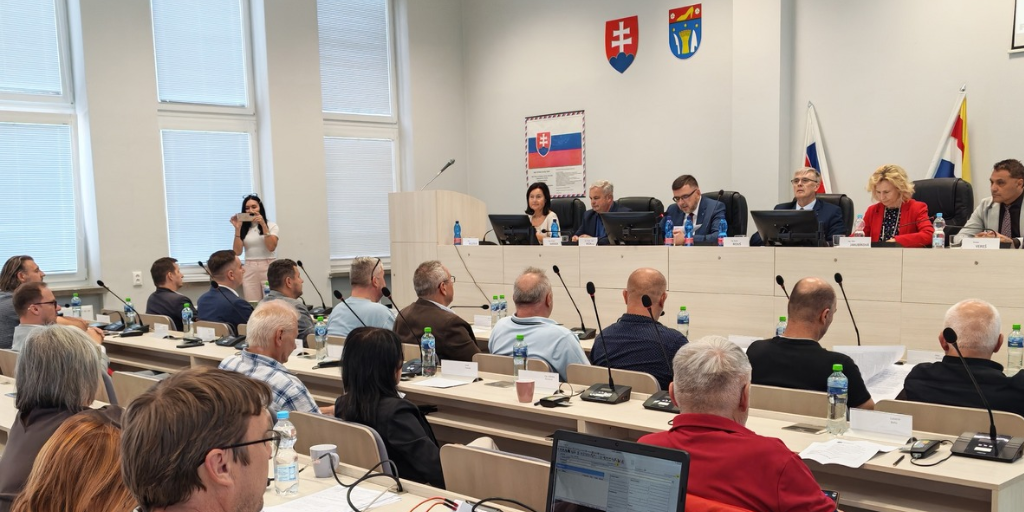
Partizánske’s town council meeting
The region has been preparing for life after coal since the Slovak government decided in 2018 to end support for coal-fired power by 2023. In September 2026, that transformation came a step closer when the town was approved for EUR 18.8 million from the EU’s Modernisation Fund.
From study to approval
The search for a way to decarbonise Partizánske’s district heating began in 2022 with a pre-feasibility study by Friends of the Earth-CEPA, which set out a structured plan. The town then turned to the European Investment Bank (EIB) and, in April 2024, secured support from the Technical Assistance for Regions Undergoing a Green Energy Transition (TARGET), a joint European Commission and EIB advisory programme. The feasibility study produced under TARGET, published in February 2026, confirmed the conclusions of the earlier study and boosted confidence in the project, helping the town apply to the Modernisation Fund.
The grant was approved by a joint committee of Slovakia’s Ministry of Environment and Ministry of Economy, and will fund the modernisation and expansion of Partizánske’s district heating network. The fund is financed from the sale of allowances under the EU Emissions Trading System, which industry and power plants must buy for their CO₂ emissions. In Slovakia, it supports district heating through a national scheme: the EIB confirms that the scheme qualifies for funding and the Commission releases the funds. While the Slovak authorities select individual projects. The grant will cover more than 80% of the eligible costs of the first phase and makes possible an investment that would otherwise have put enormous pressure on the municipal budget.
The project reached another milestone on 5 October 2026, when Partizánske’s town council unanimously approved the modernisation, paving the way for the town’s technical services company to begin work. The 18–0 vote reflected strong confidence in the project, despite its total cost of more than EUR 22 million and the EUR 3.4 million the town must find in co-financing. During the debate, councillors thanked the implementation team for its thorough and demanding preparation of the project, with one recalling a joint study visit to progressive municipalities in Slovakia and the Czech Republic. It was a powerful reminder of the broad support that has turned an ambitious idea into a project ready for implementation.
Over 10 kilometres of modern heating networks
The first phase, planned for 2027 and 2028, will focus on the heating network itself. Some 4.8 kilometres of existing pipes will be modernised and 5.5 kilometres of new distribution pipes added, with old four-pipe networks replaced by pre-insulated two-pipe networks that can significantly reduce heat losses. The project will also connect the separate heating circuits of the Šípok and Luhy housing estates, supplied by a wood-chip boiler and gas boilers, respectively. Linking them will make better use of existing capacity and begin to reduce the town’s reliance on fossil gas.
The changes will also be visible closer to people’s homes. Ninety-three new heat transfer stations will allow heating to be controlled more precisely according to actual demand. New heat storage, efficient pumps and smarter controls will further improve the way heat moves through the system. Even before new renewable sources are installed, this first phase is expected to save 1,185 megawatt hours of primary energy and cut greenhouse gas emissions by 171 tonnes of CO₂ per year.
Pipes are only the beginning
The grant will not complete Partizánske’s heating transformation, but it will create the infrastructure needed for the bigger transition. The second phase will add new, cleaner heat sources, with the longer-term aim that more than 90% of the town’s heat comes from renewable and recovered sources, such as heat pumps, geothermal and solar energy, sustainable biomass and waste heat. It’s a step-by-step approach, but one that can ultimately change how Partizánske produces and uses heat.
Large infrastructure projects inevitably sound technical. Pipes, heat transfer stations and hydraulic interconnections are hardly the things most people think about in their everyday lives, but their consequences are very real. A modern, interconnected heating network can waste less energy and make better use of different sources of heat. Reducing dependence on imported gas can make the town less exposed to external energy shocks, and a system that can draw on local renewable sources keeps more control over the town’s energy future in local hands.
Leading by example
Partizánske shows how to transform a district heating system. Through expert planning, institutional support and cooperation across sectors, the town has charted a path that can serve as a blueprint for other municipalities with similar needs. The investment is a major result of that work, but it is also opens the next chapter: Partizánske is now moving from planning to implementation, laying the physical foundations for cleaner heat, greater energy independence and a more resilient local energy system.
That is perhaps the biggest lesson from Partizánske: the energy transition does not happen all at once. It happens when towns have a plan, prepare carefully and start turning that plan into concrete investments, one step at a time. A second lesson is just as clear: any cooperation with the commercial sector is only possible if the town keeps absolute control over the ownership and operation of its district heating system – the heat sources, the distribution network and the operation itself.
Never miss an update
We expose the risks of international public finance and bring critical updates from the ground – straight to your inbox.
Theme: decarbonisation
Location: Slovakia
Project: After recovery towards cohesion
Tags: European Green Deal