With fossil fuel phase-outs underway across Europe, many municipalities must urgently find ways to replace their coal- or gas-based district heating systems. Several resources are available from the EU to help municipalities plan and execute their energy transitions. One town in Slovakia has used these tools to modernise its own district heating system.
Morgan Henley, EU Heating Sector Decarbonisation Campaigner | 17 March 2026
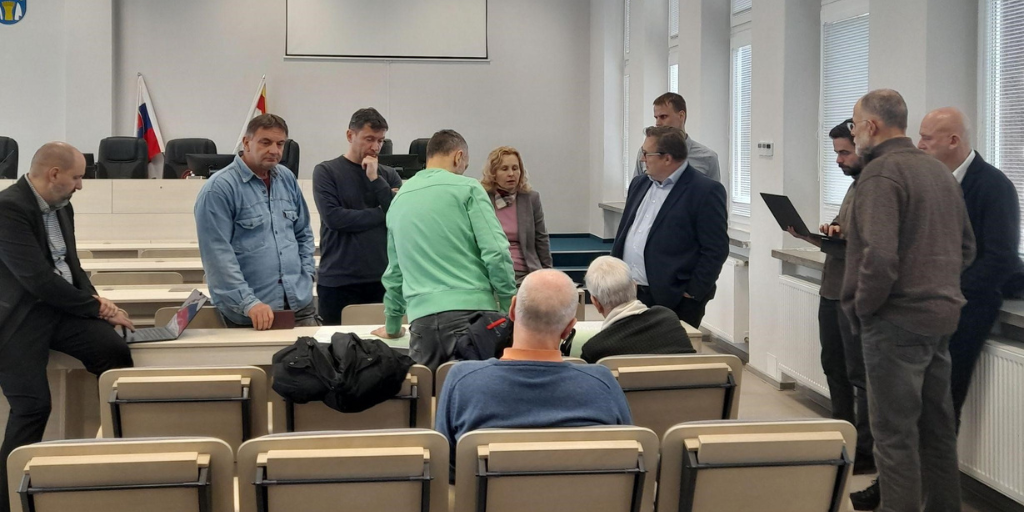
Town officials, EIB and TARGET consultants, municipal technicians, and designers discuss future steps after a feasibility study presentation in Partizánske in January 2026
How Slovakia’s coal phase-out changed the game
Partizánske is a mid-sized town in western Slovakia, located along the Nitra River in the Upper Nitra region. It was founded in the 1930s as an industrial town connected to the nearby Nováky coal power plant. Home to roughly 20,000 residents, the town has its own municipally owned district heating system, which today is powered by 66% fossil gas and 34% biomass.
In December 2018, the Slovak government announced that coal would be phased out by 2023 at the latest, giving the Nováky plant a five-year countdown until shutdown. This meant that all municipalities connected to the plant needed to find a new heating source. However, unlike some neighbouring towns, Partizánske was no longer directly dependent on domestic brown coal for its district heating.
Yet the national coal phase-out changed the outlook for the entire region. With coal leaving the energy mix, district heating systems across the region would have to reinvent themselves. By December 2023, all of the municipalities had successfully developed plans for replacement systems for all of the affected households across the region.
However, the reinvention couldn’t stop simply at transitioning to gas. With the EU’s target of complete decarbonisation by 2050, the transformation of these systems had to go further. This meant municipalities had to start planning how to modernise their district heating systems using sustainable, renewable and modern technologies.
Planning for the future
Partizánske started by working with the Slovak non-governmental organisation Friends of the Earth–Centre for Environmental Public Advocacy (Friends of the Earth–CEPA). It developed an in-house pre-feasibility study, outlining a structured plan for transforming the town’s district heating system. The study mapped:
- heat consumption across individual buildings and zones;
- the technical condition of boiler rooms;
- equipment efficiency and emissions;
- operating costs;
- precise pipeline routing;
- collisions with underground utilities; and
- terrain constraints;
Three core ideas emerged: interconnecting of the two currently separate heating systems, utilising geothermal resources and, in the long term, recovering waste heat from the town’s wastewater treatment plant. The next step was to consult external experts to assess the viability of these conclusions.
In February 2023, Partizánske reached out to the European Investment Bank (EIB). The EIB’s advisory services typically focus on larger infrastructure projects in major cities. Yet the 2022 launch of the Technical Assistance for Regions Undergoing a Green Energy Transition (TARGET) programme by the EIB and the European Commission opened the door for regions like the Upper Nitra region that have been historically dependent on fossil fuels like coal, peat, and oil shale.
As the municipality increasingly demonstrated readiness, clarity and technical preparation, interest grew. Eventually, a formal technical assistance agreement was signed in August 2024 under the Energy Efficiency and Energy Advisory Division of the EIB’s Energy Department. By September 2024, the terms of reference had been approved, with external experts procured up until March 2025. A kick-off meeting followed in April 2025, and the final feasibility study was published in February 2026.
The technical assistance confirmed the conclusions of the earlier Friends of the Earth–CEPA study: the need to interconnect the existing heating systems, and the potential to use geothermal energy and recover heat from wastewater. This endorsement will help the municipality apply for funding, as it gives investors and partners confidence in the viability of the planned project, which the EIB estimates at around EUR 6.1 million.
Next steps
With this feasibility study now complete, Partizánske is moving forward by preparing a technological concept. This will define specific technologies, required capacities and preliminary cost estimates, helping the municipality to secure building permits and negotiate financing, including an application to the Slovak Environmental Fund’s district heating modernisation financing schemes from the EU’s Modernisation Fund.
Other immediate major structural decisions have already been agreed. The current four-pipe system will be replaced with a two-pipe system, simplifying infrastructure and improving efficiency. Boiler rooms in critical or emergency condition will be prioritised and integrated first.
Additionally, Partizánske is now preparing a communications strategy aimed at residents, with the goal of building long-term public support through clear, accessible information – a particularly important step as municipal elections approach.
This pathway shows that even small municipalities can use EUservices such as the TARGET programme. Thanks to thorough preparation and municipal readiness, Partizánske is set to become a first mover in Slovakia in decarbonising its district heating system. This approach has potential for replication across Europe, where additional EU support programmes are available through the Directorate-General for Regional and Urban Policy (DG REGIO), the Joint Assistance to Support Projects in European Regions (JASPERS) programme, Horizon Europe, and networks like the EU Covenant of Mayors.
Never miss an update
We expose the risks of international public finance and bring critical updates from the ground – straight to your inbox.

