Over the past few years, the public transport fleet in Bishkek – Kyrgyzstan’s capital city – has changed visibly. In a city where privately operated minibuses, known as marshrutkas, dominated for years, new gas-powered buses and electric buses are now in service.
Alexey Juravlev Altynai Nogoibaeva, independent urban researchers, Kyrgyzstan | 29 April 2026
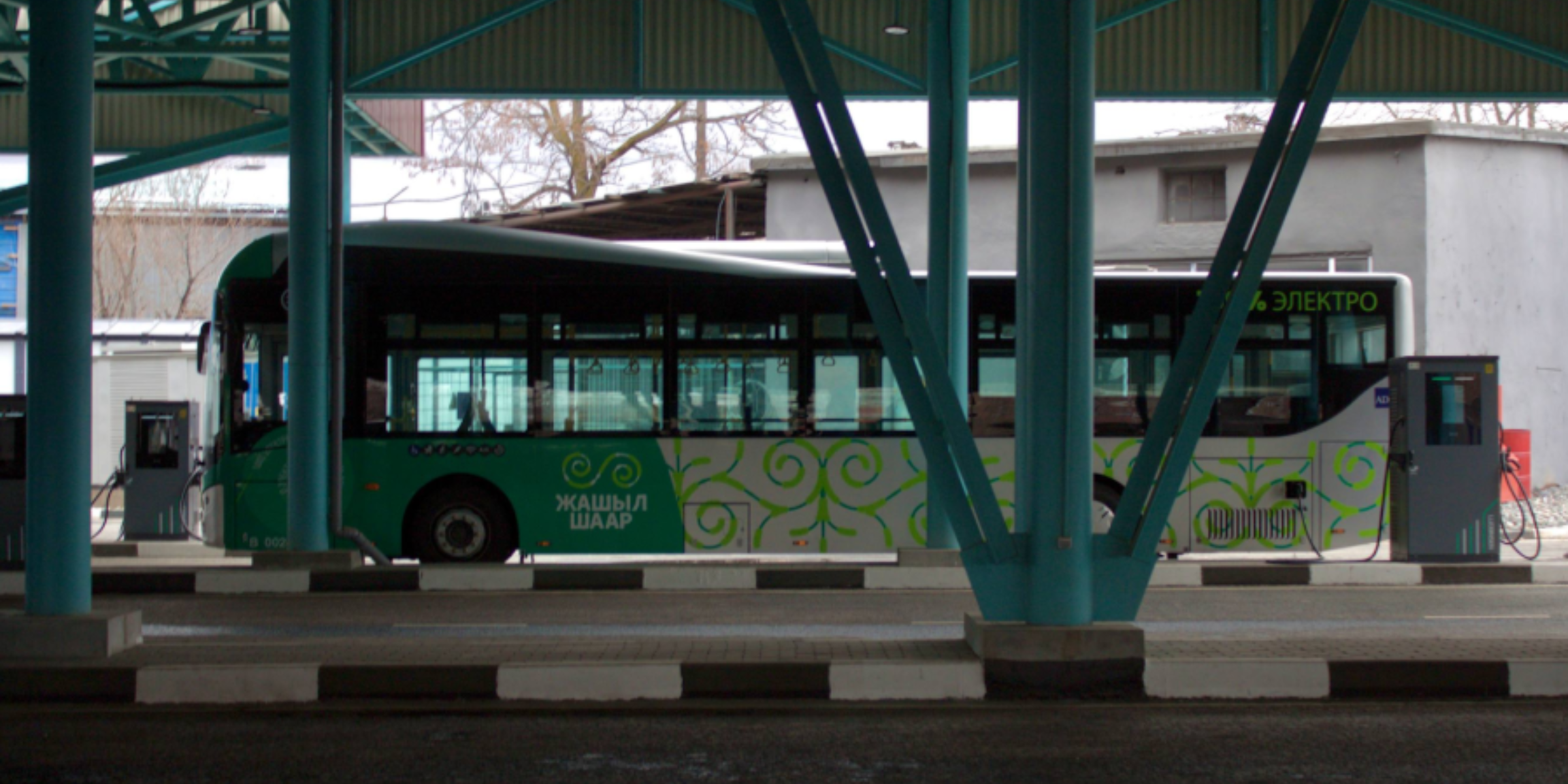
A Bishkek electric bus charges at a depot (photo: Alexey Juravlev).
Over the past few years, the public transport fleet in Bishkek – Kyrgyzstan’s capital city – has changed visibly. In a city where privately operated minibuses, known as marshrutkas, dominated for years, new gas-powered buses and electric buses are now in service.
Today, the municipal fleet includes around 1,600 vehicles. Of these, 424 were purchased through grants and loans provided by international financial institutions, including the Asian Development Bank (ADB), the European Bank for Reconstruction and Development (EBRD), and Germany’s development bank (KfW).
At first glance, this appears to be a clear move towards more sustainable urban mobility. However, an analysis of Bishkek’s public transport system, conducted by local researchers with support from CEE Bankwatch Network, suggests that fleet renewal alone has not made public transport genuinely attractive or efficient.
Modernisation, but to what end?
According to an official survey commissioned by the Bishkek mayor’s office as part of the city’s 2050 General Plan, only 38% of residents selected public transport as their primary mode of travel, with 41% of residents travelling by car. The rest walk or use personal mobility devices. These figures point to a deeper structural issue: the reform has focused primarily on replacing vehicles, while the system itself remains in need of fundamental improvement.
The analysis identified several key barriers that may prevent residents from shifting from cars to public transport. First, only 18% of the fleet can be described as fully comfortable, inclusive, safe and environmentally friendly. Many buses lack air conditioning, not all interiors are fully inclusive, and part of the fleet still fails to meet modern environmental standards.
Second, pedestrian access to stops remains limited. GIS analysis shows that only 25% of Bishkek’s built-up area lies within a 500-metre walking distance of existing stops. This means that many residents must already incur additional time and effort costs at the very first stage of their trip, making public transport less competitive compared to cars.
Third, the city still lacks a connected bus priority system. Dedicated bus lanes cover only 2% of the total route network length. Passengers lose time in traffic congestion alongside motorists. Because of traffic jams, service intervals are disrupted, travel times increase, and travel itself remains unpredictable.
International practice in public transport development recommends three types of measures known as the ‘avoid–shift–improve’ approach:
- avoid – reduce the need for trips through better urban planning;
- shift – switch demand to more sustainable modes of transport;
- improve – upgrade vehicles and technologies.
However, the changes in Bishkek primarily focus on the third measure: fleet renewal. Yet even the most modern ‘green’ buses do not, on their own, solve passengers’ problems, shorten travel times, or make public transport a more attractive option.
Beyond new buses
For public transport in Bishkek to truly become more convenient and attractive, the city must adopt a more comprehensive approach, including:
- developing a polycentric urban structure to reduce the need for long-distance travel;
- optimising excessively long routes and introducing a free transfer system;
- increasing pedestrian access to stops, particularly in residential districts and peripheral areas;
- creating a connected network of dedicated bus lanes; and
- integrating buses with rail, cycling, and pedestrian infrastructure as well as car use.
In summary, while investment in greener and more modern rolling stock is necessary, it remains insufficient. Unless the city implements these changes, it will be left with a system that is modern in form, yet fundamentally ineffective – one that ultimately fails to compete with the speed, convenience and reliability of the car.
Never miss an update
We expose the risks of international public finance and bring critical updates from the ground – straight to your inbox.
Institution: ADB
Theme: urban transport
Location: Kyrgyzstan
Tags: cities for people | sustainable cities | urban transport

