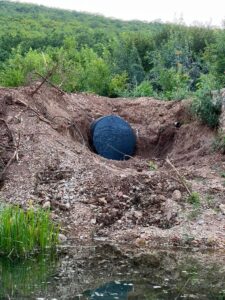
A large drainage pipe has been recently installed next to the spring of the Bunica River as part of the construction of the European Corridor Vc motorway in Bosnia and Herzegovina. Local residents became increasingly concerned and the issue gained public attention on 3 July 2026 when photographs of the works were widely shared and questions were raised about the purpose of the pipe and its potential impact on the river.
Sead Šašivarević, Alma Midžić, | 30 July 2026
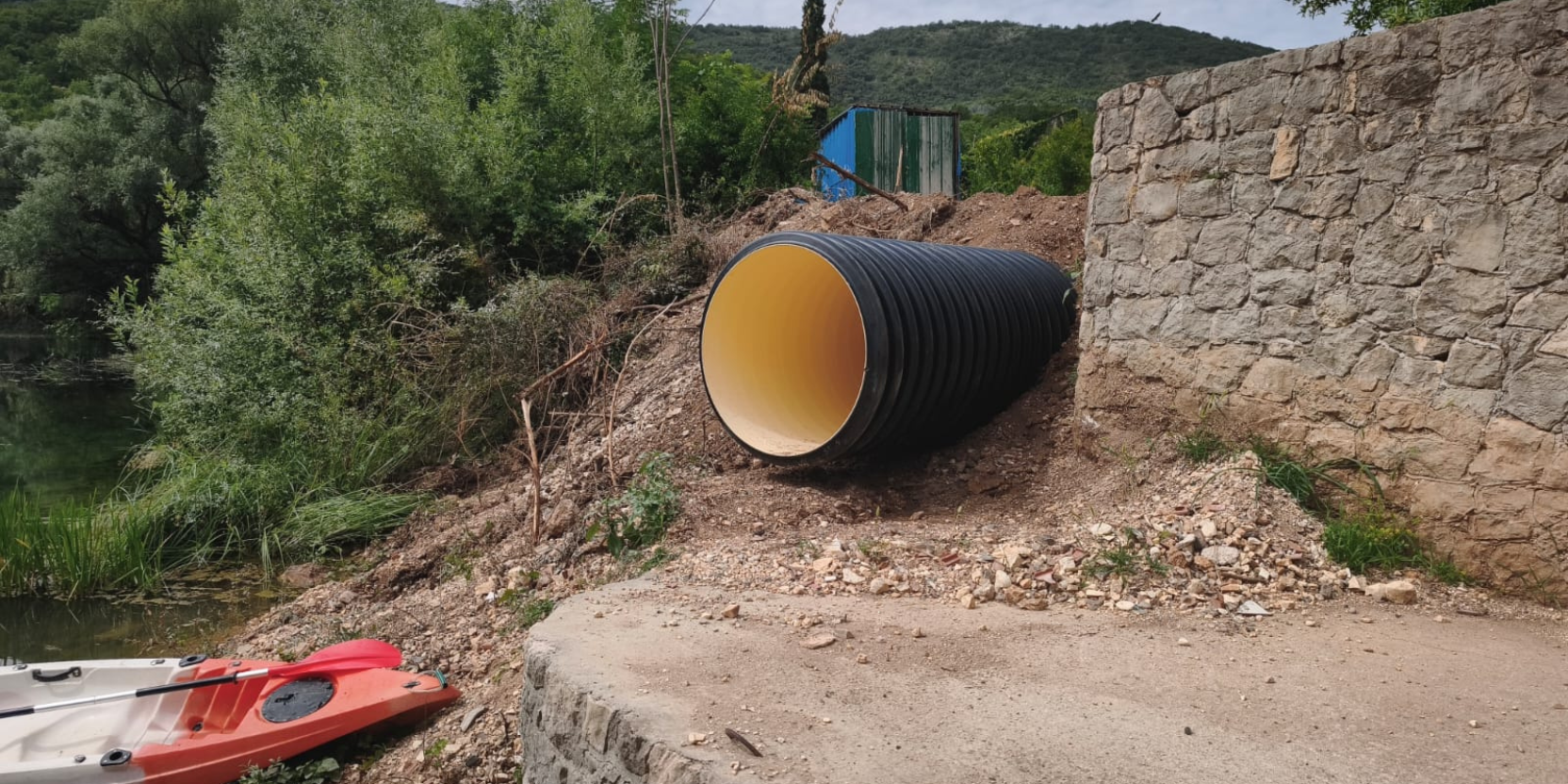
A newly installed drainage pipe beside the Bunica River. Photo: Sead Šašivarević.
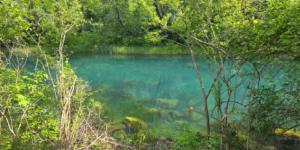
The Bunica Spring, near Mostar, is one of the country’s most important karst springs and a unique natural oasis. The river and surrounding landscape form an area of exceptional ecological value and provide a habitat for diverse wildlife. The Bunica also holds significant importance for the local community. Nearby households depend on the groundwater resources connected to the area and the river supports recreation, local livelihoods and everyday community life. Its ecological and social value has already prompted formal actions for stronger and lasting legal protection. Against this background, the decision to place such a large drainage outlet so close to the spring and river calls for much closer scrutiny.
Unexpected flash flooding after start of works
These concerns about the drainage pipe are connected to other concerns local residents have. Following the start of construction works on the Tunnel Kvanj section of Corridor Vc in late 2025, the nearby settlement of Parila experienced severe surface runoff and flash flooding after heavy rainfall. Residents observed that these events occurred after extensive earthworks and vegetation removal on the hillside above the settlement.
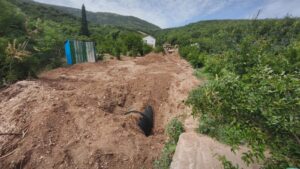
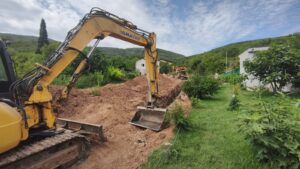
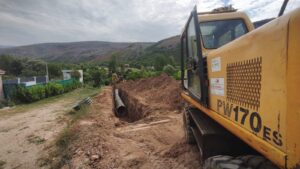
The scale of excavation and land disturbance associated with the installation of the drainage pipe near homes and cultivated land beside the Bunica River. Photo: Sead Šašivarević.
Soon afterwards, the community was shocked to see a huge underground pipeline, with an opening nearly nearly the height of an adult, emerging from the stripped hillside and pointing towards the Bunica River. No clear explanation of why it had been installed was provided by the authorities or project promoter JP Autoceste FBiH (JPAC), nor an assessment of how much water it could carry or what might happen when the next heavy rains came.
High risks in a sensitive ecosystem
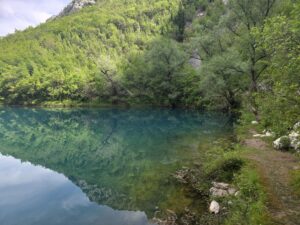
Local residents are concerned that the new drainage system may alter the natural hydrological regime around the Bunica River or harm its sensitive karst ecosystem. Residents are particularly concerned about the area’s groundwater, the private wells used for drinking water by nearby households, and the Bunica bathing area, which is currently being restored by the city of Mostar.
They also fear that, during heavy rainfall, the pipe could release large volumes of muddy runoff into the river, causing severe turbidity. It is distressing to imagine this captivating, crystal-clear emerald river suddenly overwhelmed by a torrent of murky water. Residents are also seeking clarification as to whether the current drainage solution formed part of the original approved project or represents a design modification introduced after construction had already begun.
In a statement published in the media, JPAC said that the drainage system does not discharge motorway runoff into the Bunica River. According to the company, the external drainage system collects only natural surface runoff that already flows towards the Bunica catchment, while motorway runoff would be collected separately, treated and discharged in accordance with the project documentation and water permits. The company further states that the project does not introduce additional water into the Bunica River, does not alter its natural hydrological regime and that the protection of the river has been an integral part of the project’s design from the outset.
Where things stand in late July
The local community welcomes these assurances and appreciates JPAC publicly addressing the issue. However, JPAC’s response and their covering of the pipe’s discharge point have not fully eased the concerns that have been raised. Is it really necessary to place such a large pipe so close to the spring and one of the area’s most beautiful and sensitive rivers? Given the ecological and social importance of the site, the intervention appears to have been approached far too lightly. Better and less intrusive solutions may have been possible.
If, on the other hand, the pipe was not part of the original design, this raises an equally serious concern: was it introduced hastily in response to problems that emerged during construction, rather than through careful and transparent planning?
Additional official information became available in late July in a response issued by the Federal Ministry of Environment and Tourism to a parliamentary question. According to the Ministry, the drainage solution now being implemented was developed in response to uncontrolled surface runoff that occurred during motorway construction in late 2025 and affected several residential properties in the nearby settlement of Parila. The Ministry added that the solution had been agreed upon in early 2026 following discussions with affected residents, and that the drainage pipe was installed in June 2026.
This timeline raises additional questions regarding the permitting process. The environmental permit was issued in May 2019 —well before the drainage solution was developed to address the surface runoff that occurred during construction in late 2025. As a result, the local community is seeking clarification on the approvals, technical assessments, and environmental documentation that support this subsequent intervention. Although the Ministry’s response provides useful context on how and when the drainage solution was developed, it does not include the underlying approvals or the technical and environmental documentation requested by the community.
As July draws to a close, neither this response nor JPAC’s public statement has fully addressed residents’ concerns. The initial relief at reports that the pipe had been sealed has also quickly faded. According to the latest information from the site, no cap has been installed to stop water from flowing through the pipe into the river. Instead, only a flap has been placed over the opening to prevent material from entering from the outside. Given this, residents are still seeking access to technical documentation and scientific evidence supporting these conclusions.
The community’s requests
Given the above, the community requests clarification from JPAC regarding:
- the hydrological analyses demonstrating that the natural drainage regime of the Bunica River will remain unchanged;
- the hydrogeological studies confirming that the drainage system will not affect the Bunica karst spring, groundwater or nearby private wells;
- the technical justification for replacing an originally planned open drainage channel with a large underground pipeline;
- whether alternative drainage solutions were assessed during the planning and design process, including options that would avoid or minimise discharge towards the Bunica River, and why the current solution was ultimately selected;
- the complete design of the drainage discharge system, including the exact location and function of all discharge points, infiltration structures, retention facilities and any other components through which collected water is ultimately released or infiltrated;
- the environmental assessment of potential impacts on the Bunica bathing area and local drinking water sources;
- the technical criteria and hydrological modelling used to demonstrate that the selected drainage solution represents the optimal option for protecting both the local community from flooding and the Bunica River and its karst groundwater system;
- whether the drainage solution currently being constructed represents a subsequent design modification after the initial environmental permitting process, and if so, through which approval procedure that modification was assessed and authorised;
- the long-term monitoring programme that will verify the effectiveness of the proposed protection measures; and,
- whether this design modification required amendments to the original project documentation, environmental approvals or construction permits.
The local community is not opposing the construction of Corridor Vc. Rather, it is asking for transparency and access to the technical studies on which the company’s actions were based. Given the exceptional ecological importance of the Bunica River and the international financing of the project, local residents believe that making this information publicly available would help build trust, strengthen dialogue and demonstrate compliance with both national legislation and international environmental and social standards.
We respectfully invite the international financial institutions supporting the Corridor Vc project to review these concerns and encourage a transparent dialogue between the investor, the competent authorities and the local community. Ensuring public access to the relevant technical documentation and providing clear, evidence-based answers would strengthen public confidence that the Bunica River and its unique karst ecosystem are being effectively protected.
Institutional silence will only further weaken the community’s already fragile trust. Projects carried out in the public interest should not be managed in this way.
This unresolved situation shows why continued public scrutiny and strong environmental safeguards are essential. Protecting the Bunica is not only about protecting a river. Access to the relevant technical documentation, a clear explanation of how this location was chosen and evidence that less–intrusive options were considered would go a long way towards rebuilding trust and showing that both meaningful community involvement and the protection of the river were treated as genuine priorities.
Never miss an update
We expose the risks of international public finance and bring critical updates from the ground – straight to your inbox.
Institution: EBRD | EIB
Theme: Corridor Vc
Location: Bosnia and Herzegovina
Project: Corridor Vc motorway, Bosnia and Herzegovina
Tags: Corridor Vc

