As temperatures rise over the summer months, conversations about heating homes may seem distant for many. Yet for many residents of Petroșani – a former coal-mining town in Romania’s Jiu Valley – the challenge of keeping homes warm is a recurring reality that returns every winter, shaped by ageing buildings, low incomes and limited access to support.
Laura Nazare, National Campaigner, Bankwatch Romania | 3 June 2026

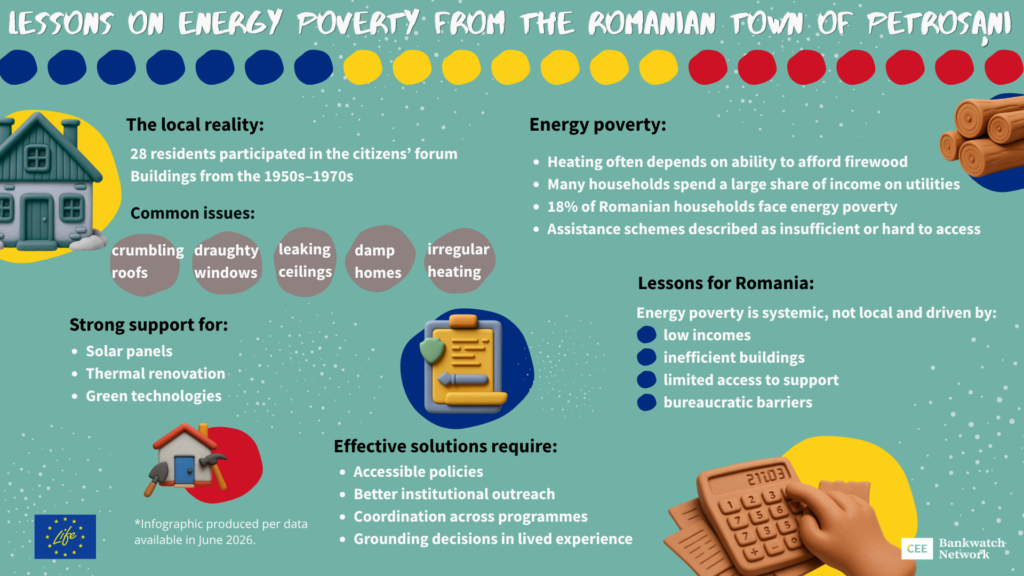
Last year, 28 residents of Petroșani came together to discuss something most of them experience every day but rarely raise in public: the struggle to keep their homes warm. The result was a citizens’ forum that cut through statistics and policy language to reveal something far more important: the lived reality behind energy poverty and what meaningful support could look like when shaped by those directly affected.
The situation on the ground
Petroșani illustrates what can happen when a regional economy built entirely around a single industry collapses. Following the insolvency of the town’s local energy conglomerate, mines began to shut down, jobs disappeared and many residents moved away. Those who stayed are now living in buildings constructed between the 1950s and 1970s, with crumbling roofs, draughty windows and heating systems that were never designed to be efficient or affordable.
Energy poverty here is not an abstract policy concept. It’s a daily negotiation over which essential needs can be sacrificed. One participant described living on the top floor of a building where the ceiling freezes in winter and rainwater leaks into the apartment during heavy downpours. The home is damp and cold, the windows have never been replaced, and heating is only available when there’s enough money to buy firewood. Unfortunately, these are not isolated cases – they’re the norm.
The many layers of energy poverty
What made the forum particularly valuable was not just what participants shared, but how their experiences reflect the broader reality of energy poverty. It’s not simply about high energy costs; rather, it’s the result of multiple factors stacking on top of one another: low incomes, ageing buildings with poor insulation, limited job opportunities, and an administrative system that’s often difficult to navigate and slow to respond.
In many households, a significant share of income goes directly towards utility bills. While heating assistance schemes exist, participants described them as either insufficient to meet their actual needs or difficult to access in practice due to bureaucratic hurdles and outdated eligibility criteria. The frustration expressed was not only about material hardship, but also about the gap between people’s needs and the institutions meant to respond to them.
Barriers to collective action
A key issue raised during the forum, and one well known in policy discussions, is the role of homeowners’ associations. These are a prerequisite for accessing most public funding for building renovations or energy-efficiency programmes.
In Petroșani, however, very few apartment blocks have functioning associations. Participants’ experiences confirmed how complex and burdensome the process of establishing one can be, requiring time, financial resources, legal knowledge, and agreement from all residents, including those who have already left town.
One resident explained that, without an association, neighbours must go door to door whenever anything needs to be done in the building, and that setting up an association took an entire year.
Depopulation further complicates the situation, as vacant apartments make collective decision-making difficult, while the costs and responsibilities fall on those who remain. These barriers are not new, but the experiences of these residents make it clear how administrative requirements can become real obstacles in practice.
What people actually want
Despite the challenges, participants were constructive and forward-looking. They expressed strong support for solutions such as solar panels, thermal renovation and other green technologies. There was a general openness to change and a clear understanding of its benefits.
At the same time, participants highlighted the need for stronger and more accessible connections with public institutions to make these solutions achievable. Their proposals were practical: a single point of contact for energy and housing matters, support in setting up and managing homeowners’ associations, neighbourhood-level renovation programmes instead of piecemeal interventions, and better public information delivered not only online but also in person for those less digitally connected.
Many participants viewed renewable energy as part of the solution, arguing that solar panels could reduce both pollution and household energy costs. What clearly emerged from the discussions is that citizens are not simply passive beneficiaries of policy; they’re ready to engage if given the tools and support to do so.
Lessons for Romania’s energy transition
While the challenges in Petroșani are shaped by its post-industrial history, energy poverty is not limited to such communities. Across Romania, households are struggling with a similar combination of low incomes, inefficient buildings and limited access to support mechanisms.
This makes energy poverty not just a local issue, but a systemic one. Addressing it requires more than financial support alone: it calls for policies that are accessible, coordinated, and grounded in peoples’ lived realities.
As the experience in Petroșani shows, solutions already exist. Yet their impact depends on whether institutions can truly reach the people they’re supposed to support. Strengthening this connection will be critical, not just for addressing energy poverty, but also for shaping a transition that is fair and inclusive across Romania.
Never miss an update
We expose the risks of international public finance and bring critical updates from the ground – straight to your inbox.
Theme: energy poverty
Location: Romania
Project: After recovery towards cohesion
Tags: European Green Deal

