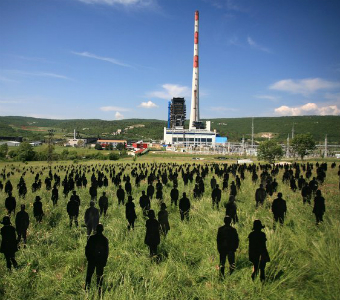
Public action: Croatian coal power plant besieged by 680 bodies
Blog entry | 10 May, 2013Yesterday, Green Action/Zelena Akcija, Greenpeace and Green Istria staged a spooky public action to raise attention for the findings of a new study that predicts approximately 17 early deaths annually due to the planned new 500 MW unit at the Plomin coal power plant in Croatia.
Read more
More dirty coal on the radar as EBRD announces new strategy for Kosovo
Publication | 10 May, 2013The EBRD’s new country strategy for Kosovo, announced by the bank on May 3 after Bankwatch Mail Issue 56 went to press, has confirmed what NGOs and others had feared in the consultation process for the EBRD’s first strategy in its new country of operation: that financial support for a new major lignite power plant is very much on the EBRD’s radar, despite evidence that Kosovo does not need such a power plant as well as the potential undermining of EU climate goals.
Read more
New EBRD Environmental and Social policy needs climate muscle and tightened safeguards for protected areas
Publication | 10 May, 2013If there is one sector in which the EBRD has been causing particular controversy in recent years, it is the energy sector. From lignite in Slovenia to hydropower in Georgia and nuclear in Ukraine, the bank has financed a series of projects that have incurred opposition from various quarters. Now that the EBRD is revising its Environmental and Social Policy it’s time to take a look at what needs to be learned from these projects.
Read more
Connie Hedegaard: Stop paying the polluters
Publication | 10 May, 2013“When the winds of change blow,” says an old Chinese proverb, “some build walls, and others build wind mills.”
Read more
When in hole, stop digging: lessons from the Ombla hydro project in Croatia
Publication | 10 May, 2013At the time of writing, it is highly uncertain what the future holds for the controversial 68 MW Ombla underground hydropower plant. Approved for financing by the EBRD back in 2011, only recently has a nature impact assessment study finally been published, and no final opinions have been given by either state institutions or the EBRD on whether the project is to go ahead.
Read more
Armenia gold mining problems cast shadow over renewed EBRD financing
Publication | 10 May, 2013The attention of the environmental community in Armenia has recently been focused on events swirling around the Deno Gold Mining Company (DGMC). The company has been contending with rising tensions in Kapan as a result of its laying off of workers at its gold mining operations coupled with failings at its Geghanush tailings facility. The controversies have arisen just as the company awaits disbursement of a new loan from the EBRD.
Read more
More questions than answers – the EBRD’s new country strategy for Russia
Publication | 10 May, 2013The new EBRD country strategy for Russia that will apply for 2013-2015 attracted input and comments from several human rights and environmental watchdogs, among them Human Rights Watch, WWF, Greenpeace and Bankwatch. As part of the consultation on the new strategy, NGOs expressed concerns about the current political and social situation in Russia as well as the dangers of natural resource development. The comments were incorporated into the strategy document but it remains unclear if NGOs were able to influence actual decision-making.
Read more
Dire straits – EBRD backing for oil transportation in the Kerch Strait appears belatedly on public radar
Publication | 10 May, 2013A European Bank for Reconstruction and Development loan to the SVL group, granted with no public oversight, threatens new oil-related catastrophes.
Read more
One of the great enablers: how the EBRD threatens the environment and human rights in Kazakhstan and Turkmenistan
Publication | 10 May, 2013In its recent report, ‘The great enablers: how investments by international financial institutions threaten the fragile Caspian Sea ecosystem’, Crude Accountability describes how investments in the Caspian Sea region by international financial institutions, including the European Bank for Reconstruction and Development, are contributing to the intensification of extraction of and trade in the region’s oil and gas.
Read more
EBRD Public Information Policy review should look to EU and US transparency advances
Publication | 10 May, 2013This year’s flurry of reviews to EBRD sectoral, country and operational strategies has given civil society organisations plenty to think about and provide input on. However, in the case of at least one of the reviews, we already have a pretty good idea what we will say. Because we’ve said it before – several times.
Read more
