Kyrgyzstan: Independent expertise exposes damage done by Kumtor gold exploitation
Press release | 31 January, 2012Bishkek — Canadian company Centerra Gold, owner and operator of Kumtor Mine, the largest gold mine in Central Asia managed by a Western company, has been contaminating local waters and glaciers while hiding evidence of such negative impacts from public oversight, reveals a report authored by an independent US-based expert published today by CEE Bankwatch Network (1). Had it operated in its home country Canada, Centerra’s practices would have caused the company serious trouble with the law.
Read more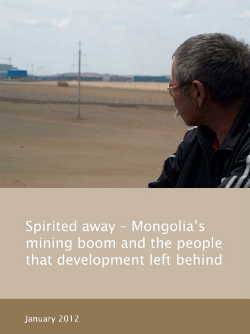
Spirited away – Mongolia’s mining boom and the people that development left behind
Publication | 30 January, 2012The report, based on a fact finding mission to the Tavan Tolgoi and Oyu Tolgoi mines in Mongolia, examines the social and environmental impacts of mining in Mongolia. It offers a more in-depth look at the impacts on herders who have been displaced by the mining operations, the local effects of the construction of infrastructure and the mining operations themselves.
Read moreBankwatch report and video: Mongolia’s mining bonanza poses threat to locals and planet
Press release | 30 January, 2012A new report launched today by CEE Bankwatch Network, urgewald and OT Watch (1), following on-the-ground research in Mongolia, details the impact of the country’s mining boom on local populations, shedding light on the ignored side of one of the biggest business stories of today: Mongolia’s planned public offering of the state-owned Erdenes Tavan Tolgoi and the rights to one of the world’s largest untapped coal reserves. (2)
Read more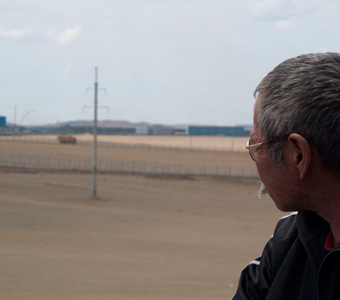
Video: Spirited away – Mongolia’s mining boom and the people that development left behind
Blog entry | 27 January, 2012Earlier this week we published an overview of two Central Asian mining projects financed by the European Bank for Reconstruction and Development – the Kumtor gold mine in Kyrgyzstan and the Ukhaa Khudag coal mine in Mongolia’s south Gobi desert, which is part of the much larger – in fact the world’s largest – coal deposit at Tavan Tolgoi.
Read more
Rushing into gold can leave people behind, EBRD
Blog entry | 25 January, 2012A look at mining projects in Kyrgyzstan and Mongolia reveal a need to carefully revise the European Bank for Reconstruction and Development’s involvement in the exploitation of natural resources.
Read moreLetter to European Commission: Insufficient environmental assessment of Ukraine NPP Safety Upgrade Programme
Publication | 20 January, 2012The letter criticises the environmental assessment of the Nuclear power plants safety upgrade programme (SUP) in Ukraine. It concludes that the assessment insufficient and does not fully elaborate the objectives and consequences of the SUP.
Read more
Tragedy or comedy, what is the Nabucco pipeline really?
Blog entry | 19 January, 2012The announcement of German energy giant RWE to reconsider its plans for the Nabucco pipeline is just the last in a series of confusingly conflicting signals regarding the fate of this gargantuan project.
Read moreComplaint to EBRD’s Public Complaint Mechanism: The Sostanj thermal power plant project
Publication | 17 January, 2012Bankwatch, Slovenian NGO Focus and Environmental Legal Service (CZ) ask the EBRD’s Project Complaint Mechanism to undertake a compliance review of whether the bank has complied with its Environmental and Social Policy 2008 in relation to two aspects of the Sostanj lignite thermal power plant: (a) Claims by the EBRD that the project in question is “CCS ready” and (b) the EBRD’s assessment of whether Slovenia can fulfil its obligations in meeting long-term EU climate goals if it undertakes the project.
Read more
Deja vu for Vienna II – a sustainable recovery is needed for the CEE financial sector
Blog entry | 16 January, 2012As pressures mount on western European banks to shore up capital ratios and with 2012 economic growth forecasts for Europe falling close to zero, officials from the European Central Bank, the European Commission, and several international financial institutions (IFIs) are meeting today in Vienna with regulators from CEE countries to discuss a second round of financial support for a fragile CEE banking sector.
Read moreThe Ukrainian nuclear power plant safety upgrade project and the EBRD’s contribution to extending outdated Soviet reactors
Publication | 15 January, 2012The European Bank for Reconstruction and Development (EBRD) and Euroatom plan to support the nuclear power plant safety upgrade project in Ukraine. The EU presents the project as a timely initiative to improve nuclear safety in the region. A closer inspection however shows that it in fact can increase nuclear risks, in that the project includes a significant number of measures necessary to extend the lifetime of the reactors.
Read more
