Western Balkan governments must finally penalise illegal coal pollution – new report
In 2025, systematic law enforcement failures allowed sulphur dioxide (SO2) emissions from the Western Balkans’ ageing coal power plants to exceed legal limits by 6.6 times, according to the eighth edition of Bankwatch’s Comply or Close report, published today (1). Nitrogen oxides (NOx) emissions also continued to breach legal limits, while dust pollution increased, reaching the highest level since the current rules entered force in 2018.
22 June 2026
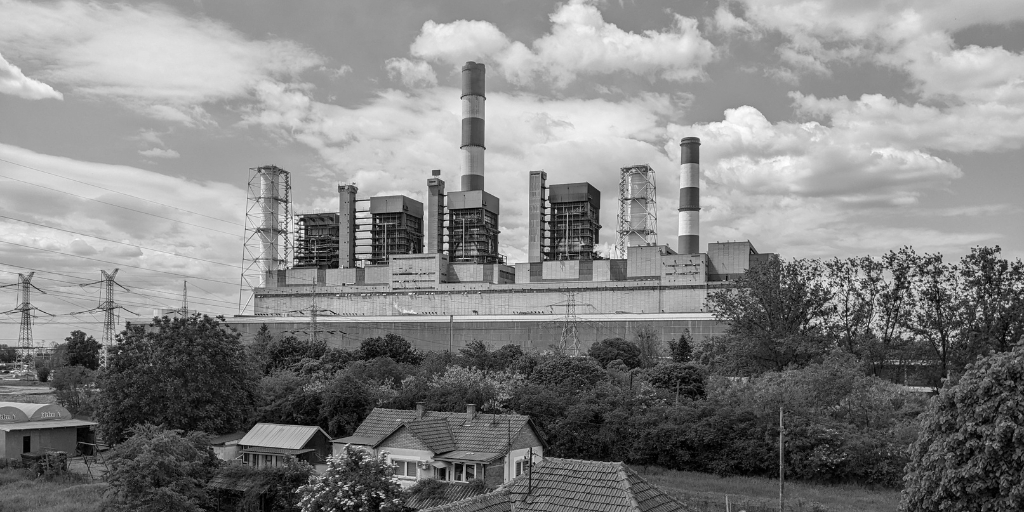
Nikola Tesla power plant, Serbia, photo: Stefan Aleksić
Eight years since pollution control standards entered force under the Energy Community Treaty, in 2025 sulphur dioxide emissions from coal plants included in the National Emissions Reduction Plans (NERPs)(2) of Bosnia and Herzegovina, Kosovo, North Macedonia and Serbia were still collectively 6.6. times as high as allowed.
Bosnia and Herzegovina’s NERP coal plants were the highest SO2 emitters, with 196,940 tonnes, or 12.7 times as high as their limit. Serbia followed, with 177,756 tonnes, or 5.1 times as high as allowed.
Region-wide, SO2 emissions have decreased only modestly since 2018. And the emissions limits were more stringent in 2025 than in previous years, leading to even larger breaches.
The highest SO2 polluter in absolute terms continued to be Ugljevik in Bosnia and Herzegovina, despite it having de-sulphurisation equipment. Its 2025 emissions of 115,079 tonnes were at their highest since the pollution control rules kicked in in 2018.
Five coal units exceeded their SO2 emissions ceilings by more than ten times in 2025 – Bitola B1 & 2 and B3 in North Macedonia; and Ugljevik, Gacko and Kakanj 6 in Bosnia and Herzegovina.
Dust pollution was 2.9 times as much as allowed in 2025, reaching the highest absolute and relative level since the rules entered force in 2018.
This was driven mainly by a massive increase at the Bitola plant in North Macedonia, which doubled its emissions compared to 2024 and single-handedly emitted more than the 7,094 tonnes allowed for the entire region.
Gacko in Bosnia and Herzegovina was once again the highest relative dust emitter. Despite a small decrease compared to 2024, it emitted 15.1 times as much as allowed.
As in 2024, total emissions of nitrogen oxides from the NERP coal plants in 2025 amounted to 1.4 times as much as allowed. Kosovo, Bosnia and Herzegovina and Serbia once again exceeded their legal limits, with Nikola Tesla B in Serbia emitting the most – 11,247 tonnes.
In addition to the NERP breaches, at the end of 2023, the deadline for closing the smallest and oldest plants under the ‘opt-out’ derogation expired. All three countries in the Western Balkans with coal power plants subject to this rule – Bosnia and Herzegovina, Montenegro and Serbia – are still breaching it.
Montenegro’s Pljevlja plant has undergone a retrofit in recent years and spent much of 2025 offline, however no evidence is available that it complies with pollution standards that would enable it to continue operating. Tuzla 4 and Kakanj 5 in Bosnia and Herzegovina, and Morava and Kolubara A in Serbia, are also still operating, more than two years after the final closure deadline.
The Energy Community Secretariat has opened several infringement-type cases against the countries (3) confirming the illegal operation of their coal power plants. However, not a single government has imposed penalties on the coal plants in question, nor do they have clear, updated and realistic plans for compliance and/or closure.
Meanwhile, the EU’s Carbon Border Adjustment Mechanism’s (CBAM) definitive regime started in January 2026, increasing electricity export costs and further challenging coal plants’ profitability in the region. And in recent years Bosnia and Herzegovina, North Macedonia and Serbia have all seen a decline in coal-fired electricity generation, despite the lack of plant closures.
Davor Pehchevski, Balkan Energy Coordinator at Bankwatch – ‘In some Western Balkan countries we now have the worst of both worlds: a decline in coal-fired electricity generation without a clear plan to mitigate the socio-economic fallout, combined with high – and in some cases even worsening – pollution levels. Instead of enforcing pollution control safeguards, governments are turning a blind eye. This goes far beyond human health and the environment, right to the heart of fundamental principles such as equality before the law.’
Ioana Ciută, Strategic Area Leader – Beyond Fossil Fuels at Bankwatch – ‘Although the Western Balkan governments clearly bear the main responsibility, the EU institutions need to step up as well, conditioning EU financing and accession progress on compliance; sending clear, public messages; and securing financing for a just transition of coal regions and a switch to sustainable heating. Stronger enforcement tools are also needed in the Energy Community Treaty, to protect human health and the environment, including dissuasive penalties for breaches.’
Contacts:
Davor Pehchevski
Balkan Energy Coordinator
davor.pehchevski@bankwatch.org
Tel: +389 71 264 087
Ioana Ciută
Strategic Area Leader – Beyond Fossil Fuels
ioana.ciuta@bankwatch.org
Tel: +40 724 020 281
Pippa Gallop
Southeast Europe Energy Policy Officer
pippa.gallop@bankwatch.org
Tel: +395 99 755 9787
Notes for editors:
(1) The report is available at ComplyOrClose.org
(2) As part of their obligations to comply with the Large Combustion Plants Directive under the Energy Community Treaty, four Western Balkan countries – Bosnia and Herzegovina, Kosovo, North Macedonia and Serbia – have drawn up National Emission Reduction Plans (NERPs) covering the period from 2018 to 2027. Instead of requiring each large combustion plant to comply with the emission limit values from the Large Combustion Plants Directive from 1 January 2018, these plans allow the countries to calculate national emissions ceilings for sulphur dioxide, nitrogen oxides and dust, and to gradually decrease their total emissions from selected pre-1992 large combustion plants until 2027. In 2027, all the plants included in the NERPs will individually need to be in compliance not only with the emission limit values from the Large Combustion Plants Directive, but also with Part 1 of Annex V to Directive 2010/75/EU on Industrial Emissions.
(3) Due to the breaches of the NERP pollution limits, in March 2021 the Energy Community Secretariat opened dispute settlement cases against BiH, Kosovo, North Macedonia and Serbia.
In July 2023, the Energy Community Secretariat took further steps against Bosnia and Herzegovina, Kosovo, and North Macedonia, making a reasoned request to the Energy Community Ministerial Council to make decisions on the cases, which it did in December 2023. The case against Serbia did not escalate for some time due to ongoing desulphurisation investments, but in view of continued breaches of its NERP limits, in 2025 the Secretariat issued a ‘reasoned opinion’.
Due to the breaches of the opt-out provisions, the Energy Community Secretariat also opened dispute settlement cases against Montenegro in April 2021, Bosnia and Herzegovina in October 2022, and Serbia in October 2023.
Never miss an update
We expose the risks of international public finance and bring critical updates from the ground – straight to your inbox.
Project: Coal in the Balkans

