Georgia’s East–West and North–South road projects: Counting the true costs of highway expansion
The East–West Highway and the North–South Corridor – two key road infrastructure projects supported by major multilateral development banks, have had devastating social, environmental and cultural impacts in Georgia.
Stay informed
We closely follow international public finance and bring critical updates from the ground.
Key facts
East–West Highway
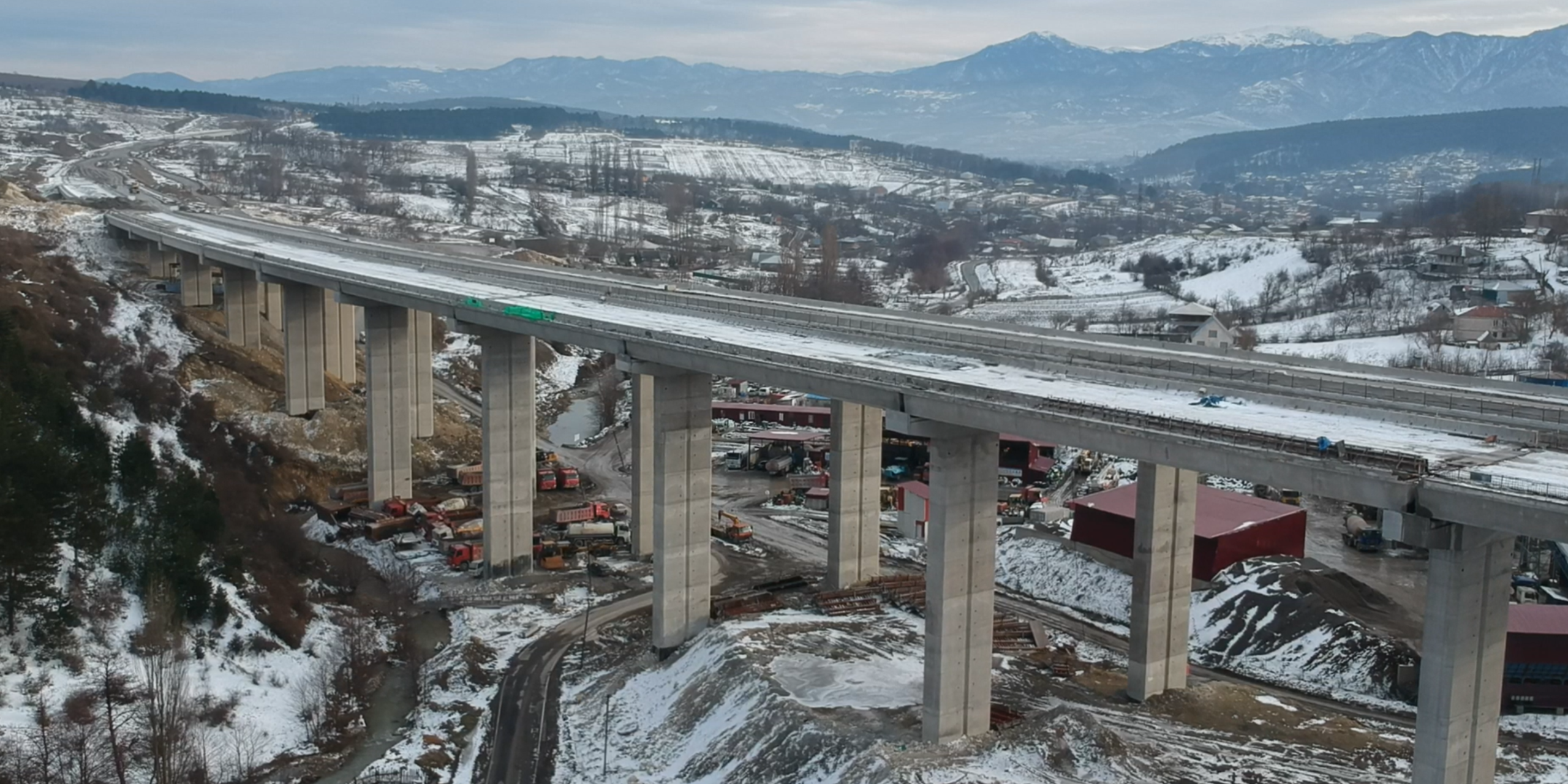
The East–West Highway, part of the international E60 corridor, spans approximately 388 kilometres across Georgia, from the Red Bridge on the border with Azerbaijan to Poti Port on the Black Sea coast.
The ADB, the EIB and the World Bank have provided the bulk of the financing for the highway’s expansion, with the construction contracts awarded to several Chinese companies.
Key upgrades along the route include its most technically intricate sections through the narrow and rugged Rikoti Pass. This particular section, known within Georgia as the Rikoti Road, extends over 50 kilometres. Developed as four separate projects, its construction cost approximately EUR 1.2 billion and, following years of delays, was completed in December 2025.
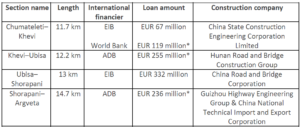
*Originally issued in USD (USD 140 million; USD 300 million; USD 278 million), these loans have been converted to EUR for consistency.
North–South Corridor
The North–South Corridor runs from Georgia’s border with Russia across the country to the border with Armenia in Sadakhlo in the south. A central component of the corridor is the 23-kilometre Kvesheti–Kobi Road, with a total estimated cost of EUR 497 million. Construction is ongoing and is expected to be completed in 2027.
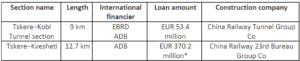
*The loan amount also includes ADB financing for the Tskere–Kobi Tunnel section.
Planned extensions in southern Georgia
Following the completion of works on the Rikoti section of the East–West Highway, the Georgian Dream government has turned its attention southwards. Two major road projects are planned to extend Georgia’s strategic transport corridors to the borders with Azerbaijan and Armenia.
The Rustavi–Red Bridge project covers a 32-kilometre section extending the East–West Highway to the border with Azerbaijan, while the Algeti–Sadakhlo project involves the construction of a 30-kilometre stretch connecting to the East–West Highway and expanding the North–South Corridor to the border with Armenia.
Collectively, these upgrades are expected to cost approximately EUR 294 million. In 2021, the EIB provided key financial support, with construction tenders closing in November 2025.

These projects were developed and implemented by the Ministry of Regional Development and Infrastructure of Georgia. In 2025, following the division of the Ministry into two separate bodies, the Ministry of Infrastructure assumed responsibility for the projects. The Ministry currently serves as the project promoter, with the Roads Department of Georgia responsible for implementation.
Key issues
The East–West Highway has rerouted traffic away from towns and rural communities, leading to the collapse of small businesses, markets and roadside economies. Some villages have effectively lost their connection to transport links. Promises of relocation and recovery have largely failed to materialise, leaving communities to bear the burdens of progress in which they had no part.
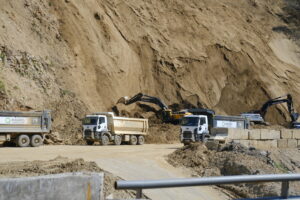
Construction of the East–West Highway has also intensified landslides, while inert waste generated both by these landslides and during tunnel works has been dumped in substandard disposal sites. Rivers along the route appear to have been narrowed or diverted in places. The resulting environmental damage has created serious safety risks for local residents and commuters, many of which remain unaddressed.
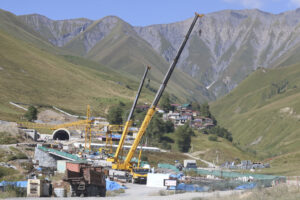
The Kvesheti–Kobi Road, part of the North–South Corridor, has devastated the nine-kilometre Khada Valley, radically altering its previously intact landscape. The project has heightened threats to biodiversity and cultural heritage and removed opportunities for ecotourism development.
The Roads Department has overseen the construction of the highways without properly assessing or mitigating the negative environmental and social impacts of these projects, often disregarding people’s lands and livelihoods in the name of the ‘public interest’. A major concern is its frequent and loose use of expropriation proceedings against affected communities.
The health and safety of employed workers – or rather, the lack of it – has also been a recurring concern, with multiple deaths reported during construction.
Background
To promote economic development and prosperity, successive governments in Georgia have sought to position the country as a transport and logistics hub, serving as a gateway between Europe and Asia. Over the past decade, the Georgian Dream government has promoted two key road infrastructure projects – the East–West Highway and the North–South Corridor – as central to this ambition. These projects aim to enhance road safety, reduce travel times and vehicle costs, and strengthen regional connectivity.
Major multilateral development banks, including the Asian Development Bank (ADB), the European Bank for Reconstruction and Development (EBRD), the European Investment Bank (EIB) and the World Bank, have provided significant financial support by financing upgrades to different sections of these highways. However, these large-scale road infrastructure projects have led to devastating social, environmental and cultural impacts.
Decimating roadside economies
Along the Rikoti Road, running from the eastern town of Surami to the western industrial centre of Zestaponi, local communities have long relied on roadside trade. Families set up small stalls outside their homes or on nearby verges, selling fruit, vegetables and everyday essentials to passing commuters. However, once traffic was diverted from the old road to the new highway, these families lost a significant source of income almost overnight.
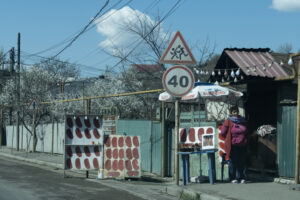
In Kharagauli municipality alone, more than 200 families who once earned a living trading along the old route have seen their daily income disappear, according to estimates from Chemi Kharagauli, a well-regarded local outlet with deep ties to the community.
In Zestaponi, the famous ‘coffee street’ – a stretch of cafés and roadside diners once buzzing with life – has suffered near-total economic collapse. Coffee shops and diners have closed one by one, with only half a dozen remaining open out of more than 40 establishments.
Shrosha, a village in Zestaponi municipality known for its deep-rooted ceramic traditions, has managed to avoid the worst of the economic fallout that hit surrounding areas thanks to the uniqueness of its locally sourced and produced clay pottery. Vendors in Shrosha have been offered a new marketplace for relocation. However, it has yet to officially open, and some vendors have been excluded from the scheme.
Similarly, in the south of the country along the planned Rustavi–Red Bridge Road, roadside vendors and small business owners – already hit hard by the long-standing closure of the Georgia–Azerbaijan land border – face further losses, having been instructed to dismantle their stalls and kiosks without compensation or relocation plans in place.
Ignoring environmental risks
There are currently at least 26 waste rock dumps along the Rikoti Highway, most of which are located in environmentally sensitive areas, including riverbeds, marshes, ravines and gorges. The impact of these dumps on rivers, their ecosystems and local communities was not assessed in advance, nor was the cumulative impact, including the associated safety risks in the context of climate change. Observations indicate that proximity to the construction site was the main reason for selecting these dump locations. All other considerations, including safety issues, were ignored.
The Vertkvichala landfill, the largest of them all, covers 130,606 square metres – equivalent to 18 football stadiums. Here, road builders are permitted to deposit a maximum of 2.3 million cubic metres of inert material. However, due to a combination of weak oversight, ongoing landslides and the generation of far more waste rock than specified, it is likely that the volume of inert material deposited at the landfill exceeds the permitted limit.
Neglecting labour health and safety
In November 2025, four construction workers died and another was hospitalised after a suspected ground collapse during work on a retaining wall near the village of Tskere on the Kvesheti–Kobi section of the North-South Corridor. In 2022, two workers died in separate incidents on the same road project, and ten others were poisoned. At least two workers died during construction of the Rikoti Road in June and August 2023.
Bullying and harassment of affected communities
The Roads Department within the Ministry of Infrastructure is responsible for the design, development and maintenance of national and international roads in Georgia, and has been at the forefront of the country’s highway construction. Between 1 January 2024 and 31 August 2025, the Roads Department submitted 31 of a total of 45 expropriation requests in Georgia, accounting for approximately 69% of all cases during this period. This trend highlights the Roads Department’s consistent failure to successfully negotiate with people impacted by its projects.
Georgia’s public ombudsman has documented a recurring pattern in which many affected families report being denied compensation, offered unfair settlements, or excluded entirely from project resettlement plans. The ombudsman’s office has also received complaints related to damage caused by construction, loss of orchards and livelihoods, worsening noise and air pollution, and increased geological hazards.
A 2023 parliamentary report highlighted inconsistent referrals to the national forensics bureau for property impact assessments and poor coordination between the bureau and the Roads Department. The ombudsman contended that these issues undermined efforts to address grievances and restore rights. Citizens have further reported limited access to information and few opportunities to participate in decisions affecting their livelihoods.
Silencing local voices
Local voices have been stifled under the weight of both projects’ strategic national importance, receiving the message that any discomfort must be endured for the nation’s greater good. Road authorities have swiftly framed any criticisms and queries as opposition to the initiative in an attempt to undermine genuine concerns. Instead of responding to legitimate questions, the Georgian government has deflected attention by pointing to the significant engagement of international donors and experts as steadfast assurance of the project’s integrity and alignment with global standards.
The East–West Highway, for example, has come to represent exclusion for many local communities along its route. Quietly, residents admit that while the highway may bring benefits to others, for them it has brought little more than loss. Yet few dare to speak out. Expressing concern risks being seen as resisting development, defying the state, or serving the interests of opposition parties. After initially being placated, locals have ultimately been shamed into silently enduring the cost of progress.
Exploiting the vulnerability of ethnic minorities
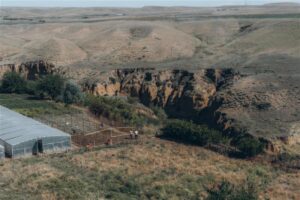
The two planned southward extension projects of the East–West Highway primarily affect Marneuli municipality, which is home to a majority ethnic Azerbaijani population. This community has long faced structural discrimination and social exclusion, resulting in restricted political participation, inadequate access to basic public services, and unresolved land issues and language barriers. Women in particular face intersecting vulnerabilities, including high rates of early marriage, limited educational and economic opportunities, and a lack of protection from state violence.
Although construction has yet to begin, the project has already significantly impacted communities along the Algeti–Sadakhlo and Rustavi–Red Bridge routes. Hundreds of households have been affected, with some reporting harassment by the Roads Department. There has also been a widespread lack of information and consultation, and many residents have reported inadequate compensation.
Disregarding cultural heritage
The construction of the Kvesheti–Kobi Road has exposed serious and persistent failures in the protection of Georgia’s tangible and intangible cultural heritage. Damage to the Khada Valley – widely known as the ‘valley of 60 towers’ and recognised for its exceptional historical landscape – illustrates systemic shortcomings in heritage safeguarding.
Despite early warnings from experts and civil society, the project advanced in the absence of adequate cultural heritage assessments. In 2023, the ADB’s Compliance Review Panel concluded that ADB management had failed to conduct proper due diligence, including the preparation of a comprehensive inventory of physical cultural resources and an assessment of the valley’s cultural significance. In the same year, the EBRD’s Independent Project Accountability Mechanism found that EBRD management had failed to verify the existence of an up-to-date cultural heritage study and ensure proper stakeholder identification or meaningful public consultation.
The scale of these omissions is striking. An environmental permit issued in 2019 identified just 34 heritage sites. Following sustained pressure from civil society and heritage specialists, additional studies in 2020 uncovered a further 155 sites. The International Council on Monuments and Sites (ICOMOS) had already warned in 2020 that the valley’s heritage was at risk. As of 2026, most of the identified sites still lack formal protected status, leaving them without enforceable legal safeguards.
A Khada Valley development plan and accompanying cultural heritage reference plan were eventually approved in 2024, but only after intervention by the ADB Accountability Mechanism during the compliance review process, and after significant damage had already occurred. While these documents offer a framework for future protection, they cannot remedy the harm already caused by earlier failures in project design and oversight.
The lessons of the Kvesheti–Kobi Road, meanwhile, remain unheeded by the Roads Department, which continues to advance new projects in sensitive areas without proper due process or adequate consideration of harm to cultural monuments.
One such project involves the reconfiguration of a section of the East–West Highway through and around Mtskheta, Georgia’s historic former capital and home to some of the country’s most cherished UNESCO-listed heritage sites. Proposed road widening, tunnel construction, and alignment changes threaten the setting of Jvari Monastery through visual intrusion, landscape fragmentation, and increased traffic pressure. Despite formal objections from heritage authorities and requirements for comprehensive impact assessments, heritage considerations continue to be treated as secondary to financial and engineering priorities – a procedural formality rather than a binding constraint.
Latest news
Bypass: the hidden social toll of Georgia’s East-West Highway on its towns and villages
Story | 5 May, 2025Supported by international development banks and promoted as a strategic corridor linking Asia to Europe, Georgia’s East-West highway is central to the country’s ambitions of becoming a regional transit hub. With a price tag of EUR 1.2 billion, much of which is financed through loans from the Asian Development Bank (ADB), European Investment Bank (EIB), and the World Bank (WB), the highway construction project was framed as a symbol of progress, promising speed, connectivity and economic growth.
Read moreThe promise and perils of Georgia’s East–West Highway project
Story | 2 May, 2024Georgia’s East-West Highway construction project, once heralded as a symbol of progress and splendour, has been marred by controversies.
Read moreThe Georgian Road to Russia: when everything goes south
Blog entry | 3 August, 2023The North-South Corridor, widely promoted by international financial institutions, aims to facilitate the transport of goods as the ‘only land access to the Russian Federation’, as well as to Iran, Armenia and Azerbaijan, running through Georgia. Yet the project impacts the cultural heritage of picturesque landscapes in Georgia without answering the major question raised Georgian taxpayers – why should they pay for a new road to Russia, a country that does not have diplomatic relations with Georgia, has occupied Georgian territories, and presents one of the major obstacles to Georgia’s European future?
Read moreRelated publications
Georgia’s East–West and North–South road projects: The billion-dollar infrastructure gambles that should make the ADB think twice
Issue paper | 29 April, 2026 | Download PDFThe East–West Highway and the North–South Corridor – two of Georgia’s most ambitious road projects supported by the Asian Development Bank (ADB) – have had devastating social, environmental and cultural impacts.
Fallout and failures: EIB’s East–West Highway investments in Georgia amid authoritarian takeover
Briefing | 17 October, 2025 | Download PDFThe EIB’s massive EUR 1 billion highway investment in Georgia has proved disastrous for impacted communities due to the country’s authoritarian turn and chronic project mismanagement.
Highway of injustice: How EIB-financed East–West road projects in Georgia impact local communities
Field visit report | 13 October, 2025 | Download PDFIn 2021, the European Investment Bank approved EUR 106.7 million in funding for two major highway projects in southern Georgia. Field research revealed significant social and environmental issues in the affected municipalities.

