More than just a few bad apples: If public engagement matters, why isn’t the EBRD tracking it?
by Michaela Kožmínová and Nina Lesikhina, Bankwatch
Although the European Bank for Reconstruction and Development (EBRD) has a mandate to support the transition to democracy, data evaluating how well it performs this role remains scarce. Involving people affected by development projects in decision-making processes is an essential part of this transition, in line with the UN Sustainable Development Goals. However, the EBRD’s reporting on its engagement with the public is limited.
Civil society organisations and accountability mechanisms have repeatedly highlighted EBRD-financed projects in which the people affected have been marginalised, consultations have been superficial, and grievances have been ignored. In some cases, individuals who have had the courage to speak out have faced retaliation. These are not isolated missteps or the work of a few bad apples, but rather recurring problems that result in serious harm to people and the environment. Our latest research identifies 38 such cases, raising a pressing question: How can the EBRD ensure meaningful public participation if it doesn’t identify and learn from its failures?
Imagine a large international company backed by a public development bank arrives in your city or town with plans for a transformative development project – the construction of a new road, for example. As someone who lives and works in the area, you – along with your family and neighbours – are likely to be significantly impacted by this project.
Naturally, you’d expect to be kept informed about all the project details as soon as possible, have the opportunity to contribute to important decisions such as choosing the project location, and be able to raise any grievances safely. You might also feel more confident knowing the company or investors had tracked concerns raised by locals on previous projects, analysed what went wrong, and learned from their mistakes.
Unfortunately, this is not always the case. Despite some policy improvements, the EBRD has yet to commit to ongoing and vigorous monitoring of public participation at the project level, and to publicly reporting on these issues as part of its impact measurement.
Impact starts with monitoring what’s broken
Earlier this year, we reviewed publicly available information to establish how the EBRD monitors and reports on stakeholder engagement across its operations. Our analysis revealed that information on EBRD reporting of public participation practices at the project level, as well as evidence of institutional learning from past mistakes, is largely lacking. The EBRD’s project information pages contain no updates on the implementation of stakeholder engagement plans, and the Bank’s impact reports do not include data on how its operations impact public participation practices in the countries where it operates.
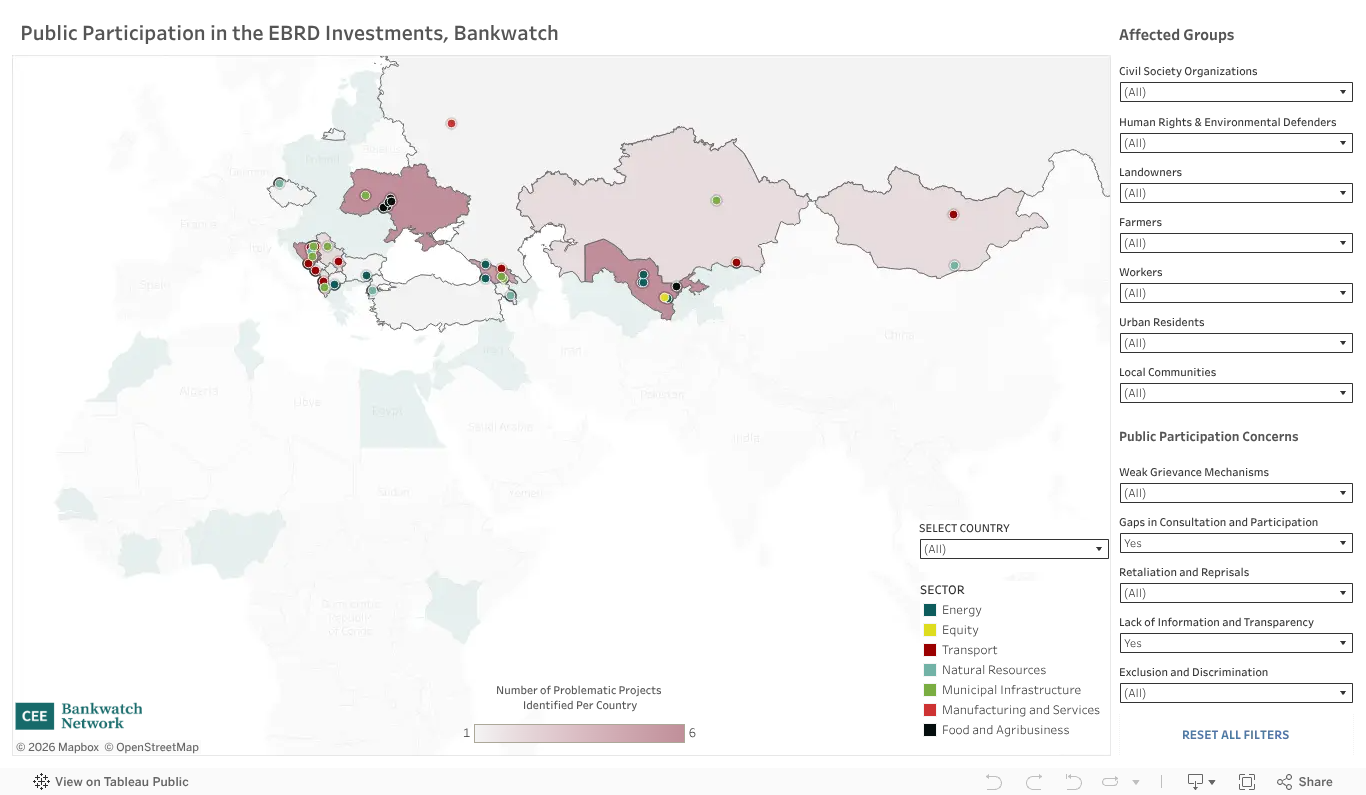
To demonstrate the value of this missing data, we gathered our own data on EBRD projects. With the help of our colleagues (including civil society organisations) and drawing on information from the EBRD Independent Project Accountability Mechanism (IPAM) Registry, we compiled data on 38 projects across 15 countries financed by the EBRD between 2009 and the present. Using this data, we created a demonstration map to visualise emerging patterns related to concerns around public participation. The map provides detailed information on specific EBRD-backed projects, along with references to sources and public monitoring reports. For the full methodology, dataset and analysis, see our briefing.
Different contexts, same issues
Bankwatch has decades of experience monitoring EBRD projects and supporting local communities and civil society organisations in voicing their concerns. While notable EBRD projects, such as Corridor Vc and Indorama Agro, have been on our radar for years, new projects continue to emerge, raising issues and complaints that we have seen all too often.
Indorama Agro: Uzbekistan’s infamous cotton project
The Indorama Agro project – a USD 130 million investment by the EBRD and the International Finance Corporation (IFC) to modernise cotton farming in Uzbekistan – illustrates how the absence of public participation can result in serious harm. Affected communities, primarily Uzbek farmers and workers, were given only limited access to information on land consolidation, environmental and social risks and expected impacts on their livelihoods. No meaningful outreach was conducted through the media channels commonly used in rural Uzbekistan. Public consultations were moved online during COVID-19, but limited internet access prevented communities from engaging, while leaflets and feedback forms were inadequate.
Stakeholder engagement plans were unavailable or not updated, and neither Indorama Agro nor the local authorities conducted consultations before approving large-scale land transfers. Workers and independent monitors faced intimidation, dismissals and surveillance, while ineffective grievance mechanisms and power imbalances excluded rights holders from assessments, monitoring and mitigation, leaving thousands without compensation. The first independent trade union established at Indorama Agro was subsequently dismantled through union-busting tactics. Despite sustained civil society engagement, no significant improvements were achieved. After a compliance review request and the launch of an IPAM investigation, Indorama Agro prepaid its loans and the EBRD marked the project as complete.
Corridor Vc: Persistent failures in public participation in Bosnia and Herzegovina
The EU’s flagship Corridor Vc motorway project in Bosnia and Herzegovina is being financed with over EUR 4.5 billion from the EU, the European Investment Bank (EIB) and the EBRD. Public participation in selecting and approving the current route south of Mostar was non-existent, and despite over 3,000 residents signing a petition against the 2016 valley route, communities were never consulted about its implications – including the loss of farmland, homes, biodiversity and cultural landmarks – before the spatial plan was approved in early 2017. At a January 2017 public meeting where the new route was presented, questions were dismissed, no alternatives were assessed, and the meeting ended in chaos.

The environmental and social impact assessment lacked information on route alternatives, the 2020 consultations saw limited participation due to COVID-19 restrictions, and concerns about the already approved routing were dismissed. Communities also reported illegal or non-consensual placement of markers on private property, while many people close to the route were neither consulted nor compensated. Many affected people have filed complaints domestically and internationally. In January 2024, IPAM confirmed that the route was chosen without consultation and that vulnerable groups were not properly identified.
Cínovec: Locals kept in dark on Czech–German lithium mine
One of the new projects drawing familiar scrutiny is the Cínovec lithium–tin mine on the Czech–German border, expected to process between 1.7 and 2.3 megatonnes per year and become the largest hard-rock lithium mining initiative within the EU. In 2022, the EBRD approved an equity investment of EUR 6 million in European Metals Holdings Ltd, an Australia-based junior mining company focused on developing the Cínovec deposit.
With operations due to begin as early as 2027, the mining company has largely kept local residents in the dark. In 2023, the company shared a completely redacted feasibility study and restricted meeting room access to a presentation on the project, preventing residents from obtaining detailed information. The revised feasibility study has yet to be released, and both affected communities and local authorities report that no meaningful engagement has taken place. They have also criticised the lack of transparency in decision-making processes, timelines, and the project-level grievance redress mechanism.
Such an approach risks excluding community interests and needs from the outset, leaving them with no say in influencing the project’s design or location. People potentially affected on both sides of the border continue to voice alarm over the project’s potential transboundary environmental and social impacts, including on water supply, chemical contamination, biodiversity loss, and landslides, which could put settlements like the historic villages of Cínovec and Zinnwald at risk. Additionally, local authorities have highlighted potential economic impacts on the region and its tourism industry, as well as the company’s failure to meaningfully engage with communities, which would have led to a better understanding and consideration of these risks.
What story do the numbers tell?
It should be noted that our analysis does not paint the full picture, nor does it attempt to do so. Rather, it should be viewed as an illustrative map showing what the EBRD can learn from public participation monitoring at the project level. The 38 projects analysed only cover a fraction of the EBRD’s total project portfolio, mainly due to restrictions on information disclosure and civic space, which make independent monitoring and raising concerns difficult in certain countries, but also to the limited capacity of Bankwatch and our civil society partners to compile a larger dataset.
While our data cannot tell the whole story, they reveal patterns that a development bank like the EBRD should continuously monitor, report and, above all, learn from. Without project-level monitoring, these trends remain invisible until they escalate into conflict, litigation or complaints filed with IPAM – by which time the damage is often already done.
Widespread public participation concerns
All 38 projects feature at least one concern related to: limited access to information, consultation gaps, exclusion, grievance mechanisms, retaliation, or enabling conditions. Yet in most cases, several of these issues overlap. This pattern reflects how projects marred by poor transparency and delayed information almost always conduct superficial consultations – often to the exclusion of vulnerable groups. Similarly, weak grievance mechanisms are associated with a higher risk of retaliation and intimidation against affected people and human rights defenders.
In 19 of the projects analysed, all of the following issues were identified: limited information on project risks and impacts, exclusion of rights holders from impact assessment and mitigation, reluctance to consider or incorporate their feedback, absence of public consultations before making key decisions, a lack of transparency in decision-making processes and timelines, and insufficient ongoing engagement by both the client and the EBRD throughout the project life cycle.
These findings suggest that weaknesses in stakeholder engagement are not isolated incidents, but rather recurring issues.
If the EBRD is serious about improvements in this area, it must first collect and report data showing the extent and trends of these shortcomings over time.
Furthermore, these patterns are consistent across sectors and project categories. Concerns occur in both category A (higher-risk) and category B (lower-risk) projects, indicating that public participation risks remain significant regardless of the overall environmental or social risk classification. Sectorally, the highest volume of issues is concentrated in the food and agribusiness, natural resources, energy, and municipal infrastructure sectors. Notably, private sector projects exhibit the greatest number of participation concerns across all sectors, suggesting weaker accountability compared to public sector projects.
No data, no problem?
Geographically, the highest volume of identified participation concerns is concentrated in Uzbekistan, Bosnia and Herzegovina, Ukraine and Georgia. In many other countries in which the EBRD operates, no problematic projects were reported by civil society or registered with IPAM. However, the absence of reported issues in these countries – which may reflect restricted civic space, limited awareness of IPAM (since EBRD clients are not required to inform affected stakeholders), or fear of retaliation – should not be equated with an absence of problems. Therefore, regular and effective monitoring of public participation practices at the project level, assessed within the specific country context, is crucial for determining whether these practices are realistic and truly meaningful.
Good apples, scarce supply
Although limited, some positive examples of meaningful stakeholder engagement at the project level were identified among the cases reviewed. These include occasional joint site visits involving multiple stakeholders in Uzbekistan, thematic engagement in Bosnia and Herzegovina, and dedicated forums in Georgia designed to facilitate dialogue between public institutions, service providers, and affected rights holders. In some urban mobility projects, the EBRD was perceived as more accessible and willing to engage than local authorities, or as playing a constructive role in facilitating engagement between local authorities, clients and communities.
Yet while these examples illustrate elements of constructive practice, such as a willingness to meet, share information or participate in facilitated dialogue, they remain the exception rather than the norm. Consistent monitoring and reporting of such examples could encourage implementation of such practices on a more systematic basis across the EBRD project portfolio.
Recommendations
For years, Bankwatch has raised concerns over public participation and repeatedly called on the EBRD to improve its approach to information disclosure, engagement with rights holders in project due diligence, and retaliation prevention across its development projects. Some of our calls have been partially reflected in the EBRD’s revised good governance policies.
Now is the time for the EBRD to systematically monitor and report on both its improvements and failures in public participation – and to continuously learn from these outcomes. Our analysis can provide inspiration to get the ball rolling. Here are our recommendations:
- Introduce project-level monitoring indicators covering access to information, quality of dialogue, inclusion, safe space, grievance effectiveness, and participation outcomes.
- Require clients to report regularly using standardised templates.
- Verify client-supplied information through engagement with rights holders and civil society.
- Publish annual portfolio-wide participation analyses to identify risks, trends and learning opportunities.
- Integrate participation indicators into governance and impact scorecards.
- Leverage participation trends as a proxy for civic space and democratic governance in country strategies.

