Skopje’s EBRD-backed bus rapid transit losing benefits before it’s even built
11 November 2026
Story by Davor Pehchevski, CEE Bankwatch Network
Six years after the European Bank for Reconstruction and Development (EBRD) approved a loan for Skopje’s bus rapid transit, the project is finally moving forward. What is not moving forward is the city’s and the EBRD’s understanding of what modern, clean and intermodal public transport looks like.
The story of the bus rapid transit (BRT) system in Skopje, North Macedonia, began in 2019, when the City of Skopje was preparing its Green City Action Plan with EBRD support. The plan was drawn up without transparency or public participation from the very beginning, and it was during this process that the city dropped its plans for a tram system in favour of BRT.
In November 2020, the EBRD approved a EUR 70 million loan for the project, and in April 2021, when the loan was signed, the city presented the concept design. It set out two main lines, east–west and north–south, with depots at their ends. The high-capacity buses were supposed to be hybrids running on compressed natural gas (CNG) and electricity, able to move large numbers of people across the city quickly.
It looked good on paper, but several local initiatives opposed the concept, mainly because the original plan would have destroyed much of the green space in the middle of the boulevards and placed the BRT lanes on top of Skopje’s main water supply. They asked for alternatives and further studies to find a better long-term solution. Just as that debate was developing, a new city administration took office after the October 2021 local elections, and the project was put on hold for four years.
After the October 2025 local elections, the third city administration since the loan was signed revived the project. There were no new consultations or studies, just a unanimous decision by the city that, having heard the earlier concerns, it would move the BRT to the leftmost lanes of the boulevards. But no one considered the consequences of this seemingly simple decision.
Urban space is limited
In September and October 2026, the city published tenders for the design and construction of the first line, running east–west from Gjorche Petrov to Novo Lisiche, and for consultants to support its project implementation unit. The cycling group NaTochak, which has campaigned for better conditions for cycling and walking in Skopje for close to 15 years and is known for its fact-based arguments, reacted to the tender criteria. In a 2 October 2026 letter to the city, it warns that the lack of consultation on the BRT design will degrade pedestrian and cycling infrastructure.
Using detailed cross-sections of the boulevards, the group shows that the streets are not wide enough for everyone. Putting the BRT in the leftmost lanes means partly sacrificing either the roadside greenery and tree lines or the cycle paths and pavements. Alternatively, cyclists and pedestrians will be forced to share the same space in substandard conditions, and the very people who need the BRT will struggle to reach it.
How the 2026 BRT concept would change the pavements and cycle paths on Partizanski Odredi Boulevard in Karpoš (video: NaTochak)
The tender documentation asks the contractor to ‘specially plan integration and continuity of the pedestrian and bicycle traffic within this project’. But as the video above shows, integration and continuity do not necessarily mean better conditions, or even keeping the current ones. These boulevards are among the few places in the city where many people walk and cycle, and that must be preserved.
The letter raises other concerns too, such as how the BRT will connect with regular buses and the new city train, whether passengers can bring bikes or scooters, and how accessible stops in the middle of the boulevards will be.
All of this could be resolved if the project were developed together with everyone who uses these streets. Instead, the tender asks the contractor to design the line in segments and start building each one as soon as its design is approved. This design-and-build approach leaves no room for consultation, or even for presenting the full design, before construction begins.
1990s technology for 2026 project
When the EBRD approved the loan, it left the choice of buses open: either CNG or CNG–electric hybrids. The city initially opted for hybrids, partly because one of the project’s main aims is to reduce air pollution.
At some point between 2021 and 2026, this changed and, according to the tender documentation, the new BRT buses ‘will be powered by compressed natural gas (CNG)’. Instead of looking ahead and adapting the project to decarbonisation goals with fully electric buses, city officials are falling back on 1990s technology. This exposes the city and its residents to volatile fossil gas prices, even though the project should be cheap, accessible and easy to maintain. Ironically, in August 2026, the Ministry of Transport signed a contract for 150 electric buses, around 100 of them for Skopje, which will run in parallel with the BRT. The contract also includes 75 chargers.
The tender documentation tries to justify this choice by pointing out that Skopje’s public transport company, JSP, already runs CNG buses, ‘has the capacity to maintain CNG vehicles’ and has ‘a long-term supply contract with the sole CNG supplier through the gas grid’.
But these cannot be the only factors behind the decision. If the project is to reduce air pollution, it must consider all pollutants, and even the most modern CNG buses emit significant amounts of methane, ammonia, nitrogen oxides and carbon monoxide. In real-world tests by the European Commission’s Joint Research Centre, a CNG city bus exceeded the limits proposed for the next EU emissions standard for all four.
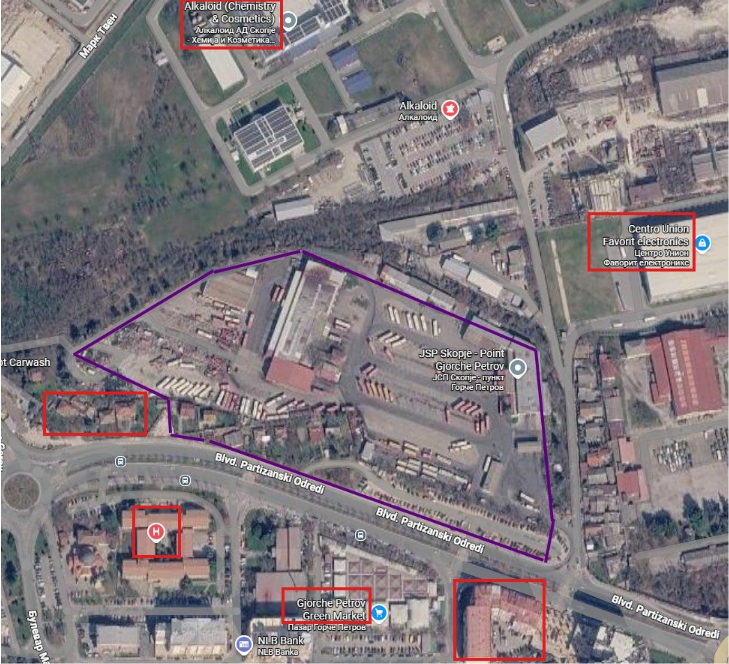
The current plan also raises serious safety concerns. The gas tanks, refuelling stations and CNG compressors are to be located at the depots at either end of the first line, both of which are in residential areas with homes, hospital clinics, schools, sports fields and industry nearby. With the expected volume of bus traffic, the fast refuelling needed to keep services on schedule and the large above-ground CNG installations, the risks are very high. JSP buses have caught fire at least five times since 2018 – in Kisela Voda, Nerezi, Sopište, Vodno and Gjorche Petrov – so the public has every reason to be concerned.
Restructuring Skopje’s entire public transport system should be a long-term solution. Running it on a fossil fuel with high environmental, social and safety risks make no sense in 2026. And since the chargers for the new electric buses are already going in at the Gjorche Petrov depot, why not use them for the BRT as well?
Accessibility only for the privileged
The plan set out in the tenders also raises serious concerns about the safety and accessibility of the platforms. The city wants ‘users to purchase/validate tickets prior to boarding the BRT’, possibly through a system that ‘may require physical barriers restricting platform entry’. The documentation itself recognises that this ‘could be a safety issue if the available space is insufficient to provide refuge to pedestrians not crossing at designated locations’. Even people who cross at designated places will find the platforms in the middle of very busy boulevards, so keeping them off a platform until they have validated a ticket could put them in high-risk situations.
And what would physical barriers mean for people with disabilities and parents with pushchairs? Will they be able to reach the platforms at all? And what about older people who need more time to cross the street and validate their tickets?
These are questions the city, as the project promoter, needs to discuss with the public, designing solutions that meet everyone’s needs. They are not decisions to be made on a whim.
In the last ten years, the number of trips taken on Skopje’s public transport system has dropped from 52 million to 22 million per year. It will take a lot of effort to regain the trust of citizens in public transport, and the first step towards this is to make it accessible to all.
Project for the people
The EBRD must not take these concerns lightly or simply accept the city’s rash decisions. Skopje will not get a second chance at this project in five years’ time, and once the BRT infrastructure is in place, there is little room for adjustment.
This is, first and foremost, a project that must serve the people of Skopje. Even if they are not traffic design experts, they know how they use the city’s streets and have needs that must be considered at the design stage. The final design must also be presented to them, opened to public consultation and adjusted to meet these needs.
Fossil gas must be removed from the project entirely. The EBRD should not support locking the city’s transit system into fossil fuel for decades, even before considering the safety concerns and the siting of the depots in residential areas.
The Bank has an obligation to make sure the project is environmentally sound, safe and accessible to everyone. The people of Skopje deserve nothing less.