
Ukraine Reconstruction Campaigner
Email:Tel.:
Anna is Bankwatch’s Ukraine Reconstruction Campaigner, working on green reconstruction and environmental safeguards in Ukraine’s recovery. Her work focuses on alternative sources of energy for communities, energy resilience, and the alignment of Ukraine’s energy policy and public investment management system with EU standards. Originally from Kyiv, she holds an MSc in Environmental Sciences and Policy from Central European University and is based in Bratislava.
More from
Green initiatives compromised by private equity
May 14, 2012 | Read more
A new greenfield gas cogeneration power plant Cogen in the north of Slovakia is planned to produce power and heat. It is to be financially supported by both the European Investment Bank and the European Bank for Reconstruction and Development through the private equity EnerCap Power Fund.
Bankwatch Mail 52
May 14, 2012 | Read more
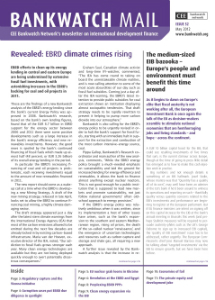
Issue 52 of our quarterly newsletter is a special double edition as this week sees the annual meetings of two of our target institutions, the EIB and the EBRD. Both banks are attracting widspread coverage: the EIB for its potential role in a belated EU-wide drive for growth; the EBRD as it prepares to extend its operations beyond central and eastern Europe into the North Africa region and as it decides on a new president.
Kiev-Chop road rehabilitation
May 14, 2012 | Read more
The rehabilitation of Kiev-Chop road project that received support from the EBRD and the EIB (each EUR 200 million) was supposed to rehabilitate the M06 Kiev-Chop Highway to European standards. Although the project was rated Category B (without significant adverse environmental impacts) it has seriously affected the life of the villagers of Bolyarka and Berezivka (Vasilivsky district, Zhitomir region) that are located along the rehabilitated road. The briefing is based on a letter sent to the EBRD’s Environmental Department in April 2012.
Linked to a slew of controversies, the Kolubara lignite mining project in Serbia is in line for support from European public banks. Corruption allegations, pollution at local level, irregularities in resettlement of local populations and not to forget a climate damaging approach to energy investments should be reason enough to find alternative options.
The letter, sent shortly before the European Investment Bank’s annual meeting, calls on EIB governors to improve the EIB’s lending before increasing its capital base as a response to the European crisis. The letter argues that in order to offer a long term solution, EIB backed projects should be economically, socially and environmentally sustainable. Right now this is not the case.

