
Economic justice policy officer
Email:Tel.:
More from
This comprehensive analysis of draft government spending plans for the allocation of EU budget money shows that central and Eastern European countries are planning to use unacceptable amounts of their €350 billion allocation on dirty energy projects, polluting forms of transport and incinerators. The study was published by CEE Bankwatch Network and Friends of the Earth Europe. See also this interactive visualisation of the spending plans.
Brussels, December 11 – Central and Eastern European countries are planning to use unacceptable amounts of their €350 billion allocation from the EU budget on dirty energy projects, polluting forms of transport and incinerators, according to a comprehensive analysis of draft government spending plans published today by CEE Bankwatch Network and Friends of the Earth Europe.
With climate protection set to be a high priority for the EU in the next five years and beyond, the EIB needs to streamline climate considerations across its lending to different sectors and in different regions as quickly as possible. Such a policy needs to deliver on multiple objectives, with the combating of climate change and the promotion of sustainability absolutely central to these.

Herders in the Mongolian Gobi Altai mountains are facing pollution and displacement by an iron ore mine. The mining company Altain Khuder responds to criticism with intimidation. The financier, the European Bank for Reconstruction and Development, is not doing enough to protect herders’ rights.
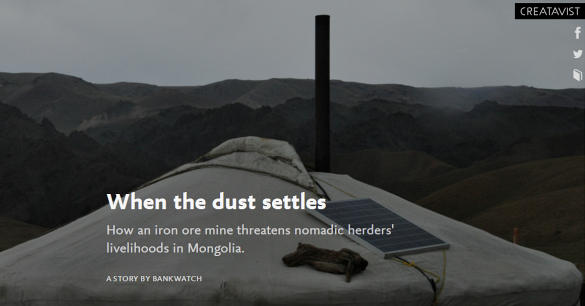
This report from a fact-finding mission to the Gobi Altai mountains in Mongolia describes the impacts the Tayan Nuur iron ore mine has on local nomadic herders, including displacement, dust pollution resulting in diminished livestock, and more. While the mining company Altain Khuder responds to criticism with intimidation, the company’s financier, the European Bank for Reconstruction and Development, is not doing enough to protect herders’ rights.