For coal-dependent communities in the Western Balkans, the launch of the JET Balkans project marks a welcome end to more than two years without a dedicated regional support platform. But with political commitment, funding and transparency still in short supply, local authorities and civil society are wondering whether the initiative can turn planning into meaningful implementation, or whether it will repeat the shortcomings that have slowed just transition efforts across the region.
Nevena Smilevska, Just Transition Coordinator for the Western Balkans | 15 July 2026
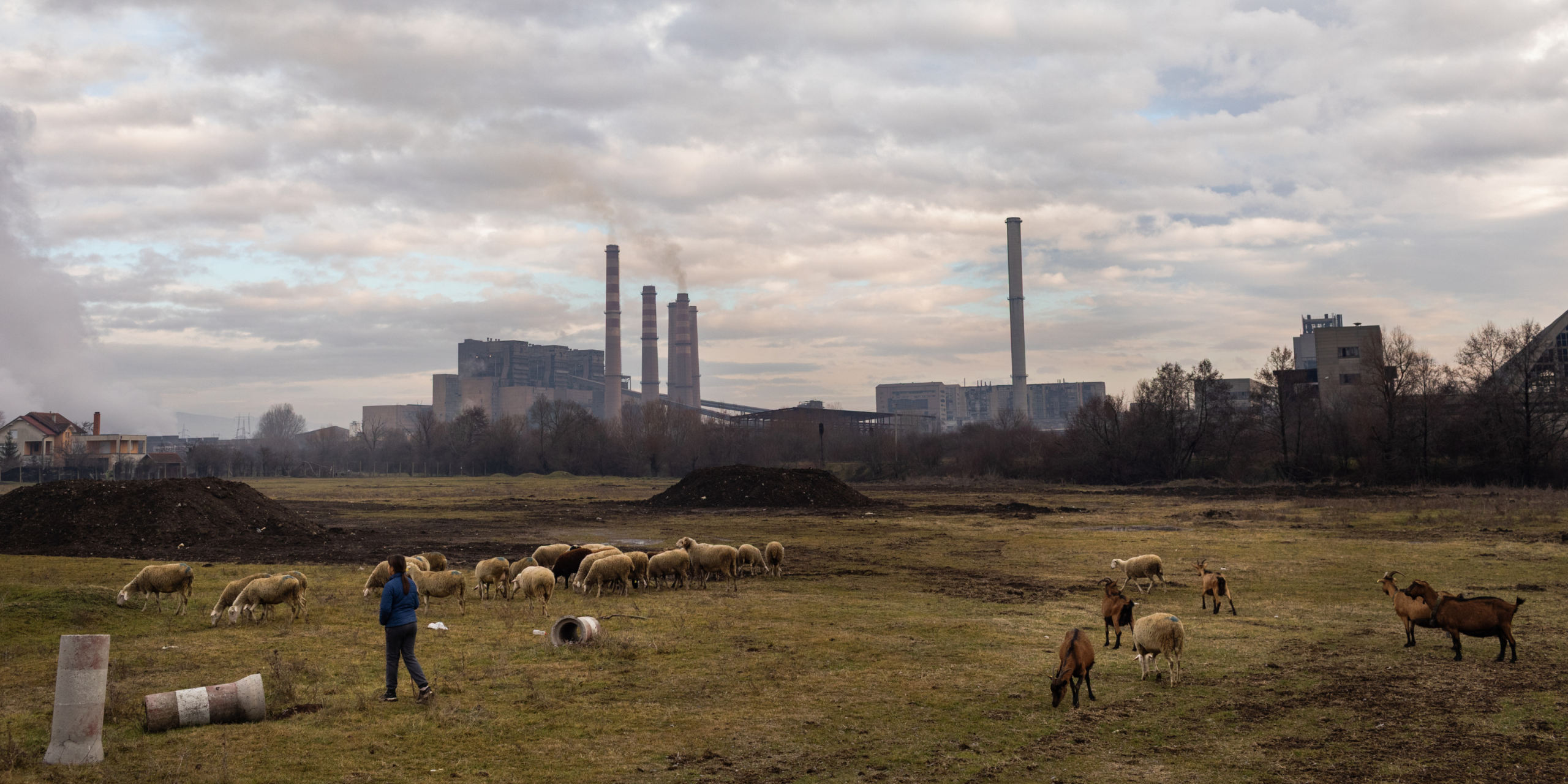
Kosova A coal power plant in Obiliq Municipality, Kosovo (photo: Matteo Trevisan, done as part of the photographic project More Necessary Than the Sun).
Local authorities, trade unions and other stakeholders affected by the just transition in the Western Balkans have been eager for a support platform ever since the Initiative for Coal Regions in Transition in the Western Balkans and Ukraine (CRiT WBUA) ended at the end of 2023. The initiative wasn’t perfect, but it did create some forward momentum.
Coal region redevelopment was again deprioritised in the Western Balkans after the end of the initiative, placing local authorities in the very difficult position of knowing what was coming but having very few options. With no dedicated EU funding stream, things were moving forward only in North Macedonia, where funding from the global Climate Investment Fund had been secured. But even there, progress remains limited.
Two and a half years later, although there is still no dedicated EU funding for the transition of coal regions in the Western Balkans, the long-awaited new support project has finally started.
JET Balkans project kicks off without key stakeholders
Implemented by Expertise France in partnership with the Slovenian Centre for International Cooperation and Development, the EUR 5 million project ‘supports the preparation of fair, credible and practical transition pathways by connecting evidence, dialogue, policy coordination, financing preparation and regional knowledge-sharing’.
At the kick-off event in Sarajevo in June 2026, high-level decision makers in the just transition field were notably missing. This was hardly surprising, given the lack of interest that governments have shown in the topic. However, what was more surprising was that there was only one representative from civil society. Civil society organisations have kept the topic alive during the vacuum period, actively supporting affected coal communities despite operating with very limited resources.
Lack of clarity at local level
The premise of the project is that the just transition is now an implementation challenge. It begins by mapping transition pressures, affected territories, sectors and groups. This is followed by policy alignment, alongside territorial and workforce support for workers, municipalities and local economies in the affected regions. The fourth component focuses on preparing financing pathways, developing project pipelines and implementing selected pilot projects.
Dialogue and cooperation are only the fifth component, which one can only hope will actually run throughout the entire duration of the project. It was emphasised that the project will build on what is already there, which is welcome considering that a lot has already been prepared. For the missing parts, the project will offer technical assistance for policy alignment, although what this involves is still unclear.
While the project team may have a comprehensive plan, the process would be much more productive if local stakeholders, including civil society at both local and regional levels, received more details about how the project goals will be achieved so that they can provide support. At this point, it is still unclear to the public what the mapping will look like and how policy alignment will be approached. While the added value of this project is that it foresees pilot projects, these are still a long way off, with the details yet to be decided.
What we need to move forward
The project’s setup, with a national coordinator in each of the six Western Balkan countries – even Albania, which doesn’t use coal in its energy sector – gives more hope for moving the just transition process forward from within the countries than the previous support platform did.
Still, as neither political will nor the promise of EU financial support for a just transition is present, implementation will likely be difficult. This makes it even more important to include local authorities in all activities, since they are currently the most interested in taking care of people in their communities. In 2024, several mayors from coal-dependent municipalities even signed a just transition manifesto that was sent to the Directorate-General for Neighbourhood and Enlargement, asking for support for the process.
Broader groups of local people must also be included and consulted as much as possible, as must civil society organisations, which continuously follow and support the process on the ground.
To put local people’s valuable experience to meaningful use, they and other civil society stakeholders need clarification on:
- what can be expected from the mapping carried out as part of the project;
- which policies will be aligned and with what, so that civil society can prepare to provide input in a timely manner; and
- what can be expected from pilot projects and project pipelines.
Our previous asks from the CRiT WBUA initiative still apply to the JET Balkans project:
- Presence on the ground is key. Events should be held in coal regions, not only in capitals, and should not always be associated with energy- and climate-related issues. At the local level, the just transition is a development challenge first and foremost.
- Existing knowledge and expertise should be used whenever possible. The work carried out by civil society during the vacuum period – for example, a declaration by Serbian civil society and the Vision for Bitola initiative developed by Eko-svest in North Macedonia – is key to preparing up-to-date redevelopment plans and projects.
- Supporting local stakeholders, particularly trade unions, but also directly workers and their families, in understanding their role in the redevelopment of their region is what will move this process forward or halt it completely. It’s up to the platform to facilitate the participation of all affected groups and up to civil society to support this, provided timely cooperation exists.
- Local redevelopment plans for the regions, equivalent to the EU’s territorial just transition plans, should be drafted and include a pipeline of redevelopment projects. Education of the new workforce should feature prominently.
- Any funding channelled by this or any other just transition support mechanism must be conditioned on these local, participatory plans, exclude any kind of support for fossil fuels, and incentivise reasonably fast coal phase-out dates.
We and other civil society groups working on the just transition in the Western Balkans are looking forward to working with the new support platform to give the process a much-needed boost.
Never miss an update
We expose the risks of international public finance and bring critical updates from the ground – straight to your inbox.
Theme: Coal | Balkan coal | Coal in the Western Balkans | Just transition | Social justice
Location: Albania | Bosnia and Herzegovina | Kosovo | Montenegro | North Macedonia | Serbia
Project: Coal in the Balkans
Tags: balkan coal | coal | coal in the Western Balkans | just transition | social justice

