The highly damaging hydropower project could hardly have had stronger political support at its inception, with the country’s parliament passing a special law in 2021 to appoint U.S. construction giant Bechtel as the main contractor. But four years later, the project has stagnated, with no environmental permit and no financing.
Andrey Ralev, Biodiversity campaigner | 24 November 2025
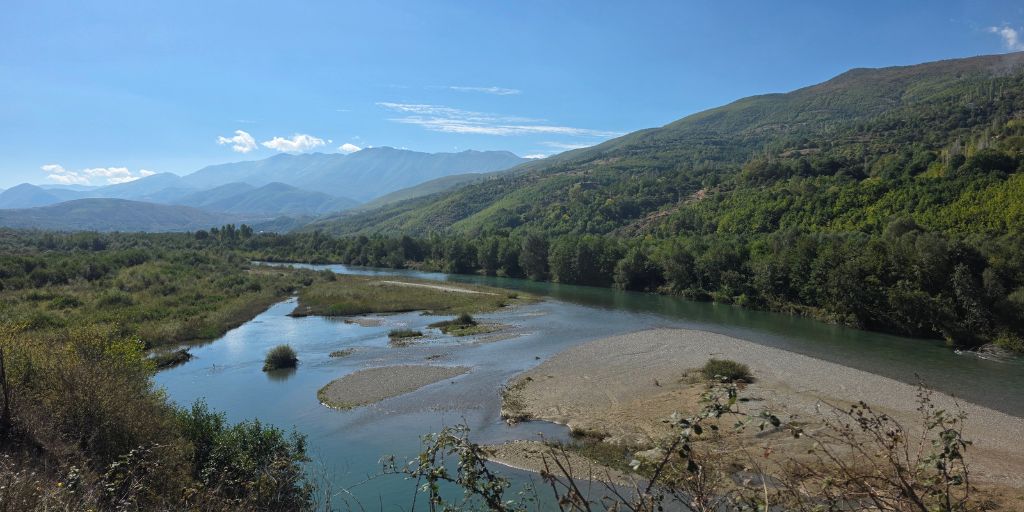
Two seemingly unrelated pieces of news have appeared regarding Albania this autumn. On 4 November 2025, the European Commission’s Enlargement Package, which shows progress towards EU membership, was published, stating that ‘The environmental risks of the Skavica hydropower plant project to ecosystem and local communities persist’.
A week earlier, an investigation against the deputy premier and infrastructure minister Belinda Balluku by Albania’s Special Structure Against Corruption and Organised Crime (SPAK) became public. The investigation is for violating tender rules, linked to the construction of a road in 2020.
Minister Balluku has also been one of the loudest supporters of the Skavica dam, a highly damaging project that would flood the Dibër valley, impact up to 15,000 hectares of land, displace several thousand people and bring the Balkan lynx to extinction.
Among others, she was at the signing ceremony of the contract between US construction giant Bechtel and the Albanian Power Corporation (KESH) for project documentation and preparatory works after a special law was adopted in the Albanian Parliament in 2021. The law chose Bechtel for the design and construction of the project – without a tender. But even this high-level political support has not been enough to get the project off the ground.
Environmental impact assessment rejected
After the initial contract was signed with Bechtel, the Skavica project looked like it was being fast-tracked. The technical investigation, building access roads for construction and project documentation were done relatively quickly and an environmental impact assessment (EIA) was submitted on 1 March 2023 to the National Environmental Agency (NEA). From January until July 2023, the NEA and KESH engaged in a process to address missing information and documents. However, according to the Albanian government, KESH’s application was rejected:
‘Conclusively, the subject has not completed the necessary documentation within the 15-day deadline, resulting in an automatic rejection of the application by the system. For this reason, the subject needs to restart the procedures from the beginning’, states the government’s report to the Bern Convention.
As of November 2025, KESH has not re-applied for a full EIA process with the environment agency.
Access roads abandoned
 |
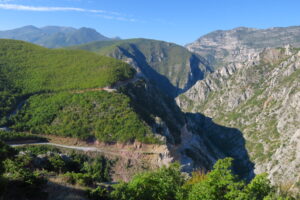 |
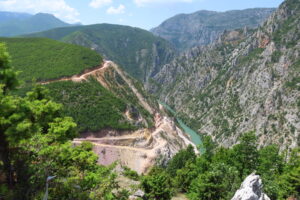
| July 2022 | October 2025 |
Our visit to the dam site in October 2025 showed that after access roads were built and geological surveys were carried out in early 2022, highlighting serious problems for dam construction, nothing has been done. There were no workers nor security guards, the vegetation was recovering and the access roads were becoming inaccessible due to lack of maintenance.
A local person from Fushë Çidhën, a village of 200 houses, 90 per cent of which could be flooded if the Skavica dam is built said: ‘Bechtel people were in the region 3 years ago, there is almost no talk about the project since then. Back then, and even now, people can’t openly speak up against the project because they are afraid the government might take away their social assistance that is vital for their survival’.
Another person from the Dibër district’s main town, Peshkopi, added: ‘The project seems to be stopped, not a priority. There are no talks about it, not even in the government. Nevertheless, the government might still try to build the dam and the local people should not only be supported to stop it, but also to develop ideas for tourism and agriculture development as a good and sustainable resource for their wellbeing.’
Investment banks not interested in the project
In January 2025, the Albanian government informed the Bern Convention about the potential lenders for the construction of the Skavica hydropower plant, including the World Bank, the Multilateral Investment Guarantee Agency (MIGA), UK Export Finance (UKEF), and the Islamic Corporation for the Insurance of Investment and Export Credit (ICIEC). As part of its progress report on the case file, the government reported that KESH had engaged a financial adviser, Ernst & Young, to assess the project’s financial and economic feasibility and to support discussions with potential lenders.
We sent letters to the World Bank, UKEF – which organised a Skavica Supplier Fair in 2022 – and the US Development Finance Corporation (DFC) which was mentioned by the Albanian government as a potential lender in 2021.
The World Bank and DFC’s responses confirmed that the banks are not currently considering the project, while UKEF underlined that the fact it organised a fair associated with the project was ‘in no way a guarantee of UKEF support for the Skavica hydropower plant’.
These responses show that funding is far from secured. Moreover, as resettlement costs are uncertain with most of the houses in the Dibër district without property documents, the real cost of the project is anything but predictable.
It’s the right time to abandon the project and protect the Dibër valley
As we warned in 2022, the Skavica dam is the last thing Albania needs. With construction costs rising to over USD 1.5 billion, its EIA rejected, the Constitutional Court highlighting the lack of public consultations and a lack of support from the EU and international financial institutions, it’s the right moment to cancel the project.
Bechtel’s selection without a tender practically guarantees that the dam would be overpriced, and it can only be a matter of time until the project attracts SPAK’s attention, if it hasn’t already.
Recent studies have shown that the Dibër valley and the Upper Black Drin deserve to become internationally-recognised protected areas. The alluvial forests along the Drin are the largest in Albania. With the forests in the region recovering quickly from previous clearances, Dibër could become the greenest district in Albania. The variety of protected species and the mosaic of natural and seminatural habitats make the area an ideal candidate site for the Emerald and Natura 2000 networks – Europe’s networks of protected areas.
It will only get harder to build new hydropower plants in the future, due to higher construction prices, annual precipitation decrease, Dibër’s unique biodiversity and public resistance. With dozens of guesthouses and tourism development initiatives appearing in recent years, the government should finally end the suspense about the region’s future and choose the path of small-scale sustainable development.
The project benefits from the support of the Donors Initiative For Mediterranean Freshwater Ecosystems.
This document was produced with the financial assistance of the Donors Initiative For Mediterranean Freshwater Ecosystems. The contents of this document are solely the liability of CEE Bankwatch Network and under no circumstances may be considered as a reflection of the Prince Albert II of Monaco Foundation or Donors Initiative For Mediterranean Freshwater Ecosystems’ position.
Never miss an update
We expose the risks of international public finance and bring critical updates from the ground – straight to your inbox.
Theme: biodiversity, hydropower, river, Albania
Location: Albania
Project: Protecting rivers and communities | Protecting rivers and communities in southeast Europe
Tags: biodiversity | hydropower | river

