The European Bank for Reconstruction and Development (EBRD) failed to trigger its environmental and social safeguards as the City of Bishkek got rid of 131 trolleybuses purchased with loans from the Bank. Will any lessons be learned from this fiasco?
Fidanka Bacheva-McGrath, Bermet Borubaeva, | 16 July 2026
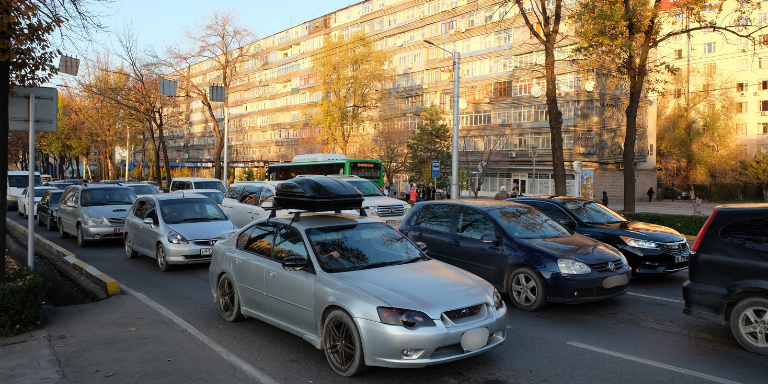
Traffic jam in Bishkek, Kyrgyzstan.
Wasted green investment
Between 2011 and 2018, the EBRD invested EUR 15 million in Bishkek’s public transport system through sovereign loans, helping the Kyrgyz capital expand its trolleybus network. Additionally, more than EUR 8 million in technical cooperation grants were approved, among other purposes, for the preparation of Bishkek’s public transport development strategy, the design of a new public transport route network, and a review of the city’s strategic planning documents, including its urban transport master plan.
In 2020, the EBRD provided an additional EUR 25 million loan to finance the rehabilitation of a bus depot and the purchase of buses running on compressed natural gas (CNG), co-financed with a capital grant of up to EUR 8 million to support implementation of a Green City Action Plan for Bishkek.
In April 2024, the City of Bishkek announced plans to replace the city’s trolleybus network with buses and transfer its trolleybuses to the City of Osh. Bishkek’s mayor said the transition would be supported by new financing from the Asian Development Bank (ADB), comprising a USD 25 million grant and a USD 25 million loan for the purchase of electric buses intended to replace 95 diesel and 25 outdated trolleybuses.
The removal of the capital’s trolleybus network began in June, although Bishkek City Council did not formally approve the transfer of 100 of these trolleybuses to Osh until August. By November, trolleybus services had been completely phased out, resulting in public transport shortages, increased use of car and CNG buses, worsening air quality and carbon emissions, loss of jobs for public transport workers, and reduced accessibility for passengers with special mobility needs.
The impacts of the reform of Bishkek’s public transport system over the past two years have been analysed by local researchers with the support of Bankwatch. Their findings show that ‘the fleet renewal alone has not made public transport genuinely attractive or efficient’, as only 18% of the active fleet can be described as fully comfortable, inclusive, safe and environmentally friendly.
Residents seek solution to no avail
Since May 2024, people in Bishkek have reached out to both the EBRD and the ADB, requesting information on the Banks’ positions regarding the loss of the city’s trolleybuses. They have raised concerns about the anticipated negative impacts of removing the city’s most inclusive and environmentally friendly mode of public transport, while demanding more transparency and public participation in decision-making.
In May 2024, an open letter signed by more than 1,600 people was submitted to the Bishkek mayor’s office concerning the planned removal of the trolleybuses and the Osh transfer. In June, when the city authorities initiated a perfunctory public consultation, local residents and environmental experts used the opportunity to submit 300 individual written appeals to Bishkek City Council demanding the retention of the trolleybus system. Beyond the consultation process, opposition to the decision continued through peaceful artistic protests, as well as legal action. Instead of engaging with local residents and the two banks, however, the city authorities responded with silence, with police blocking public gatherings and carrying out illegal detentions.
Yet, despite this official suppression, the protesters’ arguments received major legal backing from within the government itself. According to an official opinion issued by the Kyrgyz Ministry of Natural Resources, Ecology and Technical Supervision on 9 April 2025, the dismantling of the trolleybus system violated the Kyrgyz Republic’s Nationally Determined Contribution under the Paris Agreement and risked causing adverse environmental impacts.
In an update issued on 18 March 2025, the EBRD announced that the trolleybus fleet through its final loan would be converted into electric buses. However, no details or assessments were provided to the public, raising more questions than answers. By mid-2025, the EBRD’s Bishkek trolleybus loans had been repaid.
Accountability and remedy for harm
In August 2025, the environmental organisation Bishkek Smog submitted a complaint to the EBRD’s Independent Project Accountability Mechanism (IPAM). They requested a problem-solving process, provided that the Kyrgyz authorities agreed to engage voluntarily and in good faith in facilitated dialogue. Alternatively, they requested a compliance review to determine whether the EBRD had followed its 2008 Environmental and Social Policy (ESP).
Nearly a year has passed since the complaint was submitted, and with Bishkek decision makers unwilling to engage in a voluntary mediation process, it has become apparent that a facilitated problem-solving approach is no longer viable. Consequently, in a letter sent to IPAM on 1 July 2026, the requesters formally called on the mechanism to initiate a compliance review. This review now represents the main avenue for redress to determine whether the EBRD failed to follow its ESP, with the ultimate goal of developing a management action plan to remedy the harms caused by dismantling the trolleybus system.
What do requesters expect?
The August 2025 complaint, submitted on behalf of Bishkek’s affected residents, represents the interests of people with disabilities, women, young people, retired people, trolleybus company workers, and environmentalists, with support from by international organisations, experts and human rights defenders. The majority of these individuals requested confidentiality due to fears of reprisals.
They highlight the environmental and social harms resulting from the loss of the trolleybuses:
- violation of the right to access to information and public participation in decision-making;
- loss of jobs for trolleybus company workers without providing opportunities for retraining and employment on CNG or electric buses;
- increased air pollution in Bishkek, leading to health risks;
- negative climate impacts due to failure to deliver long-term greenhouse gas emission reductions;
- worsening reliability and quality of public transport services;
- expected higher costs and barriers to affordable public transport services;
- reduced accessibility for vulnerable groups, including people with disabilities, mothers and women (gender impacts); and
- damage to cultural heritage.
While the requesters acknowledged the EBRD’s limited leverage to influence decisions made by the City of Bishkek, they argue that, according to the 2008 ESP, the EBRD should have initiated an environmental and social assessment of the consequences of dismantling the trolleybus system, including impacts on air pollution and employment. Such an assessment was either not carried out at all, or not conducted transparently with the participation of those whose lives were changed for the worse.
The EBRD must be accountable for whether it took all measures available and required under its ESP to defend the public interest and ensure appropriate mitigation of adverse impacts resulting from significant material changes to its Bishkek transport projects.
Never miss an update
We expose the risks of international public finance and bring critical updates from the ground – straight to your inbox.
Institution: EBRD
Theme: urban transport
Location: Kyrgyzstan
Tags: cities for people | urban transport

