Romania’s energy crisis has laid bare the risks of relying on delayed gas projects to replace coal power. Meanwhile, battery storage has been developing much faster and is already providing much-needed flexibility. Even a state-owned coal company with designs on a gas power plant is now pursuing battery storage instead.
Raluca Petcu, Gas Campaigner | 30 September 2026
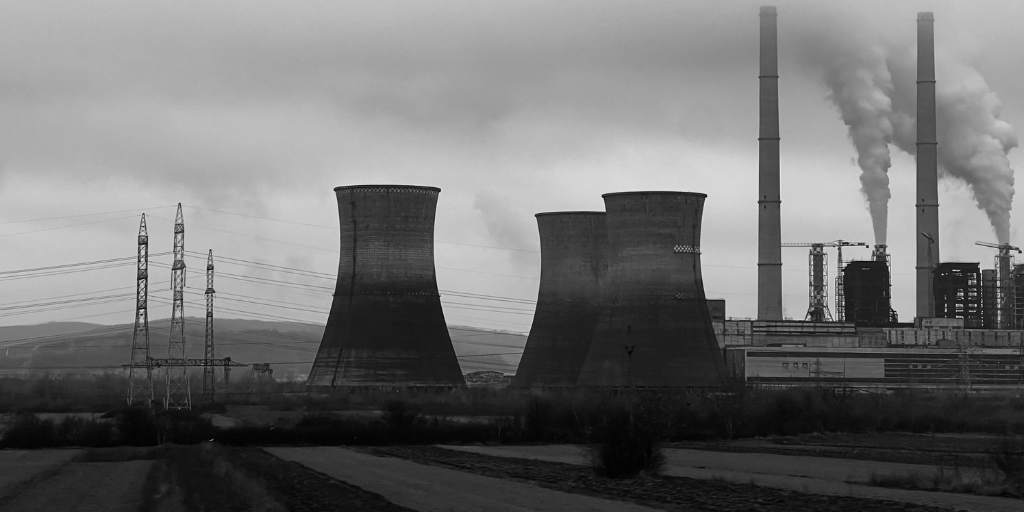
Turceni power plant in Romania (photo: Marius Vasile/Pexels).
In August and September 2026, drought pushed the Danube and other rivers to record lows, putting Romania’s energy system under severe pressure. Both reactors at the Cernavodă nuclear power plant were temporarily shut down, removing a source that normally provides 20% of the country’s electricity generation.
But drought wasn’t the only cause. Romania has kept closing coal units – 3 gigawatts (GW) since 2020 – without replacing them with enough flexible capacity. Most gas power plants set to replace coal have been delayed. And while renewable capacity has accelerated over the past six years by more than 6.9 GW, the storage needed to balance solar and wind has only taken off recently, with 1 GW installed mostly in the last year. Amidst the crisis, Romania has almost reached the official storage target it set for 2030.
Because of these delayed gas projects, the government has decided to postpone the closure of three coal units, which were due to shut by 31 August 2026 as set out under a target in Romania’s recovery and resilience plan. Meanwhile, parliament has backed a law banning the coal phase-out until the Turceni and Ișalnița gas plants – or other ‘similar’ undefined projects – are connected to the grid, blaming phase-out plans for the crisis. Romania’s president has challenged the law at the constitutional court.
How did we get here?
Romania had planned to replace most of the 3 GW of coal capacity retired since 2020 with new gas generation. By August 2026, it was supposed to have added 2 GW of gas capacity, but many projects have been delayed or cancelled.
The main coal power operator was due to replace its ageing plants with a 475-megawat (MW) gas plant at Turceni and an 850-MW gas plant at Ișalnița by 2026, as well as around 730 MW of solar on former coal landfills by 2024. All three projects were financed through the Modernisation Fund in 2022, with EUR 420 million for gas and EUR 470 million for solar.
None of them has been built. The Turceni tender has drawn just a single bid (yet to be accepted) from a consortium with close ties to the Chinese Communist Party. Additionally, construction costs have risen by 56% compared with 2022 estimates. The plant is now expected to be finalised by 2029, but under these conditions even that date seems overly optimistic.
Ișalnița tells a different story. The planned 850-MW gas plant was cancelled this year after multiple failed tenders and rising costs, with its board of directors opting to build 1 GW of battery storage instead. A feasibility study tender, launched in July, had received six bids by August.
A separate EUR 300 million recovery and resilience plan scheme for new gas-fired combined heat and power (CHP) plants also fell short: only two of the four projects were funded and completed, with the scheme eventually cut by EUR 215 million. Not a single coal-fired heating system was replaced in the process.
Storage market moving faster than policy
Beyond the immediate effects of drought and extreme weather, the energy crisis has exposed how heavily Romania has leaned on stalled gas projects. While struggling with these failed investments, the government has been slow to address the key element needed to integrate its growing renewable capacity: storage.
Battery storage only became part of government policy in 2024. The updated national energy and climate plan finally included a modest but necessary target of 1.2 GW of storage by 2030 (the 2022 version had none). Legislation to ease the integration of battery energy storage systems (BESS) was put forward in late 2024, and the first two publicly funded schemes for stand-alone projects were launched that same year. Romania has since opened calls worth around EUR 380 million from the Recovery and Resilience Facility and the Modernisation Fund, with the most recent launched in August 2026 at the height of the crisis. The two 2024 schemes were meant to support 1,980 megawatt-hours (MWh) of battery capacity.
Fortunately, the market understood both the need for storage and the profits it could bring, and so began developing projects at pace, even without public support. From zero projects in 2024, Romania had 1,094 MW of batteries (2,310 MWh) by September 2026. The crisis pushed developers to finish their projects and prompted national authorities to speed up licensing and grid connection. The 1.2 GW target for 2030 is likely to be exceeded by the end of this year.
Comparing gas power and batteries
BESS can replace gas-fired generation at certain peak times, especially during the morning and evening. Batteries balance renewable output and shift it to when demand is highest, cutting the need for extra gas generation.
They can also be built faster than gas plants, bringing clean flexibility within reach sooner. Romania is a case in point: although the country pinned its power strategy on large-scale gas generation and launched those projects early, the ‘energy security’ it promised never materialised.
Storage, despite its late start, has come on stream much faster and is already delivering. System data from Transeletrica, the national transmission system operator, shows that in August 2026 batteries discharged around 100 gigawatt-hours (GWh) of electricity, at times covering up to 8% of consumption during evening peaks – sometimes as much as coal. Together with electricity imported from battery storage in Bulgaria, BESS played an important role in managing Romania’s energy deficit.
Romania’s experience points to a realistic pathway for other EU countries to move from fossil fuels to renewables without relying on gas. An Ember study shows that scaling up batteries, vehicle-to-grid technology, and heat pumps could provide an alternative to regular gas back-up, ease pressure on the power grid, and lower peak prices.
An adequacy study commissioned by Transeletrica, which models multiple capacity scenarios, reaches a similar conclusion. It finds that up to 3.3 GW of additional storage is needed by 2030, which would allow gas generation to be limited to 3.6 GW and coal to just 70 MW. By comparison, Romania’s national energy and climate plan envisages at least 5.8 GW of gas generation by 2030.
But for this vision to become reality, Romania’s decision makers need to shift their focus from the failing coal-to-gas strategy to grid modernisation. Half the country’s transmission and distribution lines are at least 50 years old, smart metering is lagging, and policy and regulation to encourage demand response remain underdeveloped – all of which is holding back the next stage of the energy transition.
The European Commission’s recent call for candidate projects of common interest (PCIs) and projects of mutual interest (PMIs) in the electricity category is an opportunity to advance innovative cross-border projects. We hope to see more candidate projects from Romania, especially in storage, a category ignored entirely so far.
EU funding schemes and policies – central to these initiatives – should encourage Member States to embrace clean flexibility and reduce gas reliance. As EU institutions finalise negotiations on the next long-term budget, transforming the grid over adding large-scale capacity should be made a top priority.
Never miss an update
We expose the risks of international public finance and bring critical updates from the ground – straight to your inbox.
Theme: Fossil gas | Gas | Coal | Battery capacity | Battery Energy Storage Systems
Location: Romania
Project: Fossil gas
Tags: Battery Energy Storage Systems | battery capacity | coal | fossil gas | gas

