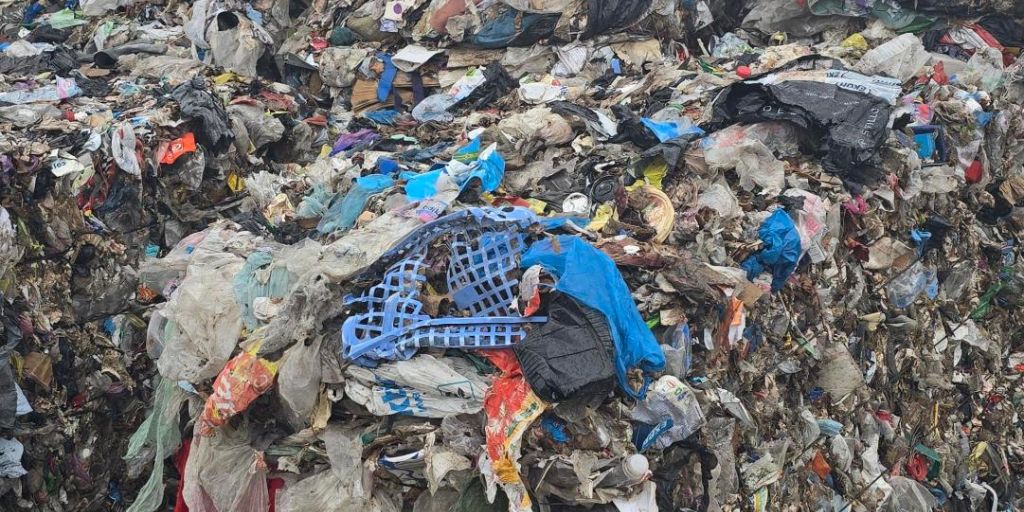
Sofia’s experience – an eight-year battle that led to the Bulgarian capital abandoning a major waste-to-energy project in 2023 – serves as a stark warning for other cities in the region, including Tuzla, Kakanj, Sarajevo and Podgorica.
Sofia’s failed incinerator project, halted due to documented health risks, unavoidable carbon dioxide emissions and crippling finances, demonstrates a critical truth: Waste incineration deepens dependence on a carbon-intensive economy, generates toxic residues and diverts crucial funding away from real, circular solutions. Unfortunately, these effects are all too visible across the Western Balkans.
Debt, toxins and missed EU targets
The push for incineration in the Western Balkans comes at a time when the region is moving towards a regulatory cliff edge. The EU’s Energy Efficiency Directive mandates that by 2030 at least 50 per cent of energy in the district heating sector must come from renewable energy or waste-heat sources. Yet today, a staggering 97 per cent of district heating in the region still relies on fossil fuels.
The Energy Community will soon transpose these binding obligations, posing an existential threat to the dozens of district heating utilities in Serbia (59) and Bosnia and Herzegovina (32), among others. By 2028, they will need to radically transform their energy mix – a near-impossible task if they lock themselves into new, long-term incineration projects that rely on co-burning waste – a process that destroys resources and fuels carbon dioxide emissions.
And the financial lock-in is no less severe. Incinerators shackle cities to decades of debt to repay their high capital costs, all while producing toxic ash that requires its own specialised and costly landfill.
Incineration versus recycling
Critically, the incineration pipeline directly undermines the Western Balkans’ legal obligations under the EU accession process. To align with the Waste Framework Directive, countries must achieve a 50 per cent municipal waste recycling rate by 2025. However, the region is already far behind. According to the Organisation for Economic Co-operation and Development, recycling rates in the Western Balkans remain critically low, with Bosnia and Herzegovina at 2.2 per cent, Serbia at 3 per cent and Kosovo at 2.5 per cent; data for Albania, Montenegro and North Macedonia are either missing or outdated. Separately, estimates from the Regional Cooperation Council place Albania at 18.5 per cent, while other Western Balkan economies remain below 5 per cent.
Investing in incineration creates a built-in incentive to burn recyclable materials simply to ‘feed the furnace’, actively working against the need to scale up recycling. It also locks Western Balkan countries into a high-emissions waste management system that makes achieving their 2025 and 2030 recycling targets practically impossible.
Incineration pipeline crisis
Despite these warnings, the Western Balkans are charging ahead with a dangerous pipeline of incineration projects, often in the face of public opposition. One example comes from Bosnia and Herzegovina, where Elektroprivreda BiH announced plans to conduct a co-combustion test using two per cent refuse-derived fuel at the Tuzla and Kakanj thermal power plants, which would have seen 100 tonnes of refuse-derived fuel or solid recovered fuel burnt alongside coal over two days. Following a stormy reaction from citizens and municipal representatives, the test was temporarily postponed, though the utility reportedly intends to try again.
At the regional level, the scale of the planned shift is alarming. According to an analysis by Deutsche Gesellschaft für Internationale Zusammenarbeit, the Western Balkans has almost no significant refused-derived fuel or solid recovered fuel production capacity. Only two mechanical–biological treatment plants currently produce refused-derived fuel or solid recovered fuel – one in Bosnia and Herzegovina and the other in Serbia – each with limited capacity.
By contrast, the region’s cement sector is already demanding exponentially larger quantities of alternative fuels. Bosnia and Herzegovina, for example, has started importing refuse-derived fuel from Italy, Austria, Croatia and Slovenia to meet this growing demand. This mismatch demonstrates that large-scale incineration requires the burning of mixed municipal waste, directly sabotaging circular economy goals.
A circular approach to waste management
The solution is not to burn, but to build. Sofia’s Han Borgov biological waste treatment plant showcases a viable, circular alternative. Instead of an incinerator, the city has invested in decentralised composting and small-scale anaerobic digestion. The plant’s two combined heat and power units (with a total capacity of 855 kilowatt electrical) uses the biogas it produces to generate electricity and heat. The facility also produces 12,000 tonnes of compost every year, distributed free of charge to citizens for gardening and reforestation.
Small-scale biogas systems like this can be environmentally sound provided certain conditions are met: feedstock is collected locally within 5 to 10 kilometres, no crops are grown solely for biogas production, energy is used on-site, and compost and liquid outputs are handled safely. When managed properly, such systems can convert local organic residues into energy and compost without the pollution and long-term costs of large-scale incineration.
Approximately 100 kilometres south of Sofia, the Bulgarian town of Blagoevgrad is applying a similar approach, putting sustainability into action with a nearly 16,000-tonne-per-year anaerobic digestion plant. Once operational, the facility will process separately collected food, garden and wood waste, serving around 100,000 residents across five municipalities. The plant will produce biogas for electricity and heat to power its own operations, and produce roughly 5,100 tonnes of compost annually, turning local biowaste into useful products rather than sending it to landfill. These examples show that small-scale, locally integrated systems can manage organic waste without the pollution and long-term costs of incineration.
Fund the future, not the furnace
Public money in the Western Balkans must be urgently redirected. Instead of funding polluting incinerators, governments, banks and EU institutions should prioritise investments in sustainable renewable energy sources for heating, alongside energy-efficiency technologies. This is the only viable pathway to meet EU directives, protect public health and build a resilient, circular economy.
Never miss an update
We expose the risks of international public finance and bring critical updates from the ground – straight to your inbox.
Institution: EU
Theme: waste incineration | district heating
Location: Bulgaria | Western Balkans
Project: District heating
Tags: district heating | waste incineration

