EBRD Energy policy review – no more excuses, rhetoric or finessing
Publication | 10 May, 2013Energy is the watchword of the day, as we keep increasing the need for it, no matter the costs, apparently. Well, the costs do matter but they are distorted by subsidies old and new, for fossil fuels and for renewable energy sources, while the global business world is made to feel increasingly insecure by the price of carbon emissions.
Read more
Croatian coal power plant predicted to be a killer – new study
Publication | 10 May, 2013A new report by Greenpeace Croatia, using European Environment Agency methodology, shows that the planned new 500 MW unit at the Plomin coal power plant in Croatia will cause approximately 17 early deaths annually, along with around 3970 lost working days due to illness and EUR 124.8 million in external costs.
Read more
NEVER AGAIN – Sostanj lignite power plant financing slammed
Publication | 10 May, 2013Following confirmation at the beginning of March that the European Investment Bank and the European Bank for Reconstruction and Development are paying out half a billion euros in loans for a new unit at the Sostanj lignite power plant (TES 6) in Slovenia, 98 organisations sent an open letter to both banks calling on them to never commit to such misguided loans again.
Read more
A black future for the Black Sea and its people – is the rest of Europe funding Turkey’s huge coal power plans?
Publication | 10 May, 2013Amasra, situated on the south coast of the Black Sea, is an ancient city that these days bases its economy on tourism and fishing. It’s the beginning of April and the women’s market is welcoming the first tourists of the year with fresh cheese, home-made pasta and vegetables. On the wall in a nearby cafe hangs a large poster with the slogan: “Amasra does not need a power plant”.
Read moreInformation disclosure and public participation in decision-making: necessary changes for EBRD policies
Publication | 10 May, 2013EBRD policy must take a stance: will it limit the ways in which stakeholders interact with each other and with the environment by adopting technical and procedural solutions? Or will it aim to promote shifts in social relations, in line with its mandate to promote sustainability and democratisation in its countries of operation? In this briefing, Bankwatch recommends a number of improvements in the EBRD’s Environmental and Social Policy and its Public Information Policy to better reflect the needs of the public.
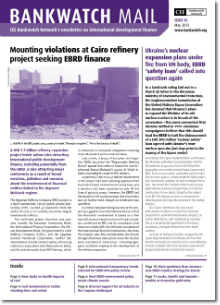
Read moreBankwatch Mail 56
Publication | 10 May, 2013Published to coincide with the EBRD’s annual meeting 2013 being held in Istanbul, this issue examines a developing controversial project in the bank’s newest region: a refinery expansion project in Cairo. Other fossil fuel investments by the EBRD also feature in the newsletter – and as the bank goes into major ‘policy review’ mode, with revisions to its energy, environmental and social and public information policies in the pipeline for this year, we put forward the case for the EBRD to rise to the climate challenge with real action rather than words. As the bank’s newly signed Kosovo country strategy demonstrates, however, the bank isn’t on course yet.
Read moreSustainability criteria for small and large hydropower plants
Publication | 10 May, 2013In recent years the EBRD has increased its funding for hydropower plants (HPPs) of all sizes. While small hydropower plants are seen by many as a far safer technology than large hydropower plants, they too can cause interruptions in river flows, loss of biodiversity and the degradation of habitats, disruptions for migrating fish and a lack of water for irrigation and drinking in downstream communities. The updated EBRD Environmental and Social Policy should include safeguards to ensure that small HPPs are truly sustainable.
Read moreKolubara B: a project of the previous century
Publication | 10 May, 2013The energy sector in Serbia is reminiscent of the industrial development strategy of the former socialist Yugoslavia, with thousands of megawatts of power plant capacities planned, and much of that production to be wasted, while people remain unable to afford their energy bills. The EBRD is set to fund this scenario with its support for a lignite-based, inefficient economy in Serbia. This briefing outlines arguments against financing the Kolubara B lignite power plant in Serbia.
Read moreCase study: The Boskov Most hydropower plant in Macedonia and the EBRD’s Project Complaint Mechanism
Publication | 10 May, 2013The Boskov Most project involves the construction of a 33 metres-high accumulation dam and hydropower plant. It is mostly located in the territory of the Mavrovo National Park, one of the oldest and most valuable protected areas in the country. The EBRD approved the project in November 2011 and signed the finance contract the same year. The civil society organisation Eko-svest from Macedonia submitted a complaint to the EBRD’s Project Complaint Mechanism (PCM). This briefing outlines the problematic communication with the bank during the investigation.
Read more