Pljevlja I power plant, Montenegro
The existing 225 MW Pljevlja thermal power plant in the north of Montenegro, near the borders with Serbia and Bosnia-Herzegovina, has been operating since 1982. The plant was originally planned to comprise two units but the second one was never built. The plant, along with the extensive use of coal and wood for heating, has caused unbearably bad air quality in the town.
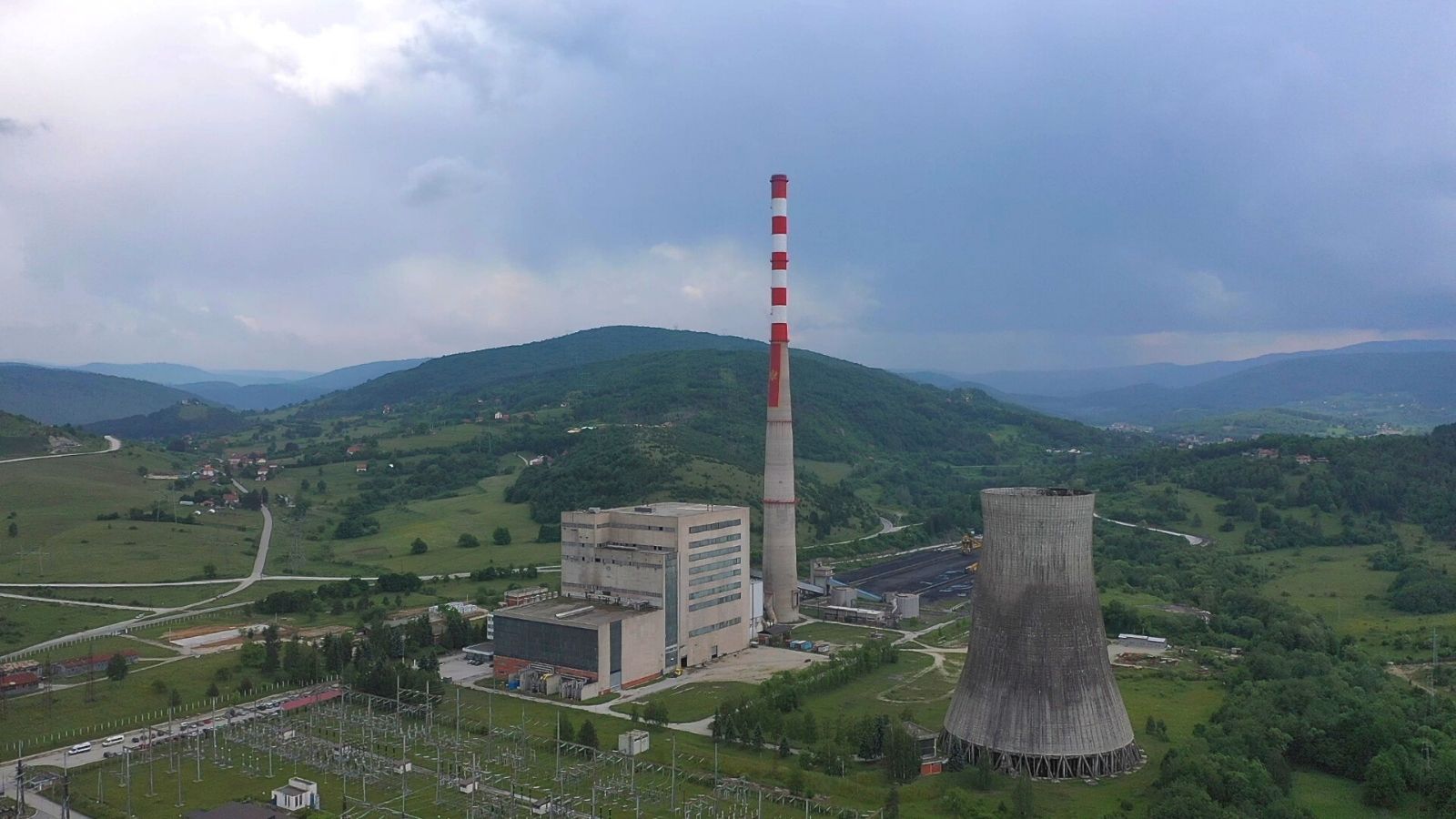
Photo: RTE Pljevlja
Stay informed
We closely follow international public finance and bring critical updates from the ground.
Background
Montenegro’s only coal power plant – the 225 MWe Pljevlja I – was commissioned in 1982 and generates around 40 per cent of Montenegro’s electricity, depending on the year.
Even though the plant should have been brought into compliance with the Large Combustion Plants Directive by 2018, the government and the plant’s operator Elektroprivreda Crne Gore (EPCG) lost several years concentrating on the construction of the now-cancelled Pljevlja II, and did not pay sufficient attention to resolving Pljevlja I’s pollution issues.
Therefore, the ‘limited lifetime derogation’ option was chosen as a way to comply with the Directive, in which Pljevlja I would be able to operate for a total of 20,000 hours between 1 January 2018 and 31 December 2023. After that, it either had to close or to undergo a retrofit that would bring it into compliance with emission limit values for new plants, not existing ones.
In March 2018, Montenegro’s Environmental Protection Agency issued the Pljevlja I plant with an integrated environmental permit, which stipulated that it must comply with the 2017 EU LCP BREF standards by 2023 – the most recent best available technology applicable. As such, it is the first existing plant in the region which has been required to do so.
In June 2020 Montenegro’s previous government signed a contract with a consortium led by China’s Dongfang (DEC International) to retrofit the plant to bring it in line with the EU’s 2017 LCP BREF.
However, EPCG has never publicly proven that the investment is be economically justified, nor that it would be technically capable of bringing the plant into compliance. At the time of signing, it was also claimed that this investment would extend the lifetime of the plant by 30 years, which seems highly unlikely. The plant is too old to operate for so long in its current state, but the works did not include reconstruction of the main parts of the plant, such as the boiler.
In the meantime, instead of spreading the available 20,000 hours evenly over the whole period from 2018 to 2023, the operator used them up as quickly as possible. By the end of 2020, the plant had already operated for 21,003 hours since 1 January 2018, but it did not stop there.
In March 2021, when Montenegro had to report its operating data to the European Environment Agency under the Energy Community Treaty, the breach was confirmed, yet the plant has continued to operate. In April 2021, the Energy Community Secretariat opened an infringement procedure against Montenegro.
Additionally, in April 2021, the Ministry for Capital Investments asked the public prosecutor to investigate the tender process for the plant’s retrofit, as well as the fact that EPCG used up all its hours in three years instead of spreading them out until the modernisation project was ready to start. The results of the investigation are not yet known.
In June 2021 Montenegro announced it will wean itself off coal by 2035, however, a public tender was actually opened in November 2021 for a feasibility study looking into connecting the existing plant to a new district heating system in Pljevlja, a project that EPCG has been promising the local community for 40 years, but whose construction would not even be finalised before the phase-out year.
In 2020 alone, as a result of the Pljevlja plant’s emissions, over EUR 1.3 billion were incurred in health costs by Montenegro and other countries. The estimated 625 deaths in 2020 make up almost 95 per cent of these costs, whilst the estimated 1,162 bronchitis cases in children due to PM10 amount to just over EUR 0.4 million.
Over 1 million restricted activity or lost work days are estimated, costing Montenegro’s and other countries’ economies EUR 51.3 million. In 2020, there were an estimated 12,257 days of asthma symptoms in asthmatic children, and a total of 436 cardiovascular and respiratory hospital admissions.
At the end of March 2025, the Pljevlja plant was taken offline for the main part of the modernisation works. After testing started at the end of November 2025, local people reported major pollution incidents.
In December 2025 – almost a year and a half after the deadline – Montenegro finally adopted its National Energy and Climate Plan, which plans the closure of the Pljevlja plant only in 2040 – unrealistically late considering its age and the impacts of carbon pricing.
Latest news
Energy Community warns Bosnia over guarantee for Tuzla power plant expansion
Bankwatch in the media | 2 October, 2018The secretariat of the Energy Community has urged the parliament of Bosnia & Herzegovina’s Muslim-Croat Federation to halt its plans to approve a guarantee for a loan from China’s Exim Bank for the construction of a new unit at the Tuzla coal-fired
Read moreEnergy Community Secretariat advises Parliament of FBiH not to to back loan for Tuzla 7 project
Bankwatch in the media | 1 October, 2018The Energy Community Secretariat has recommended to the Parliament of the Federation of Bosnia and Herzegovina (FBiH) not to approve a guarantee for a loan of EUR 614 million from the Export–Import Bank of China (China Exim Bank) to power utility Elekt
Read more200 million euro EBRD loan to Serbian energy giant EPS under investigation
Press release | 1 October, 2018Prague, Belgrade – The independent grievance body of the European Bank for Reconstruction and Development (EBRD) has started investigating a EUR 200 million ‘restructuring loan’ granted in 2015 to Elektroprivreda Srbije (EPS), the largest energy company in Serbia, following a complaint by CEE Bankwatch Network and Serbian environmental group CEKOR.
Read moreRelated publications
Comply or Close: Eight years of deadly legal breaches by Western Balkan coal plants
Report | 23 June, 2026 | Download PDFThis report exposes the systematic, deadly breaches of air pollution limits by coal-fired power plants in the Western Balkans – eight years after new pollution standards entered force.
Electricity market integration needs environmental compliance: Joint civil society position paper on CBAM and the Western Balkans electricity sector
Report | 19 March, 2026 | Download PDFThe inclusion of electricity in the EU’s Carbon Border Adjustment Mechanism (CBAM) has raised questions about CBAM’s impacts on EU-Western Balkans market integration.
The weakest link: Towards a transmission grid that supports decarbonisation in the Western Balkans
Briefing | 26 February, 2026 | Download PDFFor the Western Balkan countries to speed up their energy transformation, it is crucial to improve their transmission grids.

