Pljevlja I power plant, Montenegro
The existing 225 MW Pljevlja thermal power plant in the north of Montenegro, near the borders with Serbia and Bosnia-Herzegovina, has been operating since 1982. The plant was originally planned to comprise two units but the second one was never built. The plant, along with the extensive use of coal and wood for heating, has caused unbearably bad air quality in the town.
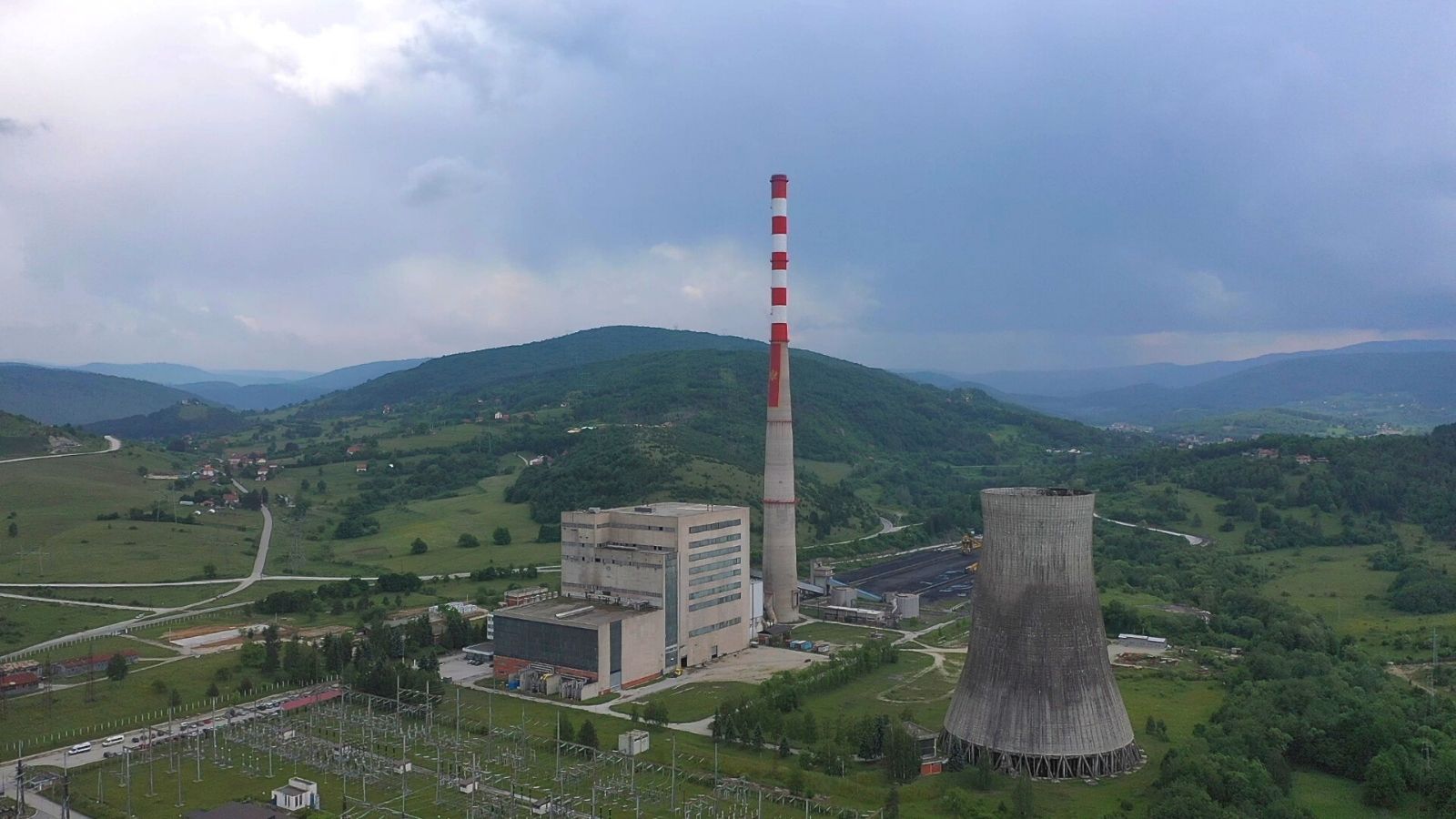
Photo: RTE Pljevlja
Stay informed
We closely follow international public finance and bring critical updates from the ground.
Background
Montenegro’s only coal power plant – the 225 MWe Pljevlja I – was commissioned in 1982 and generates around 40 per cent of Montenegro’s electricity, depending on the year.
Even though the plant should have been brought into compliance with the Large Combustion Plants Directive by 2018, the government and the plant’s operator Elektroprivreda Crne Gore (EPCG) lost several years concentrating on the construction of the now-cancelled Pljevlja II, and did not pay sufficient attention to resolving Pljevlja I’s pollution issues.
Therefore, the ‘limited lifetime derogation’ option was chosen as a way to comply with the Directive, in which Pljevlja I would be able to operate for a total of 20,000 hours between 1 January 2018 and 31 December 2023. After that, it either had to close or to undergo a retrofit that would bring it into compliance with emission limit values for new plants, not existing ones.
In March 2018, Montenegro’s Environmental Protection Agency issued the Pljevlja I plant with an integrated environmental permit, which stipulated that it must comply with the 2017 EU LCP BREF standards by 2023 – the most recent best available technology applicable. As such, it is the first existing plant in the region which has been required to do so.
In June 2020 Montenegro’s previous government signed a contract with a consortium led by China’s Dongfang (DEC International) to retrofit the plant to bring it in line with the EU’s 2017 LCP BREF.
However, EPCG has never publicly proven that the investment is be economically justified, nor that it would be technically capable of bringing the plant into compliance. At the time of signing, it was also claimed that this investment would extend the lifetime of the plant by 30 years, which seems highly unlikely. The plant is too old to operate for so long in its current state, but the works did not include reconstruction of the main parts of the plant, such as the boiler.
In the meantime, instead of spreading the available 20,000 hours evenly over the whole period from 2018 to 2023, the operator used them up as quickly as possible. By the end of 2020, the plant had already operated for 21,003 hours since 1 January 2018, but it did not stop there.
In March 2021, when Montenegro had to report its operating data to the European Environment Agency under the Energy Community Treaty, the breach was confirmed, yet the plant has continued to operate. In April 2021, the Energy Community Secretariat opened an infringement procedure against Montenegro.
Additionally, in April 2021, the Ministry for Capital Investments asked the public prosecutor to investigate the tender process for the plant’s retrofit, as well as the fact that EPCG used up all its hours in three years instead of spreading them out until the modernisation project was ready to start. The results of the investigation are not yet known.
In June 2021 Montenegro announced it will wean itself off coal by 2035, however, a public tender was actually opened in November 2021 for a feasibility study looking into connecting the existing plant to a new district heating system in Pljevlja, a project that EPCG has been promising the local community for 40 years, but whose construction would not even be finalised before the phase-out year.
In 2020 alone, as a result of the Pljevlja plant’s emissions, over EUR 1.3 billion were incurred in health costs by Montenegro and other countries. The estimated 625 deaths in 2020 make up almost 95 per cent of these costs, whilst the estimated 1,162 bronchitis cases in children due to PM10 amount to just over EUR 0.4 million.
Over 1 million restricted activity or lost work days are estimated, costing Montenegro’s and other countries’ economies EUR 51.3 million. In 2020, there were an estimated 12,257 days of asthma symptoms in asthmatic children, and a total of 436 cardiovascular and respiratory hospital admissions.
At the end of March 2025, the Pljevlja plant was taken offline for the main part of the modernisation works. After testing started at the end of November 2025, local people reported major pollution incidents.
In December 2025 – almost a year and a half after the deadline – Montenegro finally adopted its National Energy and Climate Plan, which plans the closure of the Pljevlja plant only in 2040 – unrealistically late considering its age and the impacts of carbon pricing.
Latest news
Death by a thousand transmission lines
Blog entry | 6 August, 2026The EBRD-backed development of the 400/110/35 kV Brezna substation for Montenegro’s transmission grid is opening several crucial questions – where is the red line beyond which a project’s impact on local communities makes it unacceptable? Can this even be assessed when all the institutions and financiers involved fail to identify even the obvious impacts? And why are the project’s backers so reluctant to provide environmental documentation to the affected people?
Read moreWestern Balkans gets second chance at just transition: Can new support platform deliver?
Blog entry | 15 July, 2026For coal-dependent communities in the Western Balkans, the launch of the JET Balkans project marks a welcome end to more than two years without a dedicated regional support platform. But with political commitment, funding and transparency still in short supply, local authorities and civil society are wondering whether the initiative can turn planning into meaningful implementation, or whether it will repeat the shortcomings that have slowed just transition efforts across the region.
Read moreWestern Balkans coal plants continue to breach pollution limits despite legal deadlines, report says
Bankwatch in the media | 8 July, 2026Coal-fired power plants across the Western Balkans emitted sulphur dioxide at more than six times legal limits in 2025, with dust pollution reaching its worst level since current emissions rules came into force eight years ago.
Read moreRelated publications
Formal complaints lodged against questionable EBRD energy loans
Bankwatch Mail | 13 March, 2012 |Early in the new year Bankwatch and partner groups lodged two complaints with the EBRD’s Public Complaint Mechanism (PCM): one concerning the loan agreement for the Rivne-Kyiv High Voltage Line project in Ukraine, the other concerning the EBRD’s Šoštanj lignite thermal power plant loan in Slovenia.
EIB’s clean energy credentials continue to be compromised, policy review offers clean break from fossil fuels
Bankwatch Mail | 13 March, 2012 |‘Carbon Rising’, a new study from Bankwatch, catalogues the EIB’s energy lending for the period 2007-2010 during which time the bank loaned EUR 40 billion to energy projects across the EU and EUR 8 billion outside the EU. This lending was guided by the EIB’s first energy policy ‘Clean Energy for Europe: A Reinforced EIB Contribution’, adopted by the bank in 2007.
Letters to EBRD and EIB: Irregularities in the Sostanj project in Slovenia
Advocacy letter | 13 March, 2012 |With this letter, Bankwatch, together with Focus, Association for Sustainable Development and Greenpeace Slovenia are informing the EIB’s and EBRD’s highest decision-making bodies about recent developments in the case of the Sostanj lignite power plant that in our view should prompt the banks to drop their participation in this investment. The EBRD’s president Thomas Mirow replied on April 16, 2012 (download his response (pdf)) informing us about the suspension of the EBRD’s loan for the Sostanj project. Just one day later, another letter from the EBRD (download as pdf) informed us that the suspension is not a formal suspension.

