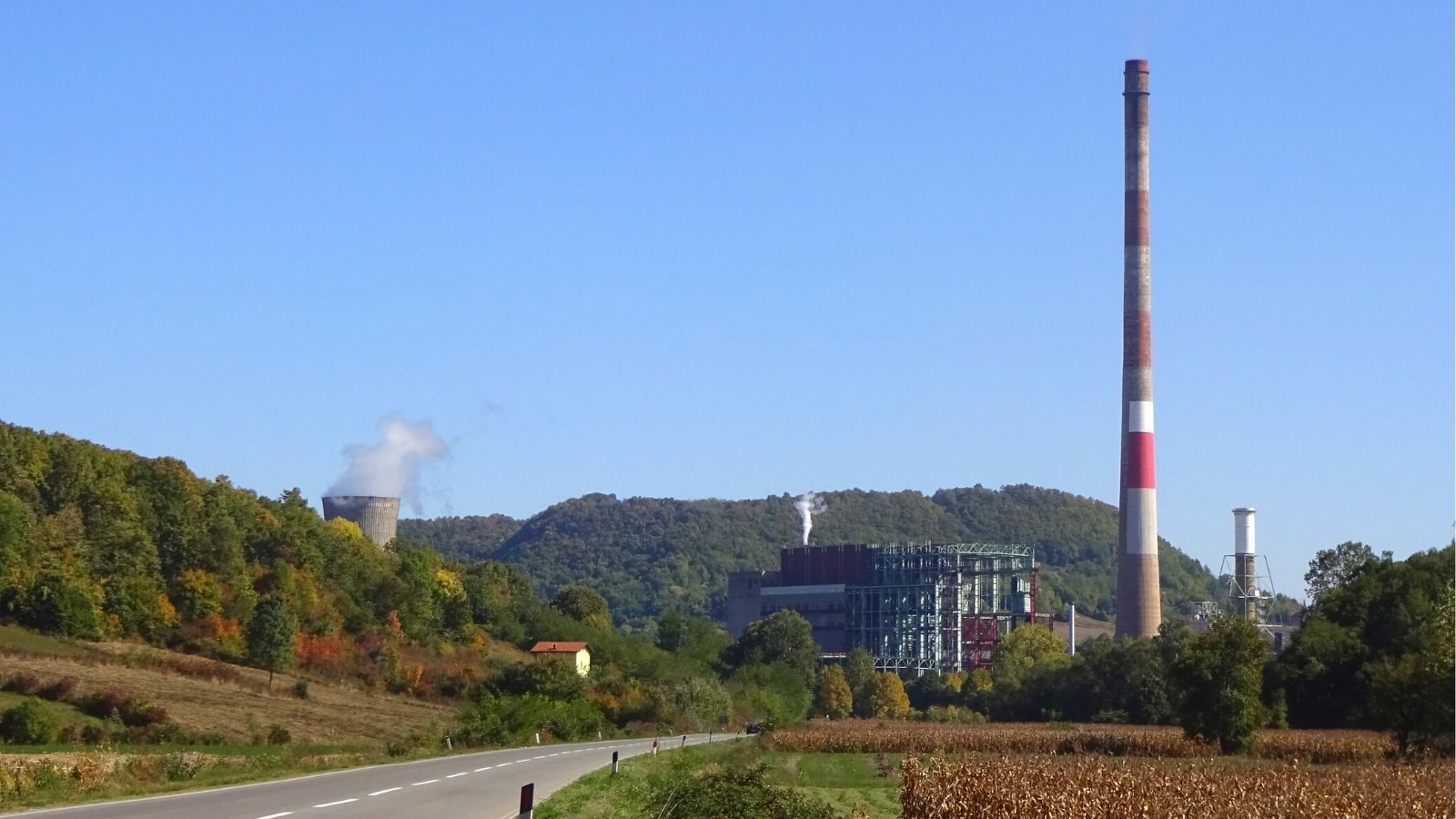
Ugljevik power plant, Bosnia and Herzegovina
Commissioned in 1985, the 300 MW coal power plant in Ugljevik, Bosnia and Herzegovina, has become famous for emitting more sulphur dioxide than all of Germany’s coal power plants in 2019.
Stay informed
We closely follow international public finance and bring critical updates from the ground.
Background
To put things in perspective, for every GWh of electricity generated in 2019, Ugljevik emitted 50 tonnes of sulphur dioxide, that is 50 times more than EU’s worst polluter, Bełchatów in Poland, which emitted 1.1 tonnes of SO2/GWh.
The problem is not new, but the paradox is that a financing contract for installing desulphurisation (de-SOx) equipment at Ugljevik was signed more than 14 years ago, and the installation is still not functioning.
Financed by a loan from the Japan International Cooperation Agency (JICA) signed back in 2009, works on the de-SOx equipment started only in 2017 and test operations began in December 2019. It seemed likely that in 2020, SO2 emissions would be significantly lower, finally justifying the EUR 85 million investment.
However, in February 2020 technical problems were reported. The plant’s dust filters, overhauled more than three years ago by the Czech company Termochem at a cost of around EUR 10 million, were faulty, and their proper functioning is reported to be a precondition for desulphurisation. The plant operator spent an additional EUR 100,000 on a study that would show how to address the problem.
In 2021, RiTE Ugljevik, the power plant operator, sought ‘technical assistance’ to obtain the operating permit, adding an extra EUR 100,000 to the costs of this project. The contract was awarded to a company owned by the mayor of Zvornik, raising a host of questions on why the publicly-owned utility RiTE Ugljevik is not capable of obtaining an operating permit itself.
The plant finally obtained an operating permit for the desulphurisation equipment in November 2021. However, its 2024 sulphur dioxide emissions of 112,943 tonnes higher than those in 2021 (86,774 tonnes). Since 2018, when the Large Combustion Plants Directive entered force under the Energy Community Treaty plant’s emissions have increased instead of decreasing. The operator admits that the de-SOX is not working mainly because it is an ‘economic burden’, and also due to a lack of disposal facilities for the gypsum that results from the process.
Out of all Bosnia and Herzegovina’s coal power plants, Ugljevik’s emissions caused the most days of asthmatic symptoms in children, with over 12,000 days in 2020. This is equal to 48 per cent of all such impacts from the country’s coal power plants which are included in the National Emissions Reduction Plan. Ugljevik is also responsible for the highest number of cases of bronchitis in children due to dust emissions, and of hospital admissions because of cardiovascular and respiratory symptoms, with 1,142 cases of the former and 469 of the latter in 2020.
Latest news
Death by a thousand transmission lines
Blog entry | 6 August, 2026The EBRD-backed development of the 400/110/35 kV Brezna substation for Montenegro’s transmission grid is opening several crucial questions – where is the red line beyond which a project’s impact on local communities makes it unacceptable? Can this even be assessed when all the institutions and financiers involved fail to identify even the obvious impacts? And why are the project’s backers so reluctant to provide environmental documentation to the affected people?
Read moreWestern Balkans gets second chance at just transition: Can new support platform deliver?
Blog entry | 15 July, 2026For coal-dependent communities in the Western Balkans, the launch of the JET Balkans project marks a welcome end to more than two years without a dedicated regional support platform. But with political commitment, funding and transparency still in short supply, local authorities and civil society are wondering whether the initiative can turn planning into meaningful implementation, or whether it will repeat the shortcomings that have slowed just transition efforts across the region.
Read moreWestern Balkans coal plants continue to breach pollution limits despite legal deadlines, report says
Bankwatch in the media | 8 July, 2026Coal-fired power plants across the Western Balkans emitted sulphur dioxide at more than six times legal limits in 2025, with dust pollution reaching its worst level since current emissions rules came into force eight years ago.
Read moreRelated publications
The EBRD, KfW, coal and corruption: European money in the Kolubara mine in Serbia
Briefing | 12 March, 2013 | Download PDFLinked to a slew of controversies, the Kolubara lignite mining project in Serbia is in line for support from European public banks. Corruption allegations, pollution at local level, irregularities in resettlement of local populations and not to forget a climate damaging approach to energy investments should be reason enough to find alternative options.
Kolubara mine “mired in crime and corruption”
Bankwatch Mail | 7 March, 2013 |At a press conference in January, Serbia’s energy minister Zorana Mihajlović spoke out strongly against the Kolubara mining complex, describing it as being “mired in crime and corruption” while also announcing that a thorough investigation is ongoing into corrupt practices by the Kolubara management. Bankwatch believes that this latest confirmed scandal at Kolubara should be giving the EBRD serious pause for reflection as it considers yet another loan to the Serbian electricity company EPS, heavily implicated in these latest revelations.
EBRD enters Kosovo: Past IFI failures must be heeded
Bankwatch Mail | 7 March, 2013 |Kosovo has just celebrated the fifth anniversary of independence. In these five years, Kosovo has achieved membership of certain international financial institutions (IFIs): having already joined the IMF and the World Bank, on December 17 last year Kosovo became the 66th member of the European Bank for Reconstruction and Development. Yet what can Kosovo’s citizens expect from EBRD membership?

