
Ukraine Reconstruction Campaigner
Email:Tel.:
Anna is Bankwatch’s Ukraine Reconstruction Campaigner, working on green reconstruction and environmental safeguards in Ukraine’s recovery. Her work focuses on alternative sources of energy for communities, energy resilience, and the alignment of Ukraine’s energy policy and public investment management system with EU standards. Originally from Kyiv, she holds an MSc in Environmental Sciences and Policy from Central European University and is based in Bratislava.
More from
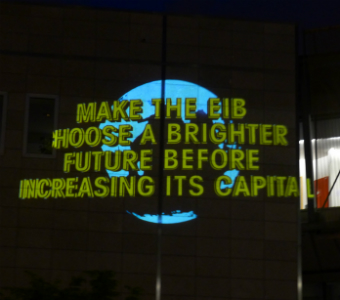
Ahead of the European Investment Bank’s annual meeting, Counter Balance and Bankwatch have chosen an unconventional way to remind the EIB shareholders of the bank’s chequered track record.
Brussels – On Monday night a video was projected on the building of the European Parliament which denounced the unsustainable energy portfolio of the European Investment Bank (EIB). The 1 minute video concluded with: “Make the EIB chose a brighter future before increasing its capital”, a message for EIB governors which gather Tuesday 15 May in Brussels during the bank’s Annual General Meeting. The main topic will be a possible capital increase of the EIB.
The 68 MW Ombla underground hydropower project, for which the EBRD approved a EUR 123.2 loan in 22 November 2011, is once again under fire, this time in the European Parliament. Both the project itself and its approval process have attracted widespread criticism from civil society and biodiversity experts as the project location forms part of a future Natura 2000 site. In 2008 the Croatian State Institute for Nature Protection declared the project “unacceptable for nature”.
As it begins to dawn on Europe’s elite that fiscal austerity is not working after all, the European Investment Bank is once again the talk of the EU as decision-makers scramble to stimulate national economies that are hemhorraging jobs and living standards – and hope – across the continent.
In February 2009 the European Bank for Reconstruction and Development, together with the European Investment Bank and the World Bank Group launched a series of meetings with commercial banks, coordinated with the European Commission and the International Monetary Fund, to shore up a weak link in the financial systems of the European Union. The weak link is in so-called ‘emerging Europe’, the countries of central and eastern Europe that are in the EU, but are outside the European Monetary Union, the Euro-zone. These are mostly ex-Communist countries whose financial systems had remained undeveloped under communism.

