The current situation among district heating companies in Serbia provides a timely warning for Western Balkan governments still betting on new fossil gas infrastructure. In recent years, these governments have shown renewed interest in building new gas infrastructure. Many projects have been on the table for years, but new schemes are also being actively promoted by the United States.
Natasa Kovacevic, District Heating Decarbonisation Campaigner for the Western Balkans | 14 July 2026
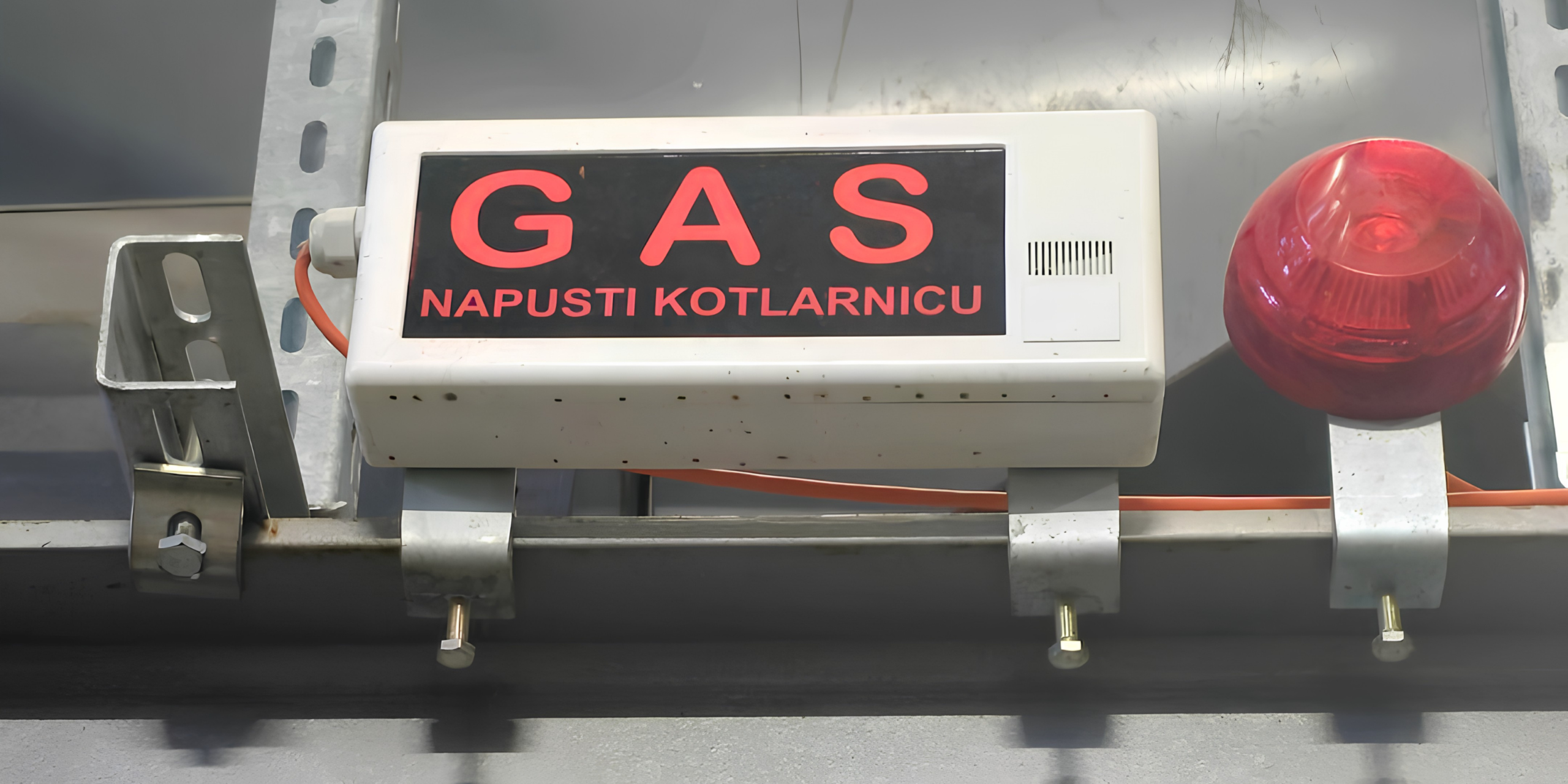
Sign reading ‘Gas, leave the boiler room’ inside an active gas district heating plant in the Serbian city of Kragujevac (Photo: Natasa Kovacevic).
Serbia’s warning sign
Rather than racing ahead with costly new commitments, however, the region’s governments should look closely at Serbia’s district heating sector, which is approaching breaking point due to its reliance on imported gas.
This increasingly chronic problem is the clearest example in the region so far of the risks associated with gas-dependent heating systems. Today, gas accounts for around 78% of fuel used in Serbia’s district heating sector, with around 90% of supplies imported. This has resulted in financial instability for heating companies, often driven by sharp fluctuations in international gas markets rather than domestic energy policy.
Financial exposure revealed
Even with significant overemployment in the sector – estimated at around 15% of total costs, with staffing levels far exceeding operational needs – fuel costs dominate. In 2024, the latest year for which data is available, fuel costs accounted for 60.5% of total district heating expenditure, leaving utilities highly exposed to fluctuations in imported gas prices.
The consequences for the sector’s financial performance are devastating. In 2024, Serbian district heating companies recorded combined losses of EUR 22.3 million, while liquidity shortages reached EUR 189 million. In practical terms, nearly EUR 200 million in working capital is missing from the system.
And the trend is worsening. Financial data shows that Serbia’s district heating sector has experienced a steady decline in performance over the past eight years. In 2024, out of Serbia’s 51 district heating utilities, 27 operated at a loss, while 24 reported positive financial results. Compared to 2023, total losses almost tripled, while 15 utilities have accumulated losses exceeding the value of their capital.
One of Serbia’s last coal-fired district heating plants, in Kragujevac, was replaced by a gas installation in October 2022, with financing from the European Bank for Reconstruction and Development (EBRD). Just two years later, Kragujevac recorded the largest financial loss of any district heating utility in Serbia, amounting to EUR 10.3 million in 2024.
This highlights the financial risks of new investment in imported fossil gas, where optimistic feasibility assumptions carry a high risk of leaving utilities with losses and long-term debt. These developments should raise concerns across the Western Balkans, where the push for new gas infrastructure continues.
Regional policy risks
Montenegro is still pursuing a government-to-government (G2G) initiative on infrastructure, including plans for a liquefied natural gas (LNG) terminal in Bar and three associated gas plants. Albania is also progressing with a planned LNG terminal and at least one power plant.
Serbia is expanding its domestic gas network and planning new interconnectors, with new gas plants foreseen in Niš and Novi Sad, while North Macedonia is building a new gas interconnector with Greece and planning additional gas-fired generation.
Bosnia and Herzegovina is also advancing the Southern Gas Interconnection with Croatia, whose planned capacity would be six times higher than current gas demand. The project relies on outdated demand and cost assumptions, increasing the risk of stranded assets and underutilised infrastructure.
However, new pipelines and gas plants do not eliminate dependence – they create it. Unlike renewable energy sources, almost all gas consumed in the Western Balkans must be purchased on external markets, exposing consumers, public budgets and utilities to price volatility and supply disruptions. This is particularly relevant for Albania, Montenegro and Kosovo, which are currently almost entirely gas-free, as they are not connected to international gas transmission networks.
Even for the three Western Balkan countries that do have gas import infrastructure – Serbia, North Macedonia and Bosnia and Herzegovina – the central energy security question is not how to safeguard additional gas supplies, but how to reduce the need for imported gas.
Alternatives and resilience
Serbian experts and heating utilities recently addressed this pressing issue at a panel discussion that deserves close attention across the region. They argue that investments in geothermal energy, solar thermal systems, heat pumps, energy efficiency and seasonal heat storage offer a more sustainable model – one based on domestic resources, lower exposure to global commodity markets and greater resilience to price shocks.
At a time when Europe is moving towards electrification and reducing fossil fuel consumption, Western Balkan countries face a stark choice: continue investing heavily in infrastructure that deepens dependence on imported gas, or prioritise renewable-based technologies that strengthen energy security and reduce long-term economic vulnerability. The financial condition of Serbia’s district heating sector suggests that the cost of choosing the first option is extremely high – and likely to result in a dead end.
Never miss an update
We expose the risks of international public finance and bring critical updates from the ground – straight to your inbox.
Institution: European Bank for Reconstruction and Development | EBRD
Theme: gas | fossil gas | liquefied natural gas | natural gas
Location: Serbia | Montenegro | Bosnia and Herzegovina | Croatia | Albania | Kosovo | North Macedonia
Project: District heating | Fossil gas
Tags: LNG | fossil gas | gas | liquefied natural gas | natural gas

