
Five reasons why EBRD should pull out of the controversial Nenskra hydropower project
Blog entry | 8 May, 2019As the realisation of the project keeps dragging on, it is becoming increasingly difficult for the EBRD, and all international financial institutions involved, to justify their engagement.
Read more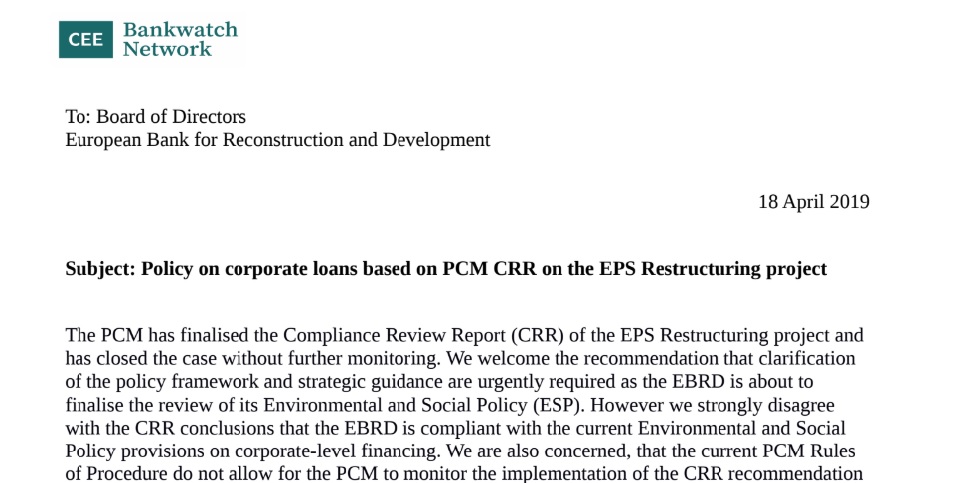
Policy on corporate loans based on PCM CRR on the EPS Restructuring project
Publication | 6 May, 2019The PCM has finalised the Compliance Review Report (CRR) of the EPS Restructuring project and has closed the case without further monitoring. We welcome the recommendation that clarification of the policy framework and strategic guidance are urgently r
Read more
Corporate loans – the rotten apple in EBRD’s Environmental and Social Policy?
Blog entry | 18 April, 2019As the Board of Directors is expected to vote any day now on the renewed Policy which lays out the conditions for reaching the Bank’s sustainability mandate and commitment to EU standards, a compliance review on Serbia’s energy company’s corporate restructuring loan calls for clearer and stronger safeguards for corporate level loans.
Read more
Letter to EBRD president Suma Chakrabarti
Publication | 3 April, 2019CEE Bankwatch Network, Arab Watch Coalition and the International Accountability Project call to the EBRD President, Sir Suma Chakrabarti, to ensure a people-centered Access to Information Policy. Communities, individuals, and civil society have the ri
Read more
Comments on the EBRD draft Accountability Policy
Publication | 27 March, 2019The draft Accountability Policy of the EBRD proposes a substantial and welcomed restructuring of the mechanism and improves on many of the issues of independence and predictability that hindered the PCM. However, the draft Policy does not yet rectify a
Read more
Comments on the EBRD draft Access to Information policy
Publication | 27 March, 2019Fulfilling the right of access to information is the beginning and foundation of true development that respects the rights of all people. Access to information goes hand-in-hand with meaningful consultation and stakeholder engagement to ensure that pro
Read more
Comments on the EBRD draft Environmental and Social Policy
Publication | 27 March, 2019We welcome the proposed improvements in the EBRD draft Environmental and Social Policy, including the stronger language on human rights, gender and vulnerable groups, as well as the reintroduction of the referral list for financial intermediary high ri
Read more
New report highlights misuse of banking secrecy rules
Blog entry | 26 March, 2019BankTrack’s study finds that client confidentiality is not an absolute legal requirement in any of the world’s major banking centres. Banks can – and do – include the right to disclose information into their contracts. Will the EIB & EBRD acknowledge this in their policies on intermediated lending?
Read more
CSO letter to the EBRD on the revision of the Good Governance policies related to Financial Intermediaries (FIs)
Publication | 13 March, 2019The undersigned CSOs welcome this opportunity to submit comments on the EBRD’s revision of its environmental and Social Policy, Access to Information Policy and Project Accountability Policy relating to financial intermediary lending. As it was documen
Read more
Milestone bank summit in Belgrade a step towards protecting Balkan rivers, but greater transparency still needed
Press release | 1 March, 2019For immediate release. Belgrade – The ‘Save the Blue Heart of Europe’ campaign [1] gave a cautious welcome to a first-of-its-kind summit between the financial sector and green activists, where a roundtable about the role of banks in the destruction of Balkan rivers by hydropower dams was centre stage.
Read more
