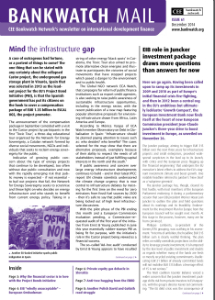
EIB and EBRD transparency nosedive needs fixing – and fast
Publication | 2 December, 2014Operational transparency standards at the European Investment Bank and the European Bank for Reconstruction and Development continue to deteriorate, according to the 2014 Aid Transparency Index (ATI) published in October by aid watchdog Publish What You Fund (PWYF).
Read more
EBRD-EIB role in Slovak private equity gas debacle questioned
Publication | 2 December, 2014The European Bank for Reconstruction and Development (EBRD) has revealed, in a letter of late October to Bankwatch’s Slovak member group Friends of the Earth-CEPA, that the EnerCap Power Fund, a private equity investor, has pulled out of the controversial COGEN gas power plant being developed in the northern Slovakian town of Považský Chlmec.
Read moreJuncker investment package shifts risk from private investors to EU taxpayers
Press release | 26 November, 2014Brussels – Today European Commission president Jean-Claude Juncker will present his widely anticipated 300 billion euro investment package aimed at stimulating growth in the European economy. Central to the InvestEU programme is a 21 billion euro allocation for the newly-created Euopean Fund for Strategic Investment (EFSI) that has to leverage 315 billion euro from private investors, or 15 times the amount of the fund.
Read moreThe Great Rush – The European Union’s responsibility in natural resources grabbing
Publication | 31 October, 2014Land, forests, water and raw materials are valuable resources that increasingly interest the major players of the economy of our planet. This report collects 16 case studies from around the world in order to better understand the impacts of natural resource grabbing on the local communities, clarify the responsibilities of the European Union and, in conclusion, examine actions to be undertaken to invert this phenomenon.
Read more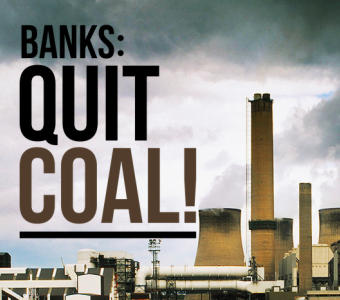
Two great new websites on all things coal
Blog entry | 31 October, 2014As anti-coal movements are gaining momentum around the world, two new websites offer a slew of information about the dirtiest of fossil fuels and the campaigns against it. They also offer a stark reminder that despite progress in the last years coal is far from dead.
Read more
European Ombudsman: EIB weakens EU efforts to strengthen rule of law
Press release | 30 October, 2014Brussels – In an unprecedented ruling this week, the European Ombudsman concluded at the end of an investigation into the EIB’s involvement with a road construction project in Bosnia and Herzegovina that the institution’s behaviour was “totally unacceptable” and it “risked putting into question the EU’s commitment for strengthening the rule of law in Bosnia and Herzegovina.”
Read more
Can the European Investment Bank move ahead of the pack on climate?
Blog entry | 21 October, 2014The European Investment Bank is gearing up for an increased role in spurring growth in Europe as set out by the new Juncker Commission. Yet as Europe’s 2030 climate targets are being undermined by some countries the bank that wants to be a leader in climate action must keep in mind that we can no longer afford growth without sustainability.
Read more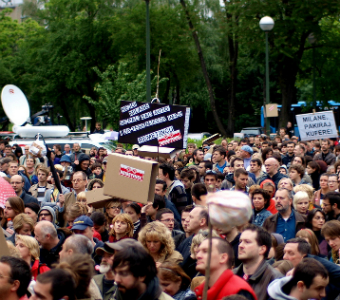
Zagreb Mayor arrested – and not before time
Blog entry | 20 October, 2014Something quite amazing happened yesterday evening in Zagreb. The Croatian police and the State Prosecutor announced that several people had been arrested on suspicion of a number of criminal corruption offences, abuse of office and peddling influence. Among the arrested were Zagreb Mayor Milan Bandic, Head of Zagreb Holding municipal company Slobodan Ljubicic, the head of the ZET public transport company Ivan Tolic, head and part-owner of the CIOS metal recycling company Petar Pripuza and around 15 more un-named people.
Read morePoor quality of draft ESIA report for Part C and D of the 750 kV Rivne – Kyiv High Voltage Line Project
Publication | 17 October, 2014Letter to the European Bank for Reconstruction and Development, 17 October 2014 – Download as pdf Letter to the European Investment Bank, 31 October 2014 – Download as pdf
Read moreGreen 10 letter to European Commission president-elect Juncker regarding the appointments of new Commissioners
Publication | 16 October, 2014This Green 10 letter highlights some controversial aspects of Commission President-elect Juncker’s new cabinet appointments, including the inclusion of sustainability within the competency of Commissioner Timmermans.
Read more
