• Skip to primary navigation
  • Skip to main content
  • Skip to footer

Bankwatch

  • About us
    • Our vision
    • Who we are
    • 30 years of Bankwatch
    • Donors & finances
    • Get involved
  • What we do
    • Campaign areas
      • Beyond fossil fuels
      • Rights, democracy and development
      • Finance and biodiversity
      • Funding the energy transformation
      • Cities for People
    • Institutions we monitor
      • European Bank for Reconstruction and Development
      • European Investment Bank
      • Asian Infrastructure Investment Bank
      • Asian Development Bank (ADB)
      • EU funds
    • Our projects
    • Success stories
  • Publications
  • News
    • Blog posts
    • Press releases
    • Stories
    • Podcast
    • Us in the media
    • Videos

Home > Archives for Press release

Press release

Romania’s dodgy math: will the country retire 2.2 GW of coal by the end of 2019?

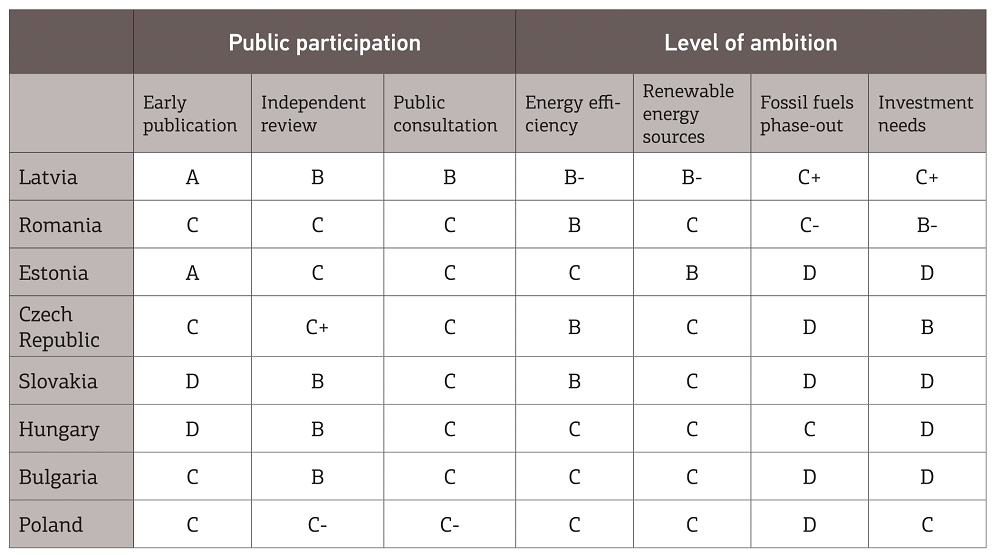
Romania’s NECP, a document supposed to guide the country’s climate and energy policy for the next decade, claims Romania will have only 3.7 GW of installed coal capacity by 2020 – a shocking claim considering that currently there are 5.9 GW installed and the government made no plans to retire any unit this year.

The document also says that an another 540MW of coal capacity will disappear by 2030. Additionally, the NECP includes a very unambitious target for renewable energy in final energy consumption of only 27.9%.

‘Normally, anybody who wants to prevent a catastrophic increase of the global temperature would be happy to hear that 2 GW of coal will be retired in one year. But let’s not open the champagne bottles yet. The NECP lacks a commitment for a coal phaseout and it relies on plans to build a new coal unit. This means the 2020 installed capacity figure is likely a blatant inaccuracy – even more embarrassing as Romania is now in the spotlight for holding the EU Presidency,’ comments Alexandru Mustata, campaigner for Bankwatch Romania.

According to Bankwatch, calculations for the NECP are based on the National Energy Strategy, which prioritizes building a new 600MW unit on the site of the existing Rovinari power plant in Gorj county. An expert assessment of the economics of the new unit included in the Bankwatch publication shows that the new Rovinari unit would hardly (if ever) be economic if built. Fuel, CO2 and limestone costs will eat up 82% of the total revenue generated by the unit, leaving little room to cover the other costs – salaries, operation etc. – not to mention making a profit.

‘Romania once again fails to prepare a clear strategy to tackle this century’s biggest challenge: climate change,’ says Mustata. ‘Instead, it plans a new coal unit while most other European countries plan phaseouts and it squanders its enormous renewables potential. All this while being at the helm of the EU and supposedly offering guidance to the entire block.’

Notes to editors:

Read the Bankwatch analysis of Romania’s NECP, including an expert assessment of the economics of the new planned coal unit at Rovinari here.

For more information, contact:

Alexandru Mustata
Bankwatch Romania campaigner
alexandru.mustata@bankwatch.org

Bosnia-Herzegovina Federal parliament guarantees Chinese coal plant loan in contempt of EU law

The vote came after the Energy Community Secretariat earlier this week published an independent legal analysis, which confirmed that the Tuzla 7 guarantee contains elements of State aid, and called on the Parliament of the Federation of Bosnia and Herzegovina not to approve the guarantee. [1]

The guarantee had been cleared by the the State Aid Council of Bosnia and Herzegovina in July 2018, [2] but in September 2018, the Energy Community Secretariat requested the Federal Parliament not to approve the guarantee [3], after its initial examination of the case indicated that the guarantee would not be in line with EU law.

Under the Energy Community Treaty, Bosnia-Herzegovina must follow EU rules on subsidies in the energy sector. Among other things, in most cases state guarantees may only cover maximum 80 percent of the total loan amount.

The proposed guarantee for Tuzla 7, however, covers 100 percent of the loan, plus interest and other associated costs. There are circumstances in which this is allowed, but, as a September 2018 complaint to the Energy Community by the Aarhus Resource Centre and Bankwatch argued, the relevant conditions are not fulfilled in this case.

Reacting to the vote, Denis Žiško from the Center for Ecology and Energy stated:

“By giving almost unanimous support to a document that is clearly not in line with the Energy Community State aid acquis, FBiH parliamentarians once again demonstrated utter irresponsibility with regard to the international obligations of our country. Actions like this are simply destroying the already questionable international credibility of BiH. It is certain that such short-sighted behaviour of our politicians further complicates our EU integration process. How can the EU trust a country whose politicians knowingly violate international treaties?”

Nina Kreševljaković from the Aarhus Resource Centre said:

“The FBiH parliament did not approve these documents five months ago, just before the elections, but has done so now when they are known to be illegal. It is clear that yesterday’s vote was not based on an assessment of the documents by the parliamentarians or the findings in the independent legal analysis of the Energy Community Secretariat. The approval is a consequence of post-election political trade-offs and completely ignores the undeniable long-term negative impacts of this decision on BiH citizens.”     

Pippa Gallop of CEE Bankwatch Network added:

“The Federal Parliament has acted with utter contempt for energy market rules. Bosnia and Herzegovina shouldn’t be allowed to export electricity to EU countries if its politicians flagrantly breach the law. The country can’t have it both ways. It has to decide: is it committed to participating in the EU energy market or not?”

Contacts

Denis Žiško
Centar za ekologiju i energiju
denis.zisko@ekologija.ba
Skype: denis.zisko
Mob: +387 61 140 655

Pippa Gallop
CEE Bankwatch Network
pippa.gallop@bankwatch.org
Mob: +385 99 755 97 87

Notes for editors

  1. The analysis and announcement are available here: https://www.energy-community.org/news/Energy-Community-News/2019/03/04.html
  2. Decision No. UP/I 03-26-1-42-4/18 of dated 23 July 2018
  3. The letter from the Energy Community Secretariat

For more information, see here.

Energy Community: Bosnia-Herzegovina guarantee for Chinese loan for Tuzla 7 is state aid, breaks EU law

‘Independent lawyers have now analysed the State Aid Council’s decision and the underlying public guarantee and have confirmed the Secretariat’s finding that the Tuzla 7 guarantee contains elements of State aid. The opinion was submitted to the State Aid Council,’ the Energy Community Secretariat wrote in a press release sent Monday evening.

‘The State Aid Council should therefore reopen its procedure and re-examine the guarantee in line with the Energy Community State aid acquis. The Secretariat also reiterates that the Parliament of the Federation of Bosnia and Herzegovina should not approve the guarantee, based on a non-compliant decision from its State aid authority.’

The guarantee had been cleared by the the State Aid Council of Bosnia and Herzegovina in July 2018, (1) but in September 2018, the Energy Community Secretariat requested the Federal Parliament not to approve the guarantee (2), after its initial examination of the case indicated that the guarantee would not be in line with EU law.

Under the Energy Community Treaty, Bosnia-Herzegovina must follow EU rules on subsidies in the energy sector. Among other things, in most cases state guarantees may only cover maximum 80 percent of the total loan amount.

The proposed guarantee for Tuzla 7, however, covers 100 percent of the loan, plus interest and other associated costs. There are circumstances in which this is allowed, but, as a September 2018 complaint to the Energy Community by the Aarhus Resource Centre and Bankwatch argued, the relevant conditions are not fulfilled in this case. (3)

The legal analysis commissioned by the Energy Community confirms the reasoning presented by the NGOs to challenge the guarantee.

Last week, while the Parliament was preparing to approve the loan guarantee, the Energy Community Secretariat issued a warning that the Parliament must not approve the loan until its investigation was complete (4). Janez Kopač, the Energy Community Director, was in Sarajevo today to discuss the issue with BiH decision-makers.

“Using public money to support a new coal power plant is unacceptable in any case, but especially when it is illegal,” said Denis Žiško of the Centre for Ecology and Energy, Tuzla. “Tuzla 7, if built, would sentence Bosnia and Herzegovina to decades of more pollution and greenhouse gas emissions and is highly likely to generate economic losses. Parliamentarians must not support new coal plants in any way, but must instead act to reduce energy wastage and to use our renewable energy potential”.

“The Energy Community is clearly saying that, by providing the guarantee, Bosnia and Herzegovina is in non-compliance with EU law. If the Parliament nevertheless votes on March 7 to approve the guarantee, then it is knowingly legalising an illegality. Even more, it willingly pushes the country into a situation where it will be penalised in a few years” stated Ioana Ciuta of CEE Bankwatch Network.

Contacts

Denis Žiško
Centar za ekologiju i energiju
denis.zisko@ekologija.ba
Skype: denis.zisko
Mob: +387 61 140 655

Ioana Ciuta
CEE Bankwatch Network
ioana.ciuta@bankwatch.org
Mob: +40724020281

Notes for editors

  1. Decision No. UP/I 03-26-1-42-4/18 of dated 23 July 2018
  2. The letter from the Energy Community Secretariat
  3. For more information, see here: https://bankwatch.org/press_release/use-of-public-money-to-support-tuzla-7-coal-power-plant-must-be-investigated-shows-new-complaint  |  https://www.energy-community.org/news/Energy-Community-News/2019/02/23.html

Milestone bank summit in Belgrade a step towards protecting Balkan rivers, but greater transparency still needed

The bank summit was initiated by the London-based European Bank for Reconstruction and Development (EBRD) and the Save the Blue Heart campaign in order to discuss the sensitive issue of hydropower development in the Balkans. Representatives from some of Europe’s largest commercial lenders, including UniCredit, Erste Groupe and Societe Generale, attended the summit.

The discussion explored how these financial institutions could start providing timely information to the public about the likely environmental and social impacts of their loans for hydropower projects in order to avoid the destruction of the pristine rivers of the Balkans, some of Europe’s last wild waterways.

A lack of transparency has plagued a number of investments [2] across the region where rivers have been impounded, dried out  important species and habitats have been lost, and local communities have confronted project developers over their loss of livelihoods.

The Save the Blue Heart of Europe campaign is calling on banks to immediately stop funding for projects that are located in protected areas and other valuable river stretches, apply more stringent green conditions to loans in the sector and increase funding for energy efficiency and other renewable energy sources, whose potential in the region remains largely untapped [3].

The Belgrade summit follows public pressure in 2018 when more than 120 000 people sent the EBRD the largest ever public petition on energy issues to drop funding for hydropower projects planned in protected areas of the Balkans. One of the largest financiers of hydropower projects in the Balkans, the EBRD has financed 61 hydropower projects in the region, where up to 2 800 potential projects have been identified [4].

Igor Vejnovic, hydropower coordinator for CEE Bankwatch Network, said: “Transparency is a cornerstone of democracy and environmentally and socially-responsible investment. Without it, banks expose themselves to legal and reputational risk. So today’s meeting is a sign that financial institutions are willing to listen, but the question remains if they will act to protect the rivers and communities of the Balkans.”

Gabriel Schwaderer, CEO of EuroNatur, said: “The destruction of the beautiful Balkan rivers by hydropower would not only be ecologically devastating, but also nonsense in regards to energy politics. A transformation of the entire energy policy is urgently required: reduction of energy consumption, increase of energy efficiency, reduction of major energy losses and investment in solar and wind instead of hydropower.”

Ulrich Eichelmann, CEO of Riverwatch: “Within the last two years, we have assessed the ecological value of the Balkan rivers in detail. The outcome is a spatial plan that defines no-go areas for new hydropower plants, the so-called “Eco-Masterplan for the Balkan Rivers”. The result is proof that this river network is without par in Europe: 76 per cent of the rivers are of such high value that they qualify as no-go zones. The banks must stop the funding of hydropower in these areas.”

Contacts

Igor Vejnovic, Hydropower Coordinator
CEE Bankwatch Network
igor.vejnovic@bankwatch.org
+420 777 995 515

Anja Arning, Head of Public Relations
EuroNatur
anja.arning@euronatur.org
+49 (0)7732 – 927213

Ulrich Eichelmann
CEO, Riverwatch
ulrich.eichelmann@riverwatch.eu
+43 676 6621512

Notes

[1] The ‘Save the Blue Heart of Europe’ campaign is an initiative of nongovernmental organisations EuroNatur and Riverwatch, together with green groups from southeast Europe, Bankwatch and activist company Patagonia in order to save the pristine rivers of the Balkan from destruction brought by dams and diversions. https://www.balkanrivers.net/

[2] http://bankwatch.org/hydrobanks

[3] https://balkanrivers.net/en/news/eco-masterplan-shows-value-balkan-rivers

[4] https://bankwatch.org/publication/financing-for-hydropower-in-protected-areas-of-southeast-europe-update

Bosnia-Herzegovina politicians defy investigation to approve Chinese loan guarantee for coal power plant

The Energy Community Secretariat, which is currently examining the case, has in response issued a warning that the Parliament must not approve the loan until its investigation is complete. [2]

The guarantee was cleared by the the State Aid Council of Bosnia and Herzegovina in July 2018, [3] but in September 2018, the Energy Community Secretariat requested the Federal Parliament not to approve the guarantee [4], after its initial examination of the case indicated that the guarantee would not be in line with EU law.

Under the Energy Community Treaty, Bosnia-Herzegovina must follow EU rules on subsidies in the energy sector. Among other things, in most cases state guarantees may only cover maximum 80 per cent of the total loan amount.

The proposed guarantee for Tuzla 7, however, covers 100 per cent of the loan, plus interest and other associated costs. There are circumstances in which this is allowed, but, as a September 2018 complaint to the Energy Community by the Aarhus Resource Centre and Bankwatch argued, the relevant conditions are not fulfilled in this case. [5]

“Using public money to support a new coal power plant is unacceptable in any case, but especially when it is most likely illegal,” said Denis Žiško of the Centre for Ecology and Energy, Tuzla. “Tuzla 7, if built, would sentence Bosnia-Herzegovina to decades of more pollution and greenhouse gas emissions and is highly likely to generate economic losses. Parliamentarians must not support new coal plants in any way, but must instead act to reduce energy wastage and to use our renewable energy potential”.

“The Energy Community has issued a clear warning that Bosnia-Herzegovina is about to dive headlong into non-compliance with EU law. If the country is serious about its European future, this warning must be headed. This is not just a matter of legal compliance but also of making the clean energy transition a reality and saving public money from being spent on a polluting and obsolete industry,” stated Pippa Gallop of CEE Bankwatch Network.

For more information, please contact

Denis Žiško
Centar za ekologiju i energiju
denis.zisko@ekologija.ba
Skype: denis.zisko
Mob: +387 61 140 655

Pippa Gallop
CEE Bankwatch Network
pippa.gallop@bankwatch.org
Skype: pippa.gallop
Mob: +385 99 755 9787

Notes for editors

  1. https://predstavnickidom-pfbih.gov.ba/bs/page.php?id=1905
  2. https://www.energy-community.org/news/Energy-Community-News/2019/02/23.html
  3. Decision No. UP/I 03-26-1-42-4/18 of dated 23 July 2018
  4. The letter from the Energy Community Secretariat
  5. For more information, see here

EU action on Western Balkans’ chronic coal pollution is a unique opportunity to improve health and productivity

Based on the methodology by the World Health Organization (WHO) and the European Commission, the Chronic Coal Pollution report shows that every year air pollution from Western Balkan coal power plants is responsible for an estimated 3,900 premature deaths, 8,500 cases of bronchitis in children and other chronic illnesses. The health issues these plants cause adds up to lost productivity and health costs of up to EUR 11,535 million.

The old, inefficient and substandard coal power plants in the Western Balkans emit an incredible amount of air pollution every year, impacting the health of people across the continent. In 2016 alone, 16 of them spewed out as much sulphur dioxide (SO2) pollution as the entire fleet of the EU’s 250 coal power plants. Just one power plant, Ugljevik in Bosnia and Herzegovina, emitted more SO2 than all German coal power plants put together. And levels for particulate matter and nitrogen oxides are equally alarming.

The European Union bears the majority of the health impacts, with 2,013 premature deaths in 2016, asthmatic children suffering from  symptoms for a combined total of over 36,400 days, an estimated 1,418 hospital admissions and over 600,000 lost working days. European Union countries also bear the majority of health costs, up to EUR 5,899 million, while the burden on the Western Balkan countries is estimated to be up to EUR 3,648 million every year (other countries: EUR 1,988 million).

‘Air pollution knows no borders and is still an invisible killer in Europe. A significant amount of pollution from the Western Balkans travels into the EU. Pollution from the Western Balkans adds to the already poor air quality in the EU countries, making it harder especially for the adjacent EU neighbours to meet air quality standards. It is high time that EU policy-makers step up efforts to clean up the air and decarbonise the power sector in the Southeastern European region,’ commented Vlatka Matkovic Puljic, Senior Health and Energy Officer at HEAL, and lead author of the report.

The Energy Community Treaty, the international treaty working since 2006 to integrate the energy markets of the EU and those of its neighours, set a deadline for Western Balkan countries to comply with EU pollution control legislation by 2018. Regrettably however, meaningful action towards healthier energy systems, investments and retrofits in energy production across the Western Balkans has largely been delayed.

‘Western Balkan coal is a burden on people’s health, the climate and the wider economy. It is therefore in the interest of people across Europe – in the EU and the Western Balkan countries – to enforce Energy Community Treaty rules and to swiftly phase out this polluting, health-harming and outdated technology.  Climate action, pollution control and air quality must also be prioritised in the EU accession process. As the EU moves to net zero greenhouse gas emissions, Western Balkan countries must also phase out coal, not just because it is a chronic air pollutant but also one of the biggest climate change culprits,’ said Igor Kalaba, Energy Policy Coordinator for Southeast Europe at CAN Europe.

Furthermore, policy makers in the region remain determined to finance and build new coal plants, mainly with support from Chinese banks. Most of these plants would not adhere to the EU’s latest pollution control standards.

‘Fossil fuels are a health, financial, and environmental liability. Rather than investing in yet more outdated coal power plants, Western Balkan leaders need to adopt a forward-looking approach and strengthen their efforts to reduce energy wastage and increase the share of sustainable forms of renewable energy. This would bring the EU accession countries in line with the EU’s decarbonisation goals, improve public health, and avoid the risk of stranded assets,’ commented Ioana Ciuta, Energy Coordinator at CEE Bankwatch.

Contact:

Elke Zander
Communications and Media Coordinator at HEAL

elke@env-health.org
call +32 (0)2 234 36 47

Stevan Vujasinović
Southeast Europe Communications Coordinator at CAN Europe
stevan@caneurope.org
+381 (0)63 390 218

Claudia Ciobanu
CEE Bankwatch media team

claudia@just-transition.info
+48 22 892 00 86

Note to editors

[1] Full report

The Health and Environment Alliance (HEAL) is a leading European not-for-profit organisation addressing how the environment affects health in the European Union (EU). With the support of more than 70 member organisations, HEAL brings independent expertise and evidence from the health community to different decision-making processes. Our broad alliance represents health professionals, not-for-profit health insurers, doctors, nurses, cancer and asthma groups, citizens, women’s groups, youth groups, environmental NGOs, scientists and public health research institutes. Members include international and Europe-wide organisations as well as national and local groups.

Climate Action Network (CAN) Europe is Europe’s leading NGO coalition fighting dangerous climate change. With over 150 member organisations from 35 European countries, representing over 1.700 NGOs and more than 40 million citizens, CAN Europe promotes sustainable climate, energy and development policies throughout Europe.

CEE Bankwatch Network is the largest network of grassroots, environmental and human rights groups in central and eastern Europe. Together with its 17 member groups in 14 countries, it monitors public finance institutions like the European Investment Bank and the European Bank for Reconstruction and Development that are responsible for hundreds of billions of investments across the globe.

« Previous Page
Next Page »

Footer

CEE Bankwatch Network gratefully acknowledges EU funding support.

The content of this website is the sole responsibility of CEE Bankwatch Network and can under no circumstances be regarded as reflecting the position of the European Union.

Unless otherwise noted, the content on this website is licensed under a Creative Commons BY-SA 4.0 License

Your personal data collected on the website is governed by the present Privacy Policy.

Get in touch with us

  • Bluesky
  • Email
  • Facebook
  • Instagram
  • LinkedIn
  • RSS
  • YouTube