Former EBRD president implicated in bank’s controversial fossil fuel loan in Tunisia
Publication | 14 May, 2014What began as research into Serinus Energy EBRD loans that were granted to the company in July 2013 for the exploration and expansion of oil and gas fields in the Chouech Essaida, Ech Chouech, Sabria, Sanrhara and Zinnia concessions in Tunisia, has become a story that reflects both the revolving doors culture that permeates elite circles and how the EBRD is able to provide loans that provide absolutely no additionality.
Read more
IFIs pull out of Turkish coal project – NGO pressure integral
Publication | 14 May, 2014Coal power plants are mushrooming all over Turkey, there’s no doubt about that. With the government’s plan to reach 120,000 MW of installed capacity by 2023, double that of today, a 1350 MW power plant in the already heavily industrialised and polluted peninsula of Aliaga in western Turkey could easily have gone unnoticed.
Read more
Concrete boots already for new EBRD energy policy? Potential support for Egyptian coal projects attracts criticism
Publication | 14 May, 2014In what is shaping up to be another controversial chapter in the European Bank for Reconstruction and Development’s already troubled entry into Egypt in 2012, questions are being asked of the international financial institution as to whether it intends to support coal power financing, specifically to assist Egypt’s cement industry.
Read more
Polish shale gas – a watery grave looms, but for who?
Publication | 14 May, 2014Tomasz Zdrojewski explains the risks to Polish water from the massively hyped fossil fuel bonanza.
Read more
Tapping central and eastern Europe’s green potential 25 years on
Publication | 14 May, 2014Environmental writer Roger Manser explains how the warnings of his 1993 book were ignored, and why ambitious green financing action is still a big need in central and eastern Europe.
Read more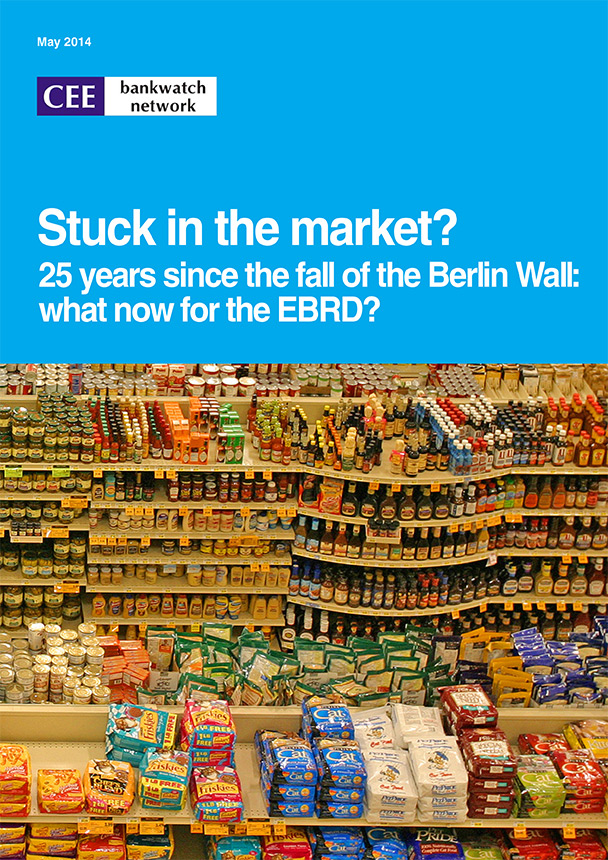
Stuck in the market? 25 years since the fall of the Berlin Wall: what now for the EBRD?
Publication | 14 May, 2014Harsh, embedded economic realities such as widespread, high unemployment across central and eastern Europe, as well as the discernible trend of democratic retrenchment in several EBRD recipient countries, are resulting in very mixed feelings about the transition process in this year of important anniversaries. This new analysis of how the EBRD conducts its financing and economic advisory activities finds serious deficiencies in the bank’s overall ‘market-oriented’ approach and catalogues a range of startling EBRD interventions.
Read moreBankwatch Mail 59
Publication | 13 May, 2014Coinciding with the annual meeting of the European Bank for Reconstruction and Development, this issue examines how some of the EBRD’s transition recipes turned out almost 25 years after the fall of the Berlin Wall. In addition, controversies with current projects and recent policy revisions provide a rather grim outlook for what further transition will bring for old and new countries of operation of the EBRD.
Read moreDoes European financing facilitate the implementation of the Espoo convention in nuclear-energy related activities? Experience from Ukraine.
Publication | 9 May, 2014Public finance can play a role in ensuring nuclear safety and the transparency and accountability of government decisions related to nuclear energy by encouraging governments to fully apply Espoo procedures at earlier stages of the programme or plan and to provide more information about loan conditionalities. However, only a limited positive effect has been seen in Ukraine due in part to a lack of transparency by the financial institutions and to the selective application of convention requirements.
Read moreThe village of Junkovac near the Kolubara mine – neglected and destroyed
Publication | 9 May, 2014The story of Junkovac in Serbia highlights systemic violations of human rights, neglect and wrong doings in the lignite mining sector that have not changed since the involvement of the European Bank for Reconstruction and Development began in 2000. One of most recent cases of violations of human and property rights involves the illegal dumping of overburden from the mines at the Junkovac site that for years has been a threat to the properties and lives of hundreds of people in the nearby village.
Read moreMore for pigs than people: experience with Danosha’s expansion in Ukraine
Publication | 7 May, 2014In 2013 the EBRD approved a loan of EUR 35 million to Danosha, a Ukrainian industrial pig farming company. Categorised as ‘B’ by the bank, the project didn’t require an Environmental Impact Assessment or public participation. Yet experience shows that Danosha’s activities are associated with adverse environmental and social impacts, and the situation has been worsened by the fact that the company does not publish any information about its impacts on the environment, public health and safety at its farms.
Read more
