• Skip to primary navigation
  • Skip to main content
  • Skip to footer

Bankwatch

  • About us
    • Our vision
    • Who we are
    • 30 years of Bankwatch
    • Donors & finances
    • Get involved
  • What we do
    • Campaign areas
      • Beyond fossil fuels
      • Rights, democracy and development
      • Finance and biodiversity
      • Funding the energy transformation
      • Cities for People
    • Institutions we monitor
      • European Bank for Reconstruction and Development
      • European Investment Bank
      • Asian Infrastructure Investment Bank
      • Asian Development Bank (ADB)
      • EU funds
    • Our projects
    • Success stories
  • Publications
  • News
    • Blog posts
    • Press releases
    • Stories
    • Podcast
    • Us in the media
    • Videos
  • Donate

Home > Archives for Blog entry

Blog entry

9 reasons why the EU’s bank is no climate leader


As declarations emerge from Paris about the billions and trillions of dollars needed to combat the affects of climate change, the world’s largest public lender, the European Investment Bank (EIB), is positioning itself as one of the pioneers in this effort. Together with other multilateral development banks, the EIB is posing as the vehicle to distribute these vast sums of money, and as the EU’s house bank, it has a guaranteed role to play in the bloc’s contribution to the fight against climate change, both within Europe and beyond.

But is the bank really fit for purpose? Can the EIB make a break from its history of financing fossil fuels and polluting forms of transportation after decades of cosy relations with the biggest culprits?

We look behind the façade and at the numbers and find nine reasons why the EIB is not the climate’s knight in shining armour.


1. Leader in climate finance … in five countries

According to an EIB evaluation (pdf), 70 per cent of the bank’s EUR 75 billion in climate finance between the years 2010 and 2014 was limited to just five countries: Germany, France, UK, Italy and Spain.

A closer look at the bank’s projects from 2014 that are counted as climate action reveals an even more glaring imbalance. The 13 EU Member States in central and eastern Europe (CEE) collectively received less than one per cent (EUR 42 million) of the EUR 4.5 billion the EIB lent for renewable energy within the EU in 2014. Of the EUR 2 billion for energy efficiency, only EUR 148 million (7.4 per cent) went to the CEE region.

Overall, CEE countries received only 10 per cent of the EIB’s climate action lending in 2014 in spite of the energy intensities of their economies compared to the EU average. (Source: EIB climate action lending database 2013-2014 (xls))


2. Energy efficiency accounts for just two per cent of EIB lending

The European Commission has underlined the need to fundamentally rethink energy efficiency by introducing the Energy Efficiency First principle, i.e. to consider the potential for energy efficiency first in all energy related decisions. The EIB couldn’t be farther away from making this a guiding principle for its lending. As a cross-sectoral issue, energy efficiency measures constituted only 2.8 per cent of the EIB’s total lending in 2014. (Sources: EIB climate action lending database 2013-2014 (xls) for total energy efficiency lending; EIB 2014 Statistical Report (pdf) for the volume of signed loans.)

In spite of this, the Commission touts the bank as an important player for boosting energy efficiency investments in the EU. In its November Communication on the State of the Energy Union, the Commission proposed that the EIB-managed European Fund for Strategic Investments (EFSI) helps Member States and project promoters boost energy efficiency schemes. If the EIB’s track record is anything to go by, energy efficiency is likely to be reduced to a footnote in the EFSI scheme.


3. Massive support for Europe’s car industry

Despite repeated calls to transform the global transport system away from private road transport, car manufacturers received a significant 11 per cent of EIB climate finance between 2010 and 2014.

As the EIB admits:

“Slightly over 40% of Climate Action RDI [Research, Development, Innovation] volume went to the German automobile sector. […] RDI operations on new RE [renewables] technologies are virtually absent from the Climate Action portfolio”.

Throwing more money at one of the most polluting modes of transportation is not the most effective form of climate finance. Adding insult to injury, car producers have actively circumvented and undermined the promised emission reduction efforts, which brings us to point four.


4. Generous EIB climate finance for the Volkswagen group

Since 2009 the EIB lent the Volkswagen group EUR 1.5 billion from its climate action programme to improve fuel efficiency and reduce emissions from its engines. Without more detailed information from the EIB about Volkswagen’s use of these loans, their contribution to emission reductions action is unknown.


5. One hand doesn’t know what the other is doing

While the EIB boasts about being a leader in climate finance, it still supports climate damaging projects with billions of euros. The EIB’s sustainability report (pdf) approximates that projects in 2014 resulted in 4.7 million tonnes of greenhouse gas emissions, the equivalent of putting 2.35 million new cars on the road.

For example, the construction of a 37 kilometre expressway adjacent to the Warsaw ring road in Poland is forecasted to contribute absolute emissions of 134 000 tonnes of CO2 equivalent per year. A gas extraction project in Tunisia will add another 1.5 million tonnes of CO2 equivalent per year.


6. EIB fossil fuel finance in European Neighbourhood countries

Between 2007 and 2014, the EIB provided EUR 3.2 billion for fossil fuel projects in sixteen countries of the European Neighbourhood Policy. Only EUR 780 million went to renewable and energy efficiency projects, the majority of which is located in just one country, Morocco.

For more, see the full infographic and executive summary of a study on EU financing in the energy sector of European Neighbourhood Policy countries.


7. Turning its back on the EU’s long term climate objectives?

In its new climate lending strategy approved in late September 2015, the EIB decided to drop a reference to the EU’s 2050 low-carbon economy roadmap. Despite bank statements repeatedly naming climate action a top lending priority since 2010, the new climate strategy fails to commit to EU decarbonisation goals.


8. EIB’s emissions standard for energy production lags behind

The EIB Emission Performance Standard (EPS) for the energy sector is currently set at a level of 550 g CO2/kWh. An EPS is a limit on the amount of CO2 that can be emitted by a power station. Conventional hard coal combustion results in the emission of approximately 850g CO2/kWh, while the most efficient gas power plants emit about 300g CO2/kWh.

During consultations on the EIB’s new climate policy, civil society organisations (E3G (pdf), WWF (pdf)) pointed out that this level is inconsistent with the EU 2050 climate target since it allows financing for infrastructure, like new oil-fired plants, with too high emissions to reach the 2050 target. Lying above the minimum level required (450 g CO2/kWh) to support the EU’s climate target the EIB’s EPS also lags behind similar standards introduced by the UK, the US and Canada.

This means that the bank may still finance fossil fuel-fired power plants that are less efficient than they could be.


9. Climate impact swept under the rug for one third of the EIB’s lending

Even though loans distributed through financial intermediaries, such as commercial banks and private equity funds, totalled 31 per cent of EIB lending in 2014, the bank still lacks a methodology to calculate the climate impact of this type of lending.


Subscribe to our newsletter


Šefčovič’s underwhelming outlook for the Energy Union’s role in the energy transition

Bern Convention Committee to decide fate of Balkan lynx and Boskov Most hydropower plant in Macedonia


At a meeting in Strasbourg from December 1-4, the Standing Committee of the Bern Convention on the Conservation of European Wildlife and Natural Habitat will agree on recommendations for the Government of Macedonia regarding hydropower developments in the Mavrovo National Park.

The forthcoming agreement by the Standing Committee is the tail end of an investigation into plans to construct at least sixteen hydropower installations in Mavrovo. In early 2013 a group of civil society organisations concerned about keeping the park intact and preserving an important habitat for the Balkan lynx filed a complaint with the Secretariat of the Bern Convention.

The current draft recommendations (pdf) ask the Macedonian Government to “suspend the implementation of the hydropower plants foreseen within the territory of the Mavrovo National Park”. They are based on a report (pdf) prepared after an on-the-spot appraisal this year in Macedonia by independent experts and observers.

A confirmation of the draft conclusions at this week’s meeting would greatly improve the chances for the Balkan lynx to remain in its territory, after being declared critically endangered by the International Union for Conservation of Nature and Natural Resources (IUCN).

The draft recommendations also explicitly address international financiers, including the European Bank for Reconstruction and Development (EBRD), and ask to suspend financing for projects in the territory of the Mavrovo national park. The EBRD approved EUR 65 million financing for the 68 MW Boskov Most Hydro Power Plant – a decision in breach of the bank’s own environmental policy.

The Boskov Most area in the Mavrovo national park in considered the core reproductive area for the Balkan lynx species whose mature population is estimated to count less than 50 individuals. The construction of the Boskov Most hydropower plant would likely cause great harm to the fragile population of this endangered species. The observers to the on-the-spot appraisal mission have stated in their report (pdf) that

“following the precautionary principle, the project as currently designed must be abandoned until the conservation status of the Balkan lynx population is brought back to a safe level and until when the Mavrovo National Park is no longer the only known core area of reproduction of this species.”

Non-governmental organisations involved in the case – Bankwatch’s Macedonian member group Eko-svest (who filed the complaint), Front 21/42 (an environmental lawyer organisation) and the Macedonian ecological society (biologists who have done GPS monitoring of the lynx in Mavrovo) – will be attending the Standing Committee’s meeting. They will ask delegates to adopt stronger recommendations that demand the cancellation of hydro projects planned by the Macedonian government and the EBRD.

Follow us on Twitter for updates from Strasbourg >>


Exporting toxic pollution from Europe to Namibia


While people associate Namibia with African wildlife, the gateway to its largest sanctuary, the Etosha national park in the northwest of the country has little to keep tourists there. The polluted air in the town of Tsumeb, home to exhausted open pit mines and a copper smelter, is something the 16 000 or so inhabitants have to live with and foreigners try to escape from.

Yet, it is not only the heavy air that has been of concern. The waste disposal site is piling up with arsenic that was left from the smelting of European ore and has caused fears of contaminated soil and water. It also raises questions about the intricate scheme of how European pollution is exported to the Global South with indirect help of public development money.

The Tsumeb smelter is an old trouble maker, created to process some of the dirtiest copper ore in the world. For years the air around the smelter is filled with fugitive emissions – from arsenic dust to sulphuric dioxide.


An old sign from a previous mining company in Tsumeb

Local people claim that some of their garden plants and crops are ailing from this pollution. And not only plants are affected. A health report tested the urine of a few hundred locals. The arsenic concentration in the urine samples was high – even for people living 60 km away from the smelter.

Development is not simply bought or built.

Find out more

Making a virtue out of necessity

The Tsumeb smelter belongs to Dundee Precious Metals, a Canadian company that operates and develops gold, copper and silver mines in Bulgaria, Armenia and Serbia. The European Bank for Reconstruction and Development (EBRD) provided the company with a EUR 20 million loan in 2005 and a USD 45 million revolving credit later in 2012 in order to increase the ore recovery at the DPM-owned Chelopech mine in Bulgaria among other things. With its higher yield, the Chelopech mine has for years kept the Tsumeb smelter economically going – half of the copper concentrate smelted in Tsumeb comes from Chelopech.

The Tsumeb smelter has a reputation of being among the few in the world capable of processing ore that is abundant in arsenic, a toxic compound dangerous to human health if not managed properly. It was a practical choice for Dundee to ship ore from Chelopech to Africa where environmental standards are more lax and refurbishment costs are lower. Back in 1988, the Bulgarian government had banned local facilities from processing the Chelopech ore because they were not able to handle the high arsenic concentrations without environmental consequences. (The alternative of cyanide leaching was rejected by Bulgarian society.)

Dundee acquired the Tsumeb smelter in 2010 with a special clause that exempts the company from any liabilities related to the environmental damage caused by the past owners. Adding to the dark legacy, the smelter has treated concentrates that contain twice as much arsenic as the ones processed in the past and the capacity of the smelter has more than doubled after technological upgrades, including the construction of new oxygen and acid plants.


Highly toxic waste stored in sugar bags.

Piling up the arsenic pollution

In Tsumeb the concentrate gets smelted under high temperatures to separate the copper from sulphide, arsenic and other compounds it contains, leaving just the metal behind. As a by-product of extracting arsenic from the ore, arsenic trioxide is produced and later sold by Dundee Precious Metals for the manufacturing of wood preservatives and herbicides. Since Europe and the USA have stopped using arsenic trioxide in the production of agriculture and wood treatment, Dundee sells arsenic to the smaller markets in South Africa and Malaysia and stores the excess at a hazardous waste site at the town’s outskirts.

The smelter is an important employer in the town and its vicinities, providing full time positions to 448 people and indirect jobs to as many as 1,466 subcontracted workers. Dundee also maintains a community fund.

Concerned about the payroll loss, locals think twice about whether to submit grievances. Despite the risks, locals dared to speak out and convinced the Namibian government to conduct an audit probing health and environmental impacts of the smelter. Finalised in January 2012, the audit concluded that the smelter was affecting negatively the environment and the health of the employees and the community. As a result, the government issued an order that the smelter needs to reduce its capacity feed by half and adopt technological improvements.

Pleased by the smelter upgrades, the government lifted the curtailment on the quantities of concentrate to be treated in Tsumeb in December 2013. Dunde Precious Metals claimed to have invested over USD 110 million into emissions improvements that have reduced both inhalable arsenic levels and arsenic contamination of the workers.

Yet, a site visit by Bankwatch staff in August 20015 revealed that the upgrades have likely not touched the hazardous disposal site. As visible from the photographs (below), the highly toxic arsenic trioxide is stored in sugar bags at a dump-site situated just a few hundred meters away from the Tsumeb houses. Although, lined on a non-permeable liner, the bags are unprotected from the wind and sun from the top. The site has been filled at accelerated rates and seems to be at the brink of its capacity, storing what looks like tens of thousands of tons of arsenic dust and other production waste piled in several layers already.


The Tsumeb waste dump where the highly toxic arsenic trioxide is being stored in sugar bags. Photos from three different years show how the site has filled up over time and is about to reach its limit.

Bankwatch staff has for months attempted to retrieve environmental documentation, including the Environmental and Social Impact Assessment to understand how Dundee manages toxic waste and prevents arsenic contamination among its workforce and the local population. Their repeated requests for a meeting with the smelter management have been turned down just like the requests for disclosure of documents to the company and the Ministry of Environment.

Tsumeb is a blatant example of a Western company exporting toxic pollution from Europe to a less restrictive developing country. The fact that European development finance is involved makes the EBRD shareholder governments complacent in the environmental wrongdoing associated with the mining industry. This should be sufficient reason for the bank to withdraw from financing ore extraction projects.

The EBRD: Fueling the future, or stuck in the past?


This article was originally published on Mada Masr and has been reproduced here with kind permission.


Three years after the first investments arrived in Egypt, Jordan, Tunisia and Morocco from the European Bank for Reconstruction and Development (EBRD), the London lender announced a quarter of a billion dollar program to support new renewable energy projects across the region.

Although the bank says it “wants to push renewables to the next level,” new research shows there is not often the money to back this up.

The EBRD has established itself as one of the leading multilateral lenders for the energy sector in the region it refers to as the southern and eastern mediterranean (SEMED). Established in 1991, with a dual mandate to finance economic transition and sustainable development in Eastern Europe and the former Soviet Union, the bank was given a similar task by its government shareholders after the popular uprisings that swept the Arab region in 2011.

Of the 1.5 billion euros invested in SEMED by the EBRD between 2012 and 2014, the energy sector accounted for about 40 percent of the total, or 604 million euros. Energy investments were particularly important to Egypt and Jordan, where they made up 37 and 72 percent of total EBRD financing respectively.

But a closer look at the projects that the bank has financed in the energy sector reveals that, despite the bank’s rhetoric about promoting sustainable energy, its balance sheet for 2012-2014 has fossil fuels all over it.

A matter of perspective

When viewed through the lens of Bankwatch’s research, the amount of money invested in sustainable energy, and especially energy efficiency, differs significantly from what the EBRD maintains. If an energy efficiency project leads to the use of more fossil fuels — be it through an increase in the capacity of an energy installation or otherwise — then it surely should not be regarded as an energy efficiency project.

One illustration is the 156 million euros the EBRD lent to the state-owned Egyptian Electricity Holding Company. The project consists of the conversion of two existing power plants at Damietta West and El Shabab to combined cycle gas turbines, in order to increase their generation capacity. Bankwatch sees this as a project that will essentially use more fossil fuels, as opposed to the EBRD, which accounts for it an as efficiency gain.

Neither does Bankwatch believe that new, so-called “greenfield” electricity and heat power plants (co-generation plants) should be seen as energy efficiency projects. Depending on the energy source used, such projects are classified either as renewable energy or fossil fuels. Take for instance the Abdali District Heating and Cooling plant in Jordan, which the EBRD presents as an energy efficiency project, even though it is difficult to know exactly what fuel the new plant will use.

Similarly, the bank views any component in the construction of a new fossil fuel-fired power plant that provides energy savings as an energy efficiency project. Bankwatch believes that such a project should not be considered green, as it will lead to the increased use of fossil fuel. This is the case with the Manakher Power Project in Jordan.

The Manakher power plant, which burns a mix of gas, heavy oil and other fossil fuels, received 130 million euros from the EBRD, in spite of vocal concerns from local residents about the project’s impacts. While the EBRD has claimed that the project will ensure a secure electricity supply for Jordan, it may in fact have the opposite effect, since Jordan is dependent on gas imports from Egypt. In 2004, the two countries signed a 15-year agreement for the supply of gas, but bombings of the pipeline running through Sinai since 2011 and the shortages in Egyptian gas deliveries led the Jordanian government to increase gas prices. Last year Jordan’s state-owned power company also signed a 15-year deal for the purchase of natural gas from Israel, adding to concerns about the future security of energy supplies.

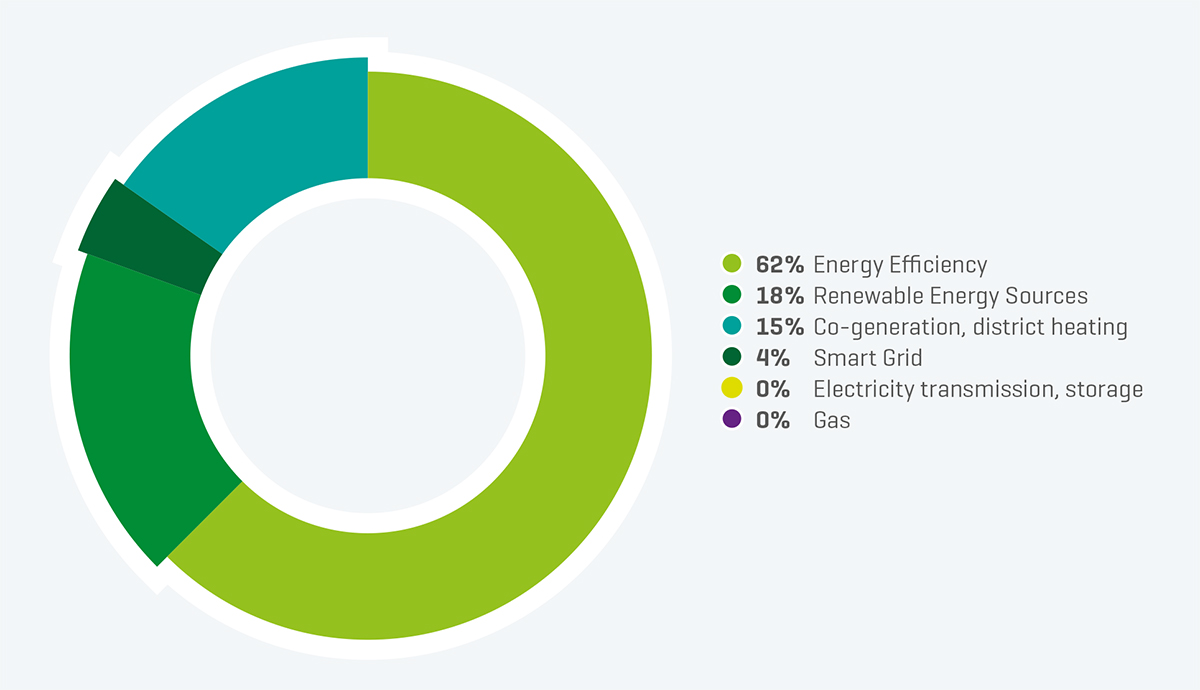
EBRD financing for energy by subsector in SEMED, 2012-2014
*EBRD financing for energy by subsector in SEMED, 2012-2014

Stuck in the past

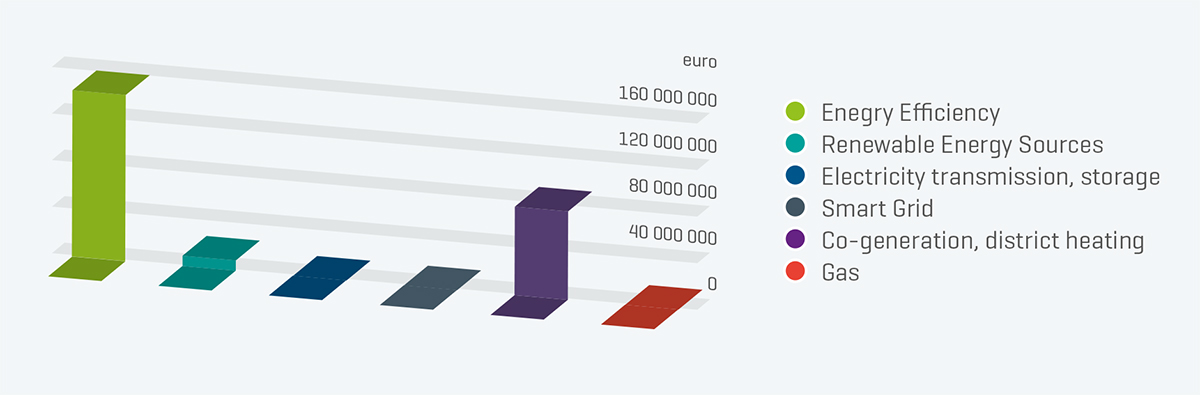
Research has indicated that, between 2012 and 2014, almost 70 percent of the bank’s financing in SEMED countries’ energy sectors (419 million euros) was spent on oil and gas-based electricity generation, as well as hydrocarbon extraction and distribution. By contrast, the bank’s support for renewables and energy efficiency totalled just 14 percent, or 85 million euros.

The difference in the amount of financing for fossil fuels and renewables is particularly striking in hydrocarbon-dependent Egypt. Egypt already ranks among the world’s fastest growing greenhouse gas emitters, and the EBRD’s 239 million euros for financing fossil fuels is likely to solidify this trend. Part of this public money was spent on offshore gas drilling.

EBRD financing for renewables and energy efficiency versus fossil fuels by country, 2012-2014

At the same time, the EBRD did little to decrease the energy intensity of Egypt’s economy, which ranks among the highest in the world. Small renewable and energy efficiency projects in the country received a meagre 24 million euros. In Jordan, a country awash with solar and wind power potential, the bank lent just 61 million euros for four solar projects.

The bank has also failed to diversify its renewables portfolio and to penetrate all SEMED markets. Although the region is rich in wind, solar, geothermal (and to lesser extent hydropower) potential, the bank invested only in solar power (the projects mentioned above in Jordan). Neither Morocco nor Tunisia received EBRD investments for renewables or energy efficiency.

EBRD financing of energy projects by type, 2012-2014

Signs of change?

Political developments and legal barriers in the SEMED region are certainly a hindrance to the business climate that the EBRD operates in and complicates the bank’s sustainable energy initiatives. While there have been encouraging signals in 2015 that the EBRD is progressing in deploying renewable energy sources and energy efficiency in the region, EBRD lending for the energy sector over the last three years has not helped alleviate these countries’ historic dependence on fossil fuels. It remains unclear whether the bank’s recent announcement will become reality or mere rhetoric.

Poland and the Energy Union: Legitimising Europe’s flagship climate laggard?


“The idea of creating the Energy Union came to life thanks to a Polish initiative. Now, the project is being carried out,” said Maroš Šefčovič, the vice-president of the European Commission and Commissioner for Energy Union, during his visit in Poland in September/October. Indeed, the concept was first voiced by Donald Tusk, the then Polish prime minister, in the context of common purchasing of gas for the European market. Since then, the Energy Union project has moved away from the initial proposal and developed in a broader – and for Poland, not always welcome – way, to include among others a push for more efficiency and for making Europe a leader in renewables.

From the Polish government’s perspective, this is where problems start – because European solidarity in the area of energy is all well and good, until someone raises the dreaded subject of climate change. When it comes to commitments to decarbonisation and shared responsibilities, the Polish call for more European solidarity, so prominent in the discussion about gas imports from Russia, suddenly disappears.

In fact, Poland has often been the one working openly to weaken EU climate targets, recently in the context of the EU’s 2030 climate change agreement, when a Polish threat of veto put the deal at risk. Our government has a track record of delaying transposition of EU climate and energy directives. It also continues to put the economic interests of an increasingly troubled coal mining sector above any and all environmental and health (pdf) concerns (pdf).

Poland’s hope for a low-carbon development has long been paralysed by an inability to deal with the hard coal-mining sector.

Poland’s hope for a low-carbon development has long been paralysed by the inability of successive governments to deal with a hard coal-mining sector that is constantly on the verge of insolvency, as well as the increasingly obsolete coal-burning industries inherited from Poland’s communist era.

Even key national strategic documents and policies, in particular the recently published Energy Policy 2050 mostly reflect present political interests, especially those of the powerful coal mining lobby. The external costs of pursueing a carbon-intensive business-as-usual are being ignored. Renewable energy is portrayed as a burden imposed on the country by Brussels bureaucrats and not as an opportunity to pursue the long-term interests of the country, its economy and its citizens.

Unearned praise and skewed priorities

In light of this, the Energy Union, as an EU-wide policy and legal framework, could be an important opportunity to set a clear agenda for the transformation of the Polish energy system.

All the more important, in fact, in light of the recent general election, which put Poland’s energy and climate policy once again on European headlines. The winning party – the conservative Law and Justice (PIS) led by Jarosław Kaczyński – makes no secret of its anti-climate position and promises to do whatever it takes to save Polish coal mines – even renegotiate Polish commitments under the EU climate and energy 2030 package – the same commitments which underpin the creation of the Energy Union.

Yet, in light of the European Commission’s recent Energy Union assessment for Poland (pdf), the hope that an impulse for change will come from the EU is quickly disappearing.

The document praises Poland for being on track to meet its 2020 energy and climate targets but a closer look makes it hard to be excited about that. Since 2000, Poland’s greenhouse gas emissions have remained more or less constant, at around 85% below 1990 levels – and this has happened without much extra effort, as the bulk of the reduction took place in the 1990s as a result of the transformation to a post-communist economy. Moreover, Poland was actually allowed to increase its emissions not included in the EU’s Emissions Trading System by 14% above the 2005 baseline.

In Poland, almost 45% of the so-called renewable energy is produced through co-firing – the simultaneous burning of coal and biomass. Co-firing consumed almost 40% of public subsidies to renewable energy between 2005 and 2012.

Another Europe 2020 target obligates Poland to reach a 15% share of renewable energy sources in gross final energy consumption. With the current 11.3% Poland indeed seems on track to reaching it. Except what counts as ‘renewables’ is a different question. In Poland, almost 45% of the so-called renewable energy is produced through co-firing – the simultaneous burning of coal and biomass – which could hardly be called green energy.

With regards to transposing the EU Renewable Energy Directive the Energy Union assessment reads: “Poland engaged into a long-term process of reforming its support system for renewables and reducing administrative barriers to market entry for renewables.” This is one way of saying that Poland was almost 5 years late with adopting a dedicated renewables law and reforming a dysfunctional support system based on green certificates. Due to this faulty system co-firing consumed almost 40% (pdf) of the already meagre public subsidies to renewable energy between 2005 and 2012.

But the true danger of the Energy Union assessment of Poland lies not in the unearned praises but in framing energy security only as stable and diversified gas supplies and increased interconnection capacity – which, in the case of Poland, is mostly related to coal power plants. This could mean perpetuating the country’s dependence on fossil fuels.

Energy security, particularly in the context of Russian gas imports, has become a hot topic in Polish public discourse. The prevalent response is to shun any restrictions on the use of indigenous energy resources, such as coal and shale gas. But we cannot discuss security of supply without honestly addressing the worsening situation on the hard coal market and the adverse impacts and external costs of fossil fuel mining and burning.

The missing points: energy efficiency and renewables

Even more so, we cannot discuss supply without first addressing demand – and prioritising energy efficiency measures over new generation and transmission projects is missing from the Commission’s assessment. Poland’s economy remains one of the most energy-consuming in Europe, with energy intensity more than double than the EU average. Energy poverty remains a widespread problem, with more than 20% of Poles not able to afford comfortable temperature at home during winter, mainly due to the poor energy standard of residential buildings.

As the Commission’s assessment points out, the Energy Union strategy must indeed help Poland “strengthen the targeted use of financial instruments for increased investments [in energy efficiency]”, but simply throwing money at Poland is not going to be enough. Investments in energy efficiency across all sectors, particularly in the housing sector, are indeed urgently needed – but to be effective they must be based on clear and focused strategies and a solid legal framework, not least the long overdue transposition of the EU energy efficiency directive.

Something else is conspicuously absent from the Energy Union assessment of Poland – and that is renewable energy. The Commission’s review quietly overlooks both the huge potential (pdf) for the production of clean energy, particularly in small, decentralised sources, and the fact that political support for the development of renewable energy sources is almost non-existent. Investments in wind, solar and small biogas are lagging because of the unstable and often outright unfavourable investment environment. Policymakers have openly been opposing renewables, even actively trying to dilute provisions to introduce feed-in-tariffs for micro-installations in the recently adopted renewables law, even before they take effect in 2016.

In the official discourse, renewables continue to be depicted not as an opportunity for innovation, sustainable growth and green jobs, but as a risk to the stability of the power grid and a financial burden to end consumers. In its silence, the Commission’s assessment is a lost opportunity to change this discussion.

Clean coal appeasement

One sentence by Šefčovič, during the Polish stop on his Energy Union tour, captures the Brussels method of dealing with Poland. “Coal should stay in the national energy mix, but it must be clean,” said the Commissioner, making sure not to antagonise his hosts.

In fact, echoing the Polish government’s rhetoric, which has repeatedly pushed coal under the umbrella of sustainable energy solutions, this could well fall under the Energy Union’s “Research and Innovation” pillar. For Polish policy-makers clean energy often means more efficient and modern coal burning, upgraded smart grids which would minimise transmission losses from coal burning, and coal-based district heating as a solution to air pollution.

The Energy Union concept might have originated in Poland as an idea of common gas purchasing, but ultimately it is the myth of “clean coal” which could become Poland’s true imprint on the shape of the Energy Union.

The final decision on a country’s energy mix remains its own – but there is a clear and urgent need for the Energy Union strategy to put more emphasis on transforming the energy system in Poland, shifting focus from security of supply to decarbonisation, moving towards small-scale, decentralised renewables and greater energy efficiency – especially in the coming era of a PIS government.

« Previous Page
Next Page »

Footer

CEE Bankwatch Network gratefully acknowledges EU funding support.

The content of this website is the sole responsibility of CEE Bankwatch Network and can under no circumstances be regarded as reflecting the position of the European Union.

Unless otherwise noted, the content on this website is licensed under a Creative Commons BY-SA 4.0 License

Your personal data collected on the website is governed by the present Privacy Policy.

Get in touch with us

  • Bluesky
  • Email
  • Facebook
  • Instagram
  • LinkedIn
  • RSS
  • YouTube