• Skip to primary navigation
  • Skip to main content
  • Skip to footer

Bankwatch

  • About us
    • Our vision
    • Who we are
    • 30 years of Bankwatch
    • Donors & finances
    • Get involved
  • What we do
    • Campaign areas
      • Beyond fossil fuels
      • Rights, democracy and development
      • Finance and biodiversity
      • Funding the energy transformation
      • Cities for People
    • Institutions we monitor
      • European Bank for Reconstruction and Development
      • European Investment Bank
      • Asian Infrastructure Investment Bank
      • Asian Development Bank (ADB)
      • EU funds
    • Our projects
    • Success stories
  • Publications
  • News
    • Blog posts
    • Press releases
    • Stories
    • Podcast
    • Us in the media
    • Videos
  • Donate

Home > Archives for Blog entry

Blog entry

All we want for Christmas is to be able to breathe …


On Sunday 21 December parallel protests against air pollution took place in the northern Montenegrin town of Pljevlja and Zenica in central Bosnia and Herzegovina. Pljevlja suffers from a combination of an ageing lignite power plant, use of wood and lignite for heating in homes, an ash landfill and open-cast mine that blow dust around on dry days and an unfortunate location in a depression that prevents the pollution from being dispersed. Zenica suffers from hosting a steel mill run by ArcelorMittal, which in spite of a 2005 EUR 25 million EBRD loan that was supposed to reduce pollution, is still the town’s worst polluter. The facility is regularly subject to protests, especially in the winter when pollution is compounded by atmospheric conditions and use of coal and wood for heating.


Image (c) Arnika

The facilities causing the pollution are different, but the situation in the two towns has some striking similarities. In both cases there has been years of ping-pong about where the blame for the pollution lies. Local and national authorities put the emphasis on domestic use of coal and wood or in the case of Zenica, also traffic, and largely ignore the – very visible – role of the towns’ main industrial facilities. At the Pljevlja protest this was wryly illustrated by a humble domestic wood-burner with a placard confessing “I admit it, it’s all my fault”.


Image (c) Ozone Environmental Movement

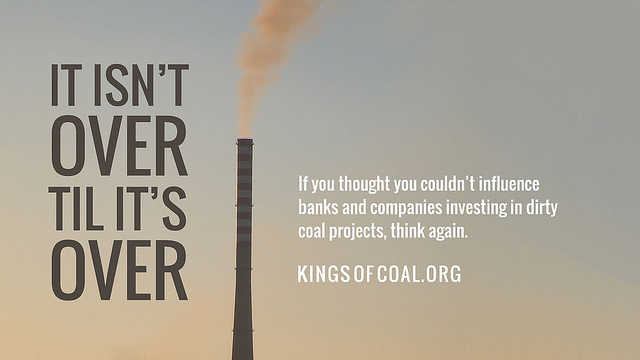
Online toolkit for coal campaigners in Turkey and the Balkans

A multilingual website that explains how to contact the investors behind a project, which policies guide their decisions and how best to influence them.

KINGSOFCOAL.ORG

Another similarity is that the protests’ demands are startlingly simple: implement the law. The legislation in the Federation of Bosnia and Herzegovina is not as strict as EU air quality legislation, but Zenica doesn’t even manage to comply with that. For SO2, the limit of 125 µg/m3 is not allowed to be exceeded for more than three days in a calendar year, but according to EkoForum Zenica, in the first half of 2014 this limit was exceeded no less than 131 times. On Sunday, therefore, the goal was to gather support for Eko-Forum to submit a lawsuit against those responsible for failing to ensure that the law is upheld and public health protected.

In Pljevlja, on 30 November at 21:00 the concentration of PM10 dust particles in Pljevlja was 516.8 µg/m3, which is more than 10 times the permitted average daily concentration and a record for this year. Various lawsuits have already been submitted by local NGO Breznica, among other things because the maximum daily concentration of PM10 and PM2.5 was exceeded for 171 days in 2013. The cases are ongoing.

The worrying thing in Pljevlja is that instead of committing to spend money on bringing the existing lignite power plant into compliance with EU standards, the authorities in Montenegro are obsessed with building a second unit. This is sold to the local population as something that will improve the pollution situation, but the claim seems overstated, as the two plants are planned to run in parallel for several years, thus increasing the pollution rather than diminishing it. Another claim made in connection with the second unit is that district heating will also be installed which would reduce pollution from individual households, but as yet there is no evidence for this, and the same thing was said when the original plant was built in the late 1970s but never happened.

The situation in Pljevlja and Zenica has lasted for years, and many people have been ready to put up with the situation for far too long as either they or their relatives work at ArcelorMittal or the Pljevlja power plant complex and are afraid of the consequences of speaking out. But EkoForum’s readiness to submit a court complaint and a recent debate in the Montenegro parliament on the situation in Pljevlja show that the issue is moving to a higher level. It won’t be easy, but if the people of Pljevlja and Zenica stay strong and persistent, their future may look much brighter.

[Campaign update] KOSID contests the opening process of the tender for the ‘New Kosovo’ Power Plant


Kosovo Civil Society Consortium for Sustainable Development (KOSID) has contested the opening process of the tender for the Power Plant ‘New Kosovo’ with only one bidder, based on Article 32.4 of the Kosovo Law on Public Procurement, according to which, “If during the conduct of a procurement activity, less than two responsive tenders or, where applicable, requests to participate are received; the contracting authority shall cancel the procurement activity.” Given that for the Power Plant ‘New Kosovo’ just one bidder has applied (Contour Global), this process falls directly contrary to the law.

It should be remembered that from the beginning of the process this project has been accompanied by non-transparent procedures and an unjustified amount of money spent for technical assistance. Moreover, the whole decision-making process on this project with a significant financial and environmental impact is happening at the end of the year and during an institutional transition period.

The Government of Kosovo is pursuing double standards compared to the opening of bids for the privatization of public enterprises. While for the opening of bids for the Post and Telecom of Kosovo last year, the Government invited the media and other interested stakeholders to participate in the bid opening, the opening of the bids for the ‘New Kosovo’ project was held in secret.

Furthermore, we are concerned by the political intervention by the former Prime Minister of Kosovo, currently the Minister of Foreign Affairs, Hashim Thaçi, in this project before the final decision is taken by the Project Steering Committee (PSC). Through a post in Facebook, Thaçi announced that this decision would be “the most serious decision which will lead to economic development and creation of new jobs.”

The ‘New Kosovo’ project is not the only project that violates the standards of privatization and investment in Kosovo, but, considering its sensitivity and its impact on health and environment, the ‘New Kosovo’ project should not be treated as previous projects.

If procedural standards are not respected and legal violations are happening even before the tender is awarded, how can we expect that the building and operation standards will be respected by the eventual winning company?!

Hence, KOSID requires the Project Steering Committee (PSC) of the ‘New Kosovo’ power plant to cancel the tender process for this project and not proceed with further violations of laws in force in the Republic of Kosovo.

Dust, displacement, intimidation – Mongolian herders are under pressure by iron ore mine


UPDATE February 9, 2015: The multimedia story is now also available in Polish language.

Whether it is animals getting sick of road dust, the loss of winter camps or the loss of access to water, the Tayan Nuur iron ore mine, owned by the Mongolian company Altain Khuder, has brought severe challenges to nomadic herder families in the Gobi Altai mountains.

If you haven’t done so, you can read and watch our multimedia story “When the dust settles” to see herders explain the problems they have since the mine came. The story is one of the products from a fact-finding mission to the Gobi Altai mountains earlier this year that we did together with researchers from the Centre for Research on Multinational Corporations (SOMO, the Netherlands) and OT Watch (Mongolia).

Read and watch the multimedia story >>” width=”585″ height=”306″ /></a><br />
<em>(Click image to read and watch the story, <a href=click here to read it in Polish language.)

While impacts on local communities are not a novelty in the mining business, Altain Khuder might be a particular case due to its source of financing and its overly hostile approach to dealing with complaints.

More materials


When the dust settles – How an iron ore mine threatens nomadic herders’ livelihoods in Mongolia
Multimedia story | December 9, 2014


Fact-finding mission report: Impacts of the Tayan Nuur iron ore mine on nomadic herders’ lives in Mongolia (pdf)
Study | December 9, 2014


Impacts of the global iron ore sector – Case study: Altain Khuder in Mongolia (pdf)
SOMO case study | December 17, 2014


Images from Gobi Altai, Monoglia
Flickr photo set


Background


Mining boom in Mongolia
Background, updates, publications

Altain Khuder is financed by the European Bank for Reconstruction and Development (EBRD), a publicly owned financial institution that – at least on paper – requires its clients to implement certain social and environmental standards.

So far, however, it is questionable if Altain Khuder is adhering to these standards. Responding to a draft version of our fact-finding mission report (pdf) that we launched today the company informed us that third party checks certify that dust pollution is within limits and that an assessment done by a company-hired consultant concluded that resettlement did not lead to any loss of herders’ assets. Unfortunately, herders have neither seen the pollution test results, nor do they have any recollection of their assets being assessed. Instead, when trying to raise their concerns with Altain Khuder, the herders faced pressure and intimidation by the company.

Intimidation of herders

Altain Khuder has a history of intimidation. Its security personnel have threatened herders, journalists and NGOs. They did not allow us to stop and take pictures of the mine. One herder told us:

When we get close to there [the mine] looking for our lost animals, the company’s security would chase after us, interrogate us and treat us as if we were thieves.

Worse still, when people complained about the pollution from the mine, Altain Khuder did not hesitate to file lawsuits against altogether 8 people, claiming they defamed Altain Khuder with the intention to cause damage to the company’s business.

The cases continued up to one year during which the locals who were charged had to travel several times the more than 1000 km to Ulaanbaatar, each time leaving their work behind. After causing a tremendous amount of burden the cases were finally dismissed.

European financing, but not European standards

Altain Khuder received financing of up to USD 55 million (EUR 44 million) from the European Bank for Reconstruction and Development. [1] The EBRD likes to claim that by being involved in projects like these, it can help protect the livelihoods of the affected communities.

In many cases, however, the EBRD fails to effectively enforce its standards and it is up to civil society organisations and the affected communities themselves to protect their rights, even in the face of intimidation.

To do its job properly, at the very least, the EBRD has to better monitor Altain Khuder and make sure that it complies with the bank’s policies.

Notes

1. The EBRD-financing includes equity financing of up to USD 25 million and debt financing of up to USD 30 million.

How much will the Macedonian hydropower plant Boskov Most really cost?

The total costs of the Boskov Most hydropower plant project in Macedonia will possibly cost more than twice the projected EUR 84 million, considering that many aspects have so far not been studied or remain unresolved.

The project includes a dam of 33 metres height and a power plant with a total capacity of 68MW. In 2011 the European Bank for Reconstruction and Development (EBRD) approved a loan over EUR 65 million plus a EUR 19 million equity share in the project company ELEM. The project has stirred controversy for being located in the Mavrovo national park, the largest and richest national park in Macedonia and home to the last reproductive population of the Balkan Lynx, an endangered species.

Critics of the project, including Bankwatch and its Macedonian member group EkoSvest have since the beginning complained about the inadequate planning. Three years after the EBRD approved its loan, it looks likely that the many uncertainties and delays of the Boskov Most project will impact its final price tag.

Many uncertainties

Lowest tender almost twice as expensive

The tenders for the power plant construction, published by the EBRD [1] range from about EUR 87 million to about EUR 114 million. Since the tenders are only for the construction (LOT 1) the absolute project costs would be much higher than the currently planned EUR 84 million (which are the same as the finance provided by the EBRD).

Based on information from ELEM the following costs are being calculated in addition to the construction works:

  • ~ EUR 25 million for equipment,
  • ~ EUR 5 million for a connection facility,
  • ~ EUR 12 million for consultancy services,
  • EUR 14 million for expropriation,
  • Plus 20% overhead costs on the total sum.

This would increase the project costs to somewhere between EUR 171 million and EUR 204 million depending on the offer that will be chosen. Not included in the calculation are costs for the transmission line (see below), monitoring and mitigation measures for environmental protection.

However, this is not even the whole story.

A power plant off grid?

The project as it is proposed now does not include a transmission line to connect the power station to the Macedonian grid, obviously an essential part of the project’s functionality. To this day, it is not known who will finance the construction of the transmission line and under what conditions, and unsurprisingly, no environmental impact assessment has been made for this part of the project.

Pending analyses

Several aspects of the project still have to be examined:

  • A series of new studies still needs to be conducted: an economic feasibility analysis is required and should follow the completion of a hydrology and hydromorphology assessments, as well as an analysis of the legislative gaps in the latest one-year biodiversity monitoring survey conducted by the investor ELEM.
  • Additionally, an assessment whether the project is in line with the EU Habitat Directive needs to be carried out before any further decision is made.

None of these analyses have even commenced, making the project cost impossible to gauge at this moment.

The fact that the economic feasibility of the project still has to be assessed creates uncertainty not only for the costs of Boskov Most, but whether it is economically worthwhile at all.

Environmental permit expired

Since the construction of the hydropower plant has still not started, the environmental permit has expired on October 13, 2014. ELEM has yet to submit a request for the extension of the permit, but according to Macedonian legislation a new permit requires the whole environmental impact assessment process to be carried out from the start.

–

At a meeting with civil society in October, the EBRD’s directors visiting Macedonia agreed that the project has been complex and a serious challenge for the bank. They also admitted that the original cost estimations were improper and too low.

Apart from revising cost estimations upwards, however, the fundamental issues with building a power plant in a protected area cannot easily be resolved. There is an inherent value in the Mavrovo national park whose loss will not be reflected in a price tag.

Rather than continuing the ill-conceived Boskov Most hydropower plant (and burdening Macedonian tax-payers with an annual commitment fee of EUR 325 000), the EBRD should cancel the loan for the project.

–

Notes

1. Due to an update of the EBRD’s website the original file is currently not available on the bank’s website. Only a cached copy (pdf) can be accessed via google.


Read more

Balkan lynx stage protest at annual meeting of European Bank for Reconstruction and Development
Blog post | May 15, 2014

Energy security for Europe or profit for Lukoil?


Half a billion dollars from the European Bank for Reconstruction and Development (EBRD) and another half billion from the Asian Development Bank (ADB) are to be invested in Lukoil’s 10 percent share in the Shah Deniz offshore gas field in Azerbaijan (a final decision by the banks is expected in early 2015 but seems certain). (A little reminder: the EBRD is a public bank of both the EU and the US, with EU countries holding over half of voting rights. The Europeans also hold 15 percent of voting shares of the ADB.)

The two banks will finance two bridge-linked offshore gas platforms, 26 subsea wells, 500km of subsea pipelines, the expansion of the gas plant at Sangachal Terminal and the South Caucasus Gas Pipeline expansion.

And perhaps the most obvious irony in all of this is the willingness of international financing institutions backed up by Western governments to work with Russian company Lukoil on this project deemed crucial to the EU’s energy security from Russia.

The Shah Deniz oil and gas field is envisaged to be the main provider for one of Europe’s pet energy projects, the Southern Gas Corridor, a set of planned pipelines meant to bring gas into Europe from the Caspian region. The transportation infrastructure included in the Southern Corridor includes three major pipelines — South Caucasus, Trans Anatolian and Trans Adriatic — and all the Corridor is expected to require a total investment of more that 35 billion euros (45 billion US dollars).

The Southern Gas Corridor has been on Europeans’ minds for years but support for it gained even more momentum since the crisis in Ukraine, with advocates arguing that it is necessary to ensure the EU’s energy security in the face of an ever more aggressive Russia. Various components for the Corridor are now deemed priority energy projects for the EU and are being fast-tracked for financing by European public banks.

The first announcement for European public money support for the Southern Gas Corridor was made by the EBRD President Suma Chakrabarti at a press conference in Baku in July 2013. This July, the bank’s Director for Energy and Natural Resources, Riccardo Puliti, said that the EBRD is considering financing of up to 700 million US dollars for the Trans-Adriatic Gas Pipeline (TAP) and the Trans-Anatolian Gas Pipeline (TANAP) projects.

Land of fire and repression


A photo story from Azerbaijan.

Read and watch

Yet the promise of the Southern Gas Corridor as a guarantor of EU energy security and independence from Russia is questionable for more than one reason. For one, Azerbaijan is in no way a more secure country of supply than Ukraine or Russia. The unresolved conflict between Azerbaijan and Armenia over Nagorno Karabakh, Russia-backed separatist regions like Abkhazia and South Ossetia claiming independence from Georgia, the threat of Maidan-style social unrest provoked by increasingly oppressive and corrupt elites in the region all pose a threat to the stability of Azerbaijan and neighbouring countries on the route of pipelines.

The EBRD justifies its loans by claiming they have a positive „transition impact” on the countries where the projects are located. Yet gas infrastructure is rarely a guarantee of peace and security as the example of Ukraine shows very well. On the contrary, energy politics undoubtedly contributed to the civil war in the country which delivered the final blow to Ukraine’s unstable economy.

And perhaps the most obvious irony in all of this is the willingness of international financing institutions backed up by Western governments to work with Russian company Lukoil on this project deemed crucial to the EU’s energy security from Russia. And this despite countless bombastic political statements from the West blaming Russia as an aggressor and calling for independence from it.

As a matter of fact, Lukoil is a long term client of the EBRD. The company has already received five EBRD loans since 2000, amounting to 840 million US dollars, of which 310 millions went for the Shah Deniz field development in Azerbaijan. The currently proposed half a billion loan follows an earlier investment of 200 million US dollars for Shah Deniz stage 1 extension of field development, which was approved by the EBRD in January this year. At the time, the EBRD stated that ‘this project has a high level of transparency and is adhering to strict international and national standards’.

The EBRD claims that its experience with the Shah Deniz development is positive and that the lead operator, British Petroleum, ‘has demonstrated a responsible approach to environmental and social issues’. But such assessments are hard to confirm, due to the crackdown on independent critics of the Ilham Aliyev dictatorship, the threats to freedom of expression and the persecution of human right defenders in Azerbaijan.

And if Lukoil company practices back in home country Russia are anything to go by, then we have only reasons for concern. In 2007, the EBRD invested 300 million US dollars in Lukoil’s strategic environmental programme in Russia which included, among others environmental remediation investments, pollution clean-up, pipeline replacement and gas flaring reduction.

At the end of 2013, shortly before the latest EBRD loan to Lukoil was approved, Lukoil was fined 614 million rubles (18.5 million US dollars) for nine oil spills since 2011 in Russia’s northern republic of Komi, which covered an area estimated between 20.5 and 21 hectares of land in the province. Reportedly Lukoil-Komi spent 15 million rubles on recultivating the polluted land, but the court ruled it to be an insufficient measure.

Greenpeace Russia produced a shocking video and reported accounts of indigenous Komi people who failed to note the ‘environmental benefits’ that the EBRD financed, but instead complained about lack of consultation on well construction in their backyard and a cover-up attempt of a leaking oil pipeline. In April the municipal council of Izhma district supported claims of local community and voted to stop oil company Lukoil operations in the area. A rally on Sunday, Nov. 16 [ru] was only the last protest by indigenous people from Komi against the damage from Lukoil operations.

Lukoil is a company with a poor environmental and safety record, in Russia and abroad. This should be enough reason for the EBRD to halt loans to it. Since the Ukrainian crisis, support for Russian energy companies from European public finance is hardly excusable. Finally, the deal is being justified by energy security needs of Europe, though Azerbaijan is far from a secure country of supply and Europe’s energy security would be much better ensured through domestic renewables and energy efficiency than through mega-pipelines bringing fossil fuels from countries with authoritarian regimes.

The way the Sourthern Gas Corridor and the political situation in the EU neighbourghood look today, one has to wonder whether the only ones to surely win from these loans are not the oil and gas companies involved in the development of these oil and gas fields and pipelines. The likes of British Petroleum, Turkish TPAO, Azeri SOCAR, Russian Lukoil and Iran’s Nico, members of the consortium in charge of the Shah Deniz field. Should we really use scarce European public resources to prop up the profits of such companies?

–

Read more

Azerbaijan – Land of fire and repression
A Bankwatch photo story.

Read and watch

EU Project Bonds are a worrying indication for the future EU long term investment plans


(Cross-posted from the Counter Balance blog.)

The pilot phase of the EU Project Bond Initiative is about to come to an end. Over the last two years nine infrastructure projects have been approved for refinancing through this risk sharing facility developed by the European Commission and the European Investment Bank (EIB). And much more will follow as this financial instrument and similar guarantee mechanisms will be used to leverage the foreseen €315 billion of Juncker’s InvestEU package.

We couldn’t think of a better moment to assess the merits of this mechanism and so, in co-operation with the GUE/NGL and Greens political groups, we brought together MEPs, civil society organisations and the European Commission (the EIB unfortunately did not attend) for a roundtable on the EU Project Bond Initiative in the European Parliament – what lessons can we learn from the pilot phase and what are the implications for the Juncker package?

Read also:


Castor project sends Project Bonds Initiative shockwaves, taxpayers hit worst
Bankwatch Mail article | December 2, 2014

Mind the infrastructure gap
Bankwatch Mail article | December 2, 2014

The Castor project, a gas storage facility in Spain, is the first and probably most notorious project that has been refinanced through EU project bonds. After the first gas injections caused a series of hundreds of earthquakes the project had to be halted but due to a contractual clause it was the Spanish government who had to take the losses. Spanish civil society groups were well represented to speak out against this project which first caused physical and later on financial shocks – with €1,4 billion debt being passed on to Spanish citizens through their gas bills.

Another iconic case which was presented: Passante di Mestre, a controversial motorway in Italy. So far it received an EIB loan but the huge debt that the project generated is being considered to be refinanced with EU project bonds. Rebecca Rovoletto of Opzione Zero, an Italian civil society organisation, explained why this should be avoided. Several companies and government officials involved in the project are entangled in a huge corruption scandal and have been arrested by the Italian authorities. Project bonds would be used to restructure the debt generated by these dodgy structures while the public would take up the guarantee for that.

It appeared that both projects, Castor and Passante di Mestre, revealed many of the structural weaknesses of the project bond mechanism, said representatives of Counter Balance.

First of all the PBI is structured as such that the public entity absorbs most of the risk in order to attract private investments. As a consequence losses are socialized while profits are privatised. Linked to that, the mechanism allows refinancing risky projects that failed to attract investments in any other way, and as a result the risk of failure and thus public debt is much higher.

The PBI favours projects such as Castor and Passante, large infrastructure projects, often with a considerable environmental impact. This mechanism is not suited to finance sustainable, locally supported projects.

The Castor project also showed that transparency remains a huge issue. Despite the well documented impacts of the project, most of the details about the contractual agreement, clauses and absorbed risks remain secret.

Finally there is also a corruption risk involved. In the case of Passante di Mestre hundreds of arrests of politicians and business men directly or indirectly linked to the motorway have been made on suspicions of corruption and links to organized crime. In this context, the president of the Italian anti-corruption authority has called project bonds a tool for money laundering as long as no public register for bondholders is in place and their identity remains unknown.

Giorgio, Chiarion-Casoni, one of the architects of the project bonds at the European Commission, stressed the need not to confuse the projects themselves with the financial mechanism mechanism. “I would also be angry [for the Castor project] if I were a Spanish citizen. This could be avoided with proper due diligence. The mechanism is not to blame”, he said.

room2

He did acknowledge however that in the project bonds mechanism the risks are completely shifted to the public. This will have serious consequences for the Juncker investment plan which will make use of similar risk-sharing mechanisms to leverage private investments amounting to €315 billion. The same risks than with the project bonds are likely to exist, but multiplied on a much larger scale.

To avoid new disasters civil society and the European Parliament need to take action. In this context, this public event can be seen as a first step to challenge the set-up of new risk-sharing mechanisms at EU level following the announcement of the InvestEU package, starting with the project bonds.

Counter Balance called for a moratorium on the Project Bond Initiative to take place, in order to re-assess its financial, social and environmental impact on EU citizens. Civil society also urged the Commission to ensure that a full-scale evaluation of the initiative materializes in 2015, in connection with an open and inclusive public consultation enabling not only market actors but also public authorities and civil society to voice their concerns about the roll-out of the initiative. Finally, NGOs called for more democratic oversight over project bonds through greater involvement of the European Parliament and possibly the European Court of Auditors.

Speakers at the event were the MEPs Teresa Rubio Rodriguez (GUE/NGL), Ernest Urtasun (Greens/EFA), Paloma Lopez Bermejo (GUE/NGL), Jordi Sebastia (Greens/EFA), Pablo Echenique (GUE/NGL) and Victor Tormo Ruiz (GUE/NGL). Civil society was represented by Sebastian Monserrat Esteller (Plataforma de vecinos de Vinarós), Rebecca Rovoletto (Opzione Zero), Elena Gerebizza (Re: Common) and Xavier Sol (Counter Balance).
Giorgio Chiarion-Casoni represented the European Commission (DG ECFIN), The European Investment Bank cancelled its participation at the last minute unfortunately.

« Previous Page
Next Page »

Footer

CEE Bankwatch Network gratefully acknowledges EU funding support.

The content of this website is the sole responsibility of CEE Bankwatch Network and can under no circumstances be regarded as reflecting the position of the European Union.

Unless otherwise noted, the content on this website is licensed under a Creative Commons BY-SA 4.0 License

Your personal data collected on the website is governed by the present Privacy Policy.

Get in touch with us

  • Bluesky
  • Email
  • Facebook
  • Instagram
  • LinkedIn
  • RSS
  • YouTube