• Skip to primary navigation
  • Skip to main content
  • Skip to footer

Bankwatch

  • About us
    • Our vision
    • Who we are
    • 30 years of Bankwatch
    • Donors & finances
    • Get involved
  • What we do
    • Campaign areas
      • Beyond fossil fuels
      • Rights, democracy and development
      • Finance and biodiversity
      • Funding the energy transformation
      • Cities for People
    • Institutions we monitor
      • European Bank for Reconstruction and Development
      • European Investment Bank
      • Asian Infrastructure Investment Bank
      • Asian Development Bank (ADB)
      • EU funds
    • Our projects
    • Success stories
  • Publications
  • News
    • Blog posts
    • Press releases
    • Stories
    • Podcast
    • Us in the media
    • Videos
  • Donate

Home > Archives for Press release

Press release

Bankwatch and Counter Balance statement on the mid-term review of the Investment Plan for Europe

Brussels, Prague – European Commission Vice President Jyrki Katainen presented today the mid-term result of the Investment Plan for Europe. The European Fund for Strategic Investments (EFSI), the financial arm of this investment strategy, was established by the European Commission and the European Investment Bank (EIB) in 2015 with the aim of mobilising private investments to stimulate the European economy.

Nevertheless, one year on, the EFSI portfolio is still far from kickstarting the energy transition that Europe needs.

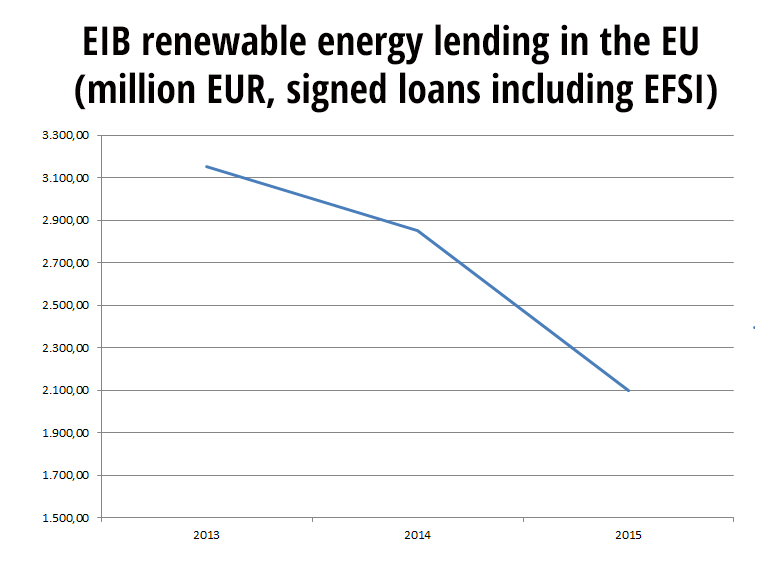
“So far EFSI guarantees have not catalysed any new finance on top of the EIB’s normal investments in energy efficiency and renewable energy sources. In fact, EIB lending to renewable energy has decreased in 2015, and the higher share of clean energy investments in the EFSI is the result of EIB simply shifting the few clean energy projects from its normal portfolio to the EFSI,” says Markus Trilling, EU Funds Policy Officer at CEE Bankwatch Network.

“Despite the praise from the European Commission and the EIB, the main beneficiaries of EFSI support have so far been the same countries, primarily richer ones, that have seen the largest EIB investments in sustainable energy [1]. As a result, the EFSI is not the effective de-risking mechanism it was meant to be. The EFSI was intended to help the EIB extend its financing to sectors and markets it has so far not been active in – for example, research and development to support the clean energy transition in central and eastern Europe – but this has not happened,” says Anna Roggenbuck. EIB Policy Officer at CEE Bankwatch Network.

“To date the information available on projects financed under EFSI is not sufficient to understand how the fund really delivers on its stated objectives. Given the EU guarantee awarded to the bank, it is now up to EU institutions to ensure a much higher level of transparency. Therefore, the European Parliament and European Court of Auditors will have a key role in coming months to hold the EFSI to account” says Xavier Sol, Director of Counter Balance.


Graphs


EIB renewables lending dropped significantly even including EFSI lending. (Source: EIB energy lending database 2015 – signed loans)


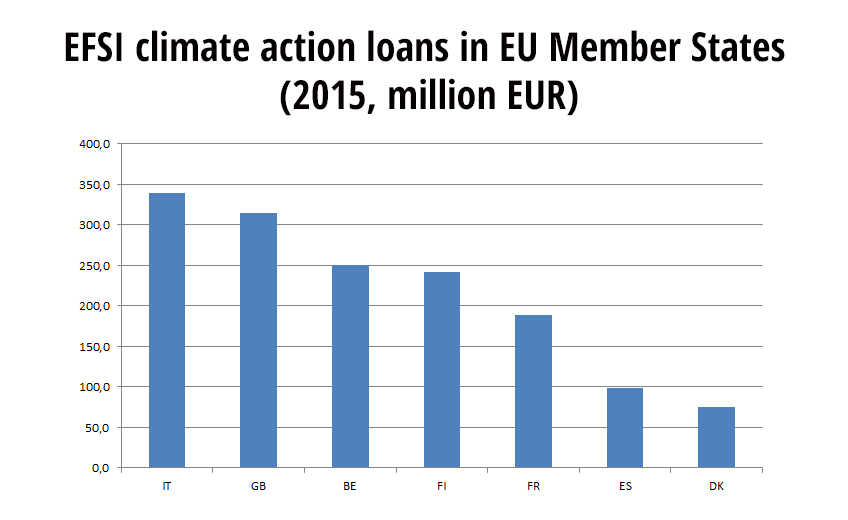
Climate action within the EFSI was limited to richer countries which already see larger EIB investments in sustainable energy. (For more details, see Bankwatch’s briefing on the EIB’ climate action lending in 2013-2015.)


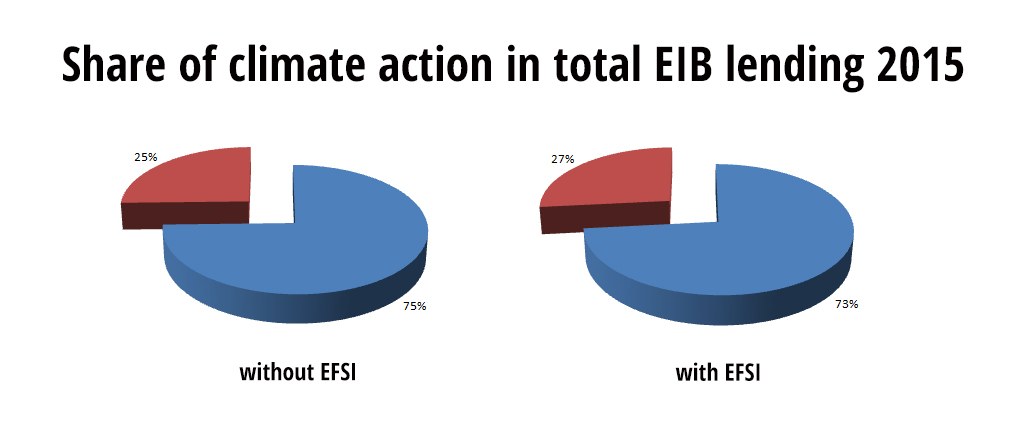
At the same time, the EFSI overall only marginally contributed to the EIB’s climate action lending. (For more details, see Bankwatch’s briefing on the EIB’ climate action lending in 2013-2015.)


For more information contact:

Markus Trilling
EU Funds Policy Officer, CEE Bankwatch Network
markus@bankwatch.org
+32 484 056 636
Twitter: @SustEUfunds

Anna Roggenbuck
EIB Policy Officer, CEE Bankwatch Network
annar@bankwatch.org
Office: +48 91 831 5392
Twitter: @RoggenbuckA

Xavier Sol
Director, Counter Balance
xavier.sol@counter-balance.org
+32 2 893 08 61
Twitter: @xavier_sol

Notes:

[1] According to an EIB evaluation, 70 per cent of the bank’s EUR 75 billion in climate finance in 2010-2014 was limited to just five countries: Germany, France, UK, Italy and Spain. Except for Germany, these are also among the few recipient countries of EFSI finance.

For more see Bankwatch’s blog post from December 2015 on the EIB’s climate finance: https://bankwatch.org/news-media/blog/9-reasons-why-eus-bank-no-climate-leader

Western Balkan countries invest more than twice as much in coal as in wind power: new Bankwatch analysis


Prague, Subotica, Banja Luka, Tuzla, Sarajevo, Skopje – Western Balkan countries are planning investments in wind power, but these are being heavily outweighed by their investments in coal plants, according to a CEE Bankwatch Network analysis launched today. The region’s governments are actively planning 2800 MW of new coal plants [1] but allowing only around 1166 MW of wind power plants to be built [2].

The analysis and background data are available at:
https://bankwatch.org/publications/western-balkans-countries-invest-least-24-times-much-coal-wind-power

The new coal plants will cost a minimum of EUR 4.5 billion, mostly from public sources. The wind plants would cost around EUR 1.89 billion [3], and are mainly planned by private sector investors.

In 2012, countries in the region committed to increase their share of renewable energy by 2020 under the Energy Community Treaty [4]. Yet, their governments continue to prioritise coal projects. Currently, Serbia and Macedonia only have one wind farm each in operation – Kula (9.9 MW) and Bogdanci 1 (36.8 MW) and Bosnia and Herzegovina, Montenegro and Albania have none [5]. Solar electricity generation is even more scarce.

In addition to conflicting with the Paris Agreement’s aim to limit global temperature rise to 1.5-2 degrees, the Balkan coal plans contrast sharply with the situation in the EU. Most EU countries have given up building new coal plants and seven states are already coal-free [6]. 12.8 GW of wind capacity was installed in the EU last year – more than for any other electricity generation source – meaning that wind can now generate 11.4% of the EU electricity consumption in a normal wind year.

As well as huge potential for energy efficiency, all Western Balkans countries have high potential for wind and rooftop solar photovoltaics. Together with existing hydropower, these could completely cover the region’s electricity demand by 2050.

There is significant investor interest in tapping the region’s wind potential, but they face regulatory hurdles. Governments have capped the amount of wind power capacity that can be connected to the grid and receive feed-in tariffs at a conservative level – eg. 500 MW until 2020 in Serbia and 350 MW until 2019 in Bosnia and Herzegovina – thus delaying numerous projects.

Despite governments’ overt preference for coal, however, it would be wrong to assume that the plans are a fait accompli. All of the seven actively planned coal plants [7] are seriously delayed.

Only one, Kostolac B3 in Serbia, has a financing contract signed – with China Exim Bank. Four do not have valid environmental permits, either because the environmental impact assessments have not been carried out yet (Pljevlja, Montenegro; Kosova e Re, Kosovo) or because the project preparations have taken so long that the EIA decisions have already expired (Tuzla 7, Bosnia and Herzegovina; Kostolac B3, Serbia). The environmental permits for Stanari, Banovići, Ugljevik III and the expired permit for Kostolac B3 are subject to court challenges by local civil society groups.

“The delays with the new coal plants open up an opportunity for the Western Balkan countries to turn around their energy systems. Governments need to stop seeing the electricity sector as a zero-sum choice between coal or imports. If they are really dedicated to using domestic resources, then they can show it by stepping up efforts to save energy and allowing more solar and wind power to be connected to the grid,” commented Igor Kalaba of Center for Environment, Bosnia and Herzegovina.

Ioana Ciuta, Energy Co-ordinator at Bankwatch, added: “Energy efficiency improvements, solar and wind projects can all be delivered more quickly than new coal power plants. They are also likely to turn out better value for money, as the costs of wind and solar are falling fast. Coal is no longer the economic option, as evidenced by Slovenia’s disastrous Šoštanj 6 project and the ongoing woes of EU utilities such as RWE and E.ON which failed to take account of the changing times and are paying a heavy price”.

Contacts:

Pippa Gallop
Research Co-ordinator, CEE Bankwatch Network
pippa.gallop@bankwatch.org

Ioana Ciuta
Energy Co-ordinator
CEE Bankwatch Network
ioana.ciuta@bankwatch.org
+40 724 020 281
@unaltuser

Notes for editors:

(1) This includes only plans which are being actively pursued and for which construction could start within the next few years. If projects are included which are mentioned from time to time in the media or government documents but do not appear to be advancing, the planned coal capacity rises to at least 5700 MW.

(2) Included in the calculation for wind are projects which we believe could go ahead before 2020. Some plants have not shown any obvious development for several years, particularly in Albania, while others are held back by feed-in tariff quotas or other administrative issues.

(3) The costs for the coal plants are for construction only and do not include the cost of mine expansion, financing, resettlement or ash dumps. The real cost is therefore much higher.

(4) The Energy Community brings together Albania, Bosnia and Herzegovina, Kosovo, Macedonia, Moldova, Montenegro, Serbia and Ukraine with the goal of creating a common energy market between the EU and some of its neighbours. The Energy Community Treaty, among other things, includes binding obligations for member countries to implement certain pieces of EU environmental law and renewable energy targets.

(5) Kosovo has three 0.45 MW turbines at Golesh near Pristina which have been installed already since 2010 but were not operating until 2014 due to a dispute over feed-in tariffs. See
http://www.kostt.com/website/images/stories/dokumente/tjera/Generation_Adequacy_Plan_2011_-_2020.pdf
and
http://mzhe-ks.net/repository/docs/Balanca_e_energjise_2015_eng.pdf

(6) Cyprus, Luxemburg, Malta, Lithuania, Latvia, Estonia and Belgium. Several EU countries including the UK and Austria have also announced plans to phase out coal. See
http://www.greenpeace.org/eu-unit/en/blog/belgium-kicks-the-coal-habit/blog/56044/

(7) Ugljevik III, Banovići, Tuzla 7 and Kakanj 8 in Bosnia and Herzegovina, Kosova e Re in Kosovo; Pljevlja II in Montenegro; and Kostolac B3 in Serbia. The list does not include Stanari in Bosnia and Herzegovina, which is undergoing test operations.


Image by Roland Peschetz (CC BY 2.0)

The Paris Agreement is a wake up call for the EU’s house bank to realign its investment strategy

The European Investment Bank (EIB) must adopt new directives and operating principles to play a meaningful role in realising the EU’s goal of a decarbonised and resource efficient economy, say CEE Bankwatch Network and Counter Balance ahead of the bank’s annual meeting during the EU finance ministers’ Council this Wednesday, May 25.

A new Bankwatch analysis released today shows that, while the EIB has met its climate action objective – a minimum loan allocation for projects intended to reduce greenhouse gas emissions and facilitate adaptation to the impacts of climate change – the contribution of the EU’s house bank to addressing the unfolding climate crisis is far from sufficient.

The full briefing can be found here: https://bankwatch.org/publications/european-investment-bank-and-climate-action-2013-2015

The EIB has set itself a target of 25 percent of its annual lending volume to be earmarked for projects labelled “climate action”. According to the analysis, the bank has so far managed to meet this target, but since 2013 it has failed to finance such projects in a number of EU countries including Portugal, Croatia, Poland, and Belgium.

Specifically, the EIB’s climate action lending appears to prioritize richer EU member states. Between 2013-2015 the top four beneficiaries of such finance were the UK, Austria, Sweden and France. Climate action investments made over 35 percent of EIB financing in each of these countries. At the same time, in Croatia, Cyprus, Portugal and Malta, EIB lending under the climate action program amounted to less than 10 percent.

Not least, the bank’s revised climate strategy, adopted ahead of the landmark Paris climate summit, has failed to up its climate action target. Moreover, this new strategy also does not commit the EIB to facilitate the EU’s climate and energy goals, or to increase its lending for much needed energy efficiency and renewable energy projects.

“The EIB’s investment trajectory currently looks particularly worrying,” says Anna Roggenbuck, EIB Policy Officer at CEE Bankwatch Network. “With plans to spend EUR 3 billion on the massive fossil fuels project that is the Southern Gas Corridor, the world’s largest lender is turning its back on the global effort to tackle the climate crisis. Instead of enabling the transition to sustainable energy, the EIB could be helping a European carbon lock in for decades to come.”

A European Parliament resolution last month flagged up the broadening gap between the EU’s climate and energy policies and the EIB’s operations. The Parliament called on the bank to improve the sustainability of its operations by stepping up lending for energy efficiency and renewable energy projects. It also urged the bank to reconsider its ongoing tendency to finance carbon intensive infrastructure such as motorways and fossil fuel projects.

The contribution of EIB financing to cross-sector energy efficiency has widely varied across Europe, the Bankwatch analysis found, and in a number of countries it has been well below the EU average or even plain zero.

Additionally, EIB investment in renewable energy has plummeted from EUR 5.1 billion in 2013 to EUR 2.7 billion in 2015. In a number of EU countries, EIB funding is completely consumed by public authorities and state-owned companies, and in turn private promoters of renewable energy from have no access to this funding source.

“At the Paris summit, the EIB portrayed itself as a climate champion. Now the bank has to translate this rhetoric into action,” says Xavier Sol, Director of Counter Balance. “It is now up to EIB Governors to ensure the European Parliament’s call is not ignored. A major effort is required to improve the bank’s transparency, sustainability and accountability standards.”

For more information contact:

Anna Roggenbuck
EIB Policy Officer, CEE Bankwatch Network
annar@bankwatch.org
+48 91 831 5392
Twitter: @RoggenbuckA

Xavier Sol
Director, Counter Balance
xavier.sol@counter-balance.org
+32 2 893 08 61
Twitter: @xavier_sol

NGOs file a complaint against Vinci Russia for corruption of foreign public officials in Khimki Forest motorway case

A complaint filed last week is requesting an investigation into alleged corruption involving French company Vinci in the construction of a controversial motorway through Khimki Forest near Moscow. The complaint was filed to Nanterre’s chief investigating judge by civil society groups Sherpa and CEE Bankwatch Network, activists Evgenia Tchirikova and Mikhail Matveev, and with the support of Princip, defenders of the Khimki forest.

In 2007 the Russian Federal Roads Agency, ROSAVTODOR, launched a call for tenders for the construction of a section of the M11 motorway. Three companies submitted tenders, including the North West Concession Company (NWCC), owned by the Vinci Group and Russian partners including Vladimir Putin’s close associate Arkady Rotenberg. After studying the submissions, the Russian state decided to declare the call for tenders unsuccessful and rejected all three tenders. In 2009, Russian authorities awarded the section’s construction directly to NWCC for 1.63 billion Euros.

Yet several studies have shown that the route that was chosen, compared with twelve others, is the most expensive one, and the one that would have the worst environmental impact. The project’s usefulness is therefore being questioned, as it does not meet the social and environmental challenges of the Russian transportation sector.

This is the first wide-ranging case which could lead to holding a major French company liable for corruption in Russia.

Sherpa has already filed an initial complaint against VINCI CONCESSIONS RUSSIE SA on 24 June 2013 for alleged corruption of foreign public officials in the case of the tender for the construction of the section of motorway M11 through the Khimki Forest..

The appointment of an investigating judge will make it possible to carry out all actions necessary to establish the truth and identify who should be held responsible.

At a time when France has enhanced its legal framework for the fight against corruption, and French companies are making more commitments, the French judicial system must be able to establish who is liable for actions allegedly committed by a French company in a country which is known to be plagued with corruption.

For more information contact:

William Bourdon
President of Sherpa
01 42 60 32 60 / +33 (0)6 08 45 55 46

Pippa Gallop
Research Co-ordinator, CEE Bankwatch Network
pippa.gallop@bankwatch.org

Parliament gets tough on control of EU Bank’s funds

In its annual resolution on the European Investment Bank adopted today in Brussels, Members of the European Parliament have criticised the bank’s support to projects under corruption investigations. They also called on the EIB to go further on fighting climate change, tax evasion and tax dodging.

Counter Balance and CEE Bankwatch Network welcome the positions taken today by the Parliament in this resolution.

The MEPs asked the EIB to “stop further loan disbursements to projects under ongoing national or European corruption investigations”, like it did in Slovenia for the Sostanj coal power plant [1]. The Parliament calls on the EU Bank to learn lessons from past experiences instead of repeating the same mistakes over and again.

In particular, the Parliament condemned the bank’s support to the Passante di Mestre highway in Italy [2]. The Passante di Mestre project received EIB support in 2013, even after several project promoters had been arrested on allegations of corruption and money laundering. In 2016 the project is being refinanced using the Project Bond Initiative, a risk-sharing instrument jointly set up by the European Commission and the EIB. Echoing previous NGO demands [3], MEPs “call on the EIB, once again, to suspend all forms of funding for the project”.

A similar warning is sent in relation to tax evasion and tax dodging: the EIB needs to get serious on those issues by closing the loopholes in its current tax havens policy and requesting more transparency from its clients on their tax practices, as proposed in a Counter Balance report in 2015 [4]. MEPs call on the EIB to develop in 2016 a taxation policy that includes inter alia public country by country reporting requirements for all its clients.

The Parliament is also seeking to increase the sustainability of the bank’s operations by:

– Enhancing its lending to energy efficiency and renewable energy projects in new Member States so that they reach 30% of total investments in these fields by 2020;
– Calling for a review of EIB’s climate action objective, since the 25% target set by the bank has already been reached in 2015; and by
– Expressing its concerns about the “tendency to finance infrastructure such as motorways, which encourage fossil fuel consumption and therefore run counter to the Union’s long-term objectives of moving towards a carbon-free economy”.

Anna Roggenbuck, CEE Bankwatch Network, said:

“It is encouraging that the European Parliament notices EIB investments in renewable energy and energy efficiency are in a number of Member States far below the EU average. Those investments are crucial to modernize economies and mitigate climate change in order to deliver on the Paris agreement. The EIB and Member States should discuss how to address this failure, especially via the European Fund for Strategic Investments.”

Xavier Sol, Counter Balance Director, said:

“This resolution really sends a strong signal to the EIB: business as usual is not feasible anymore. This is an important step forward to make the EU Bank a more accountable and transparent institution. It is now time for the EIB to deliver on this call for action”.

Notes for editors

[1] Read more about the case of Sostanj: Sostanj lignite plant: A mistake not to be repeated
[2] Find out more about the Passante di Mestre project in the new NGO report “Highway to hell”
[3] Read the article EIB set to finance motorway under corruption investigation in Italy
[4] Read the report “Towards a taxation policy for the EIB”

Contacts

Xavier Sol
Director, Counter Balance
xavier.sol AT counter-balance.org
Mobile: +32 473 223 893 Office: +32 289 308 61
Twitter: @Counter_Balance

Anna Roggenbuck
EIB policy officer, CEE Bankwatch Network
annar AT bankwatch.org
Mobile: +48 509970424 Office: +48 91 831 5392
Twitter: @RoggenbuckA

EU’s flagship climate instrument used to subsidise coal in Central and Eastern Europe

The EU’s carbon market rules allow Central and Eastern European Member States to invest up to €12 billion in coal powered energy production. As representatives of the EU Member States are due to discuss the EU ETS this Wednesday, the new publication “Fossil fuel subsidies from Europe’s carbon market” adds momentum to the need to overhaul this policy.

Under a provision referred to as “Article 10c” in the EU Emissions Trading System (EU ETS), low-income Member States can grant free pollution rights to their electricity producers until 2019. This is permitted on the condition that they invest at least the equivalent monetary value of those allowances in diversifying and modernising their electricity generation.

“The experience to date demonstrates that this provision has so far not resulted in the diversification of the energy mix in lower-income Member States. Quite the contrary, it will lock them in carbon intensive energy production and investment uncertainty. Europe’s carbon market is hence being used to subsidise coal power, including investments in the second largest fossil-fuel power station in the world,” says Urska Trunk, Policy Officer at Carbon Market Watch.

In 2013, only about 10% of the investments through Article 10c were related to clean technologies or the diversification of the energy mix. An overwhelming 90% of investments benefitted the upgrading and retrofitting of existing (fossil fuel) infrastructure.[1] The majority of Article 10c investments did not lead to a more diversified energy mix in countries such as Poland and the Czech Republic that are highly dependent on coal.

“Continuing to allocate free pollution permits is contradictory to the EU’s transition away from fossil fuels,” says Joanna Flisowska, Coal Policy Coordinator of Climate Action Network Europe. “To turn carbon trading into a tool that helps end our addiction to fossil fuel, especially coal, polluter handouts must end, and the price of carbon must increase. This will boost investments in renewables and energy efficiency.”

In addition to supporting carbon-intensive energy systems, Member State analysis has exposed other shortcomings, such as little or no time for the public to provide comments on the government’s investment plans.

Markus Trilling, EU Policy Officer at CEE Bankwatch Network explains: “Detailed information on the investments is often lacking and oversight by third parties is very difficult if not impossible. This makes it very hard to assess the effectiveness of the investments and their compliance with the EU’s clean energy objective”.

Despite concerns from civil society that Article 10c has not had desired effects, the EU ETS proposal for the next trading round from 2021-2030 continues to allow lower-income states to give free allowances to their power sector.

“Decision makers must ensure that Article 10c moves away from subsidizing coal to becoming a tool to diversify the energy mix and take bold steps needed to reduce energy poverty and import dependency of emerging European countries,” Urska Trunk concludes.

Media contacts

Urska Trunk, Policy Officer, Carbon Market Watch
Tel: +32 487 12 96 17
urska.trunk AT carbonmarketwatch.org

Kaisa Amaral, Press Officer, Carbon Market Watch
Tel: +32 485 07 68 90
kaisa.amaral AT carbonmarketwatch.org

Markus Trilling, EU Policy Officer, CEE Bankwatch Network
Tel: +32 2 893 10 31
markus AT bankwatch.org

Notes to editor

Recommendations by Carbon Market Watch and CEE Bankwatch Network to reform Article 10c after 2020:

– Ensure that all investments are selected based on a transparent process through a competitive bidding process with full accessibility of relevant documents.
– Introduce selection criteria for the ranking of projects so that no investments in coal production are eligible and investments in energy efficiency and sustainable renewable energy sources are prioritized.
– Base the investment selection process on open consultation that provides for public input and takes the comments raised by stakeholders fully into account.
– Allow all interested parties to participate in the competitive bidding process, including non-ETS operators, such as renewable energy companies to ensure it is non-discriminative.
– Guarantee that investments are additional so that Article 10c does not support projects that would have been undertaken regardless of the option of derogation.

[1] See 2015 Commission’s Impact Assessment (p.133)

« Previous Page
Next Page »

Footer

CEE Bankwatch Network gratefully acknowledges EU funding support.

The content of this website is the sole responsibility of CEE Bankwatch Network and can under no circumstances be regarded as reflecting the position of the European Union.

Unless otherwise noted, the content on this website is licensed under a Creative Commons BY-SA 4.0 License

Your personal data collected on the website is governed by the present Privacy Policy.

Get in touch with us

  • Bluesky
  • Email
  • Facebook
  • Instagram
  • LinkedIn
  • RSS
  • YouTube