• Skip to primary navigation
  • Skip to main content
  • Skip to footer

Bankwatch

  • About us
    • Our vision
    • Who we are
    • 30 years of Bankwatch
    • Donors & finances
    • Get involved
  • What we do
    • Campaign areas
      • Beyond fossil fuels
      • Rights, democracy and development
      • Finance and biodiversity
      • Funding the energy transformation
      • Cities for People
    • Institutions we monitor
      • European Bank for Reconstruction and Development
      • European Investment Bank
      • Asian Infrastructure Investment Bank
      • Asian Development Bank (ADB)
      • EU funds
    • Our projects
    • Success stories
  • Publications
  • News
    • Blog posts
    • Press releases
    • Stories
    • Podcast
    • Us in the media
    • Videos
  • Donate

Home > Archives for Press release

Press release

Lost in transition: Far-reaching changes needed as European bank marks 25 years

On April 15, the European Bank for Reconstruction and Development (EBRD) will be marking its 25th anniversary. Reflecting on two decades of monitoring the EBRD’s policies and projects, a new report from CEE Bankwatch Network raises concerns about a growing gap between the bank’s operations and its mandate.

Download the full report at https://bankwatch.org/lost-in-transition

Established in 1991 to facilitate the transition to market economies through sustainable development, the bank’s region of operation has grown well beyond its original geographical scope of eastern Europe and the former Soviet Union without actually achieving its goals, says the new report. In fact, only one country, the Czech Republic, has formally ‘graduated’ as recipient country of the EBRD, and in 2013 the bank itself acknowledged that many of the other recipient countries were ‘stuck in transition’.

The report explores two of the cases where the EBRD’s financial support has effectively helped deepen countries’ economic dependence on natural resource extraction, leaving them to the mercy of fluctuating commodity markets. At least 13 coal and metals mining operations in Mongolia have received sizeable financial support from the bank since 2006. Among them, last December the EBRD signed its largest ever syndicated loan of USD 1.2 billion for the expansion of Rio Tinto’s Oyu Tolgoi copper and gold mine, despite unresolved complaints of local herders.

Support for the Shah Deniz II gas field development has made up the largest share of EBRD funding for Azerbaijan over the past five years, thus contributing to the economic crisis the country is now facing as a result of the fall in oil and gas prices. But not only is petro-finance for Azerbaijan at odds with the EBRD’s commitment to help tackle the climate crisis, it is also in stark violation of the bank’s mandate to work only in countries practicing multi-party democracy.

Fidanka Bacheva-McGrath, Bankwatch’s EBRD campaign co-ordinator, says:

“25 years ago, at the start of transition, everyone asked ‘When will we catch up with the West?’ Now the EBRD says it will be decades before convergence of living standards is achieved. More importantly, economic reforms have promoted unsustainable development and have allowed for corrupt and undemocratic elites to get a tight grip on societies. The bank was a leading force in the region, both in terms of finance and in ideological guidance, as to how transition progress should be measured, but now it blames the lack of progress on the countries themselves. If the success of the bank is measured by the success of its recipient countries, the bank’s shareholders should pause to seriously reconsider the institution’s approach to development.”

The bank’s involvement in a large number of projects with adverse environmental and social impacts has also overshadowed its stated mission to promote sustainable development. Among the cases described in the report are hydropower development in Georgia and ageing nuclear power in Ukraine. In both cases, and others, the EBRD turned a blind eye to the lack of strategic assessment of sustainable alternatives and relied on outdated plans for development of the energy sector in these countries. These projects are indicative of a questionable trend of the bank using public money to support business as usual while overlooking both the public interest and its own environmental and social standards.

The report calls on the EBRD and its shareholders – that include the U.S., Japan, China, and the EU and its member states – to critically reflect on the way the bank has worked to accomplish its mission, and on the impacts its investments have had on people and the environment. In a number of cases, the report authors stress, it is still not too late to change course.

Pippa Gallop, Bankwatch’s research co-ordinator and one of the authors of the report, says:

“The EBRD is taking one step forward and two steps back when it comes to sustainable development, while the concept of economic transition has become so blurry as to be virtually meaningless. A thorough re-think of the bank’s purpose is needed in order to re-orientate its investments from quantity to quality. But this is only going to happen if the EBRD’s shareholders push for it.”

For more information contact:

Fidanka Bacheva-McGrath
EBRD Campaign Co-ordinator
fidankab@bankwatch.org
Twitter: @fidankabmg

Pippa Gallop
Research Co-ordinator
CEE Bankwatch Network
pippa.gallop@bankwatch.org

Balkan protests show need for more EU action on air pollution – new analyses

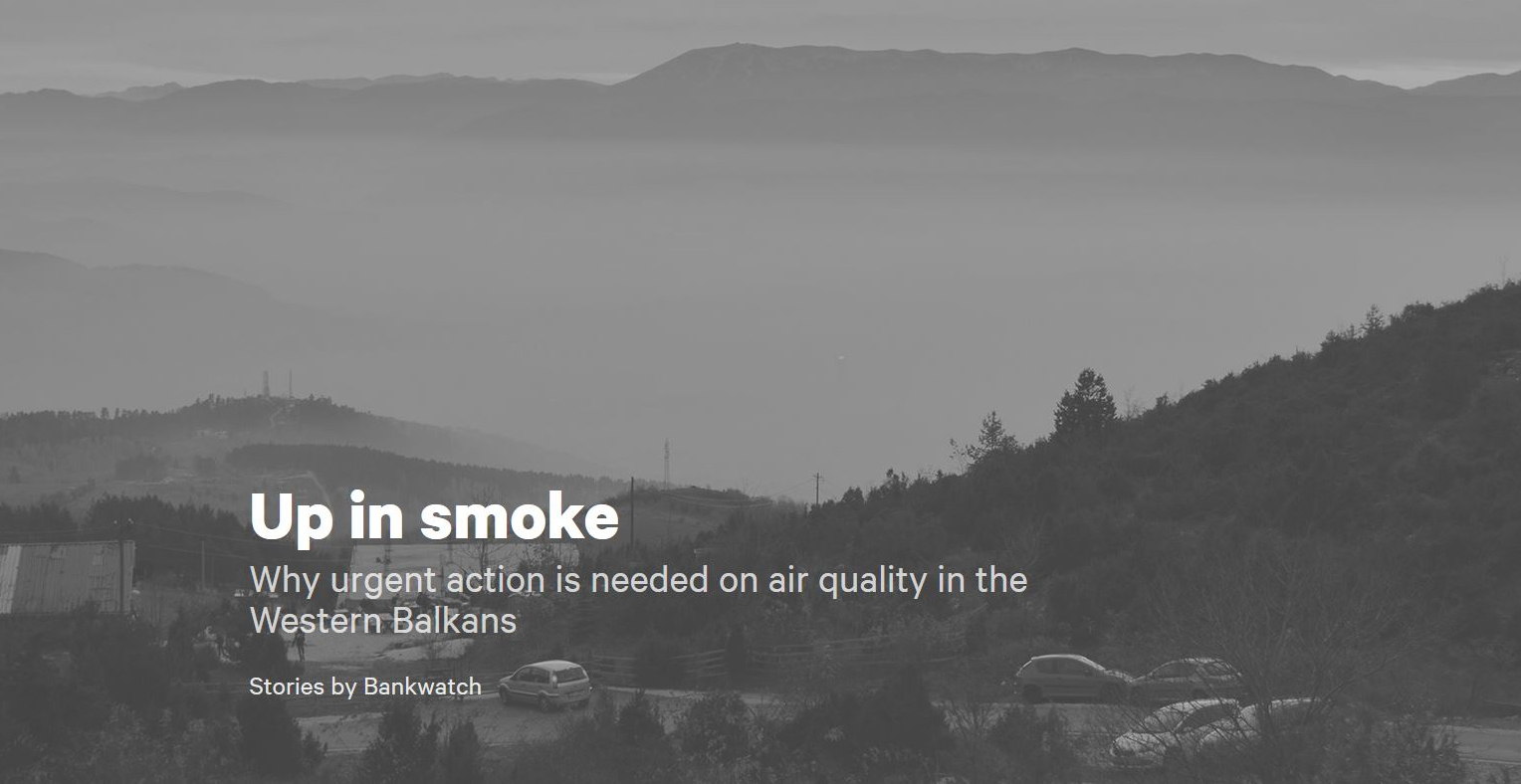
Thousands of people took to the streets of Skopje, Pljevlja, Tuzla and other cities across the Western Balkans in December to demand action on chronic air pollution plaguing their communities. A new briefing shows that to a large degree these recurring smog incidents are the result of national authorities’ protracted inaction. Yet, air quality could be dramatically improved if two EU directives are transposed into the Energy Community Treaty, according to two legal analyses also released today.

Every winter, towns across the Balkans face the same problem of heavily polluted air, and residents are increasingly concerned about the health implications.

The briefing paper, released today by CEE Bankwatch Network CEE Bankwatch Network and a group of environmental organisations in the region [1] explores the context of air pollution in Pljevlja, Tuzla, Sarajevo, Skopje and Tetovo following massive public protest across the region. According to the document, the main culprits vary by location but include thermal power plants, polluting industrial facilities, traffic, and poor enforcement of national air quality standards.

Read the briefing

In Pljevlja, Montenegro, airborne dust pollution in has exceeded the allowed annual limit by more than five times every year since 2010. And yet, the Montenegrin government keeps blaming individual household stoves while failing to limit pollution from the lignite-fired power plant.

This winter has seen particularly bad air pollution in Sarajevo, Bosnia and Herzegovina. On 19-20 December levels of inhalable coarse particles known as PM10 reached 350 micrograms/m3 – that is, seven times the maximum allowed level of 50 micrograms/m3. Over the same days, PM10 concentration in Beijing, notorious for heavy smog, did not exceed 279 micrograms/m3. [2] And that was not all. On January 24, 2016, at 10pm, PM10 concentration spiked to the literally breathtaking level of 750 micrograms/m3.

“Such levels of air pollution are unacceptable, and they are the most blatant symptoms of a systemic energy and transport problem,” says Ioana Ciuta, Energy Co-ordinator at CEE Bankwatch Network. “Without stronger action from the EU to ensure that environmental legislation is transposed and enforced this situation looks set to continue.”

The briefing recommends adopting two directives into the Energy Community Treaty in order to improve their implementation in the region.

According to the two legal analyses, the EU’s Air Quality Directive and the Industrial Emissions Directive Chapter II can be vital pieces of environmental legislation for countries of the Western Balkans. Moreover, adapting them to fit the scope of the Energy Community Treaty is feasible and comes with great public health benefits.

The adoption of the Air Quality Directive would introduce, among others, the obligation to establish air quality plans in zones or agglomerations where levels of pollutants in ambient air have exceeded any limit value, so when the plan explores causes of declining air quality, it can aim its measures specifically at the core of the cause – for example the electricity generation sector.

Another legal instrument that could help abate air pollution is the implementation of Best Available Techniques (BAT) requirement under the Industrial Emissions Directive, both for existing facilities and for new ones.

“This provision would ensure the level playing field in energy generation in the EU and the Energy Community that we aspire to and prevent the danger of emissions leakage,” concluded Pippa Gallop, Research Co-ordinator at CEE Bankwatch Network.

The briefing can be found here:
http://stories.bankwatch.org/up-in-smoke

The legal analysis of the Industrial Emissions Directive Chapter II can be found here:
https://bankwatch.org/sites/default/files/Legal-analysis-application-ChapterII-IED-Energy-Community.pdf

The legal analysis of the Air Quality Directive can be found here:
https://bankwatch.org/sites/default/files/Prospects-for-implementing-air-quality-directives-Energy-Community.pdf

For more information contact:

Ioana Ciuta
Energy Co-ordinator, CEE Bankwatch Network
ioana.ciuta@bankwatch.org
Tel.: +40 724 020 281
Twitter: @unaltuser

Pippa Gallop
Research Co-ordinator, CEE Bankwatch Network
pippa.gallop@bankwatch.org

Notes to editors:

1. Zelena akcija/Friends of the Earth Croatia; Ekotim, Center for Ecology and Energy, and Center for Environment (Bosnia and Herzegovina), Green Home (Montenegro), Eko-Svest (Macedonia), and CEKOR (Serbia).

2. Converted from 163 US AQI figures, see https://www.airnow.gov/index.cfm?action=resources.aqi_conc_calc

Water disputes persist as Rio Tinto pushes ahead with second Oyu Tolgoi mine

Prague; Khanbogd Soum, Mongolia – A large new copper mine in Mongolia could cause irreversible damage to terrain and deprive water from some of the world’s last remaining nomadic herding groups, finds a new report released today by Oyu Tolgoi Watch, the Bank Information Center, CEE Bankwatch Network and Accountability Counsel.


DOWNLOAD THE REPORT:
Full report Oyu Tolgoi Phase 2: Plans, Issues and Risks – Download pdf (7 MB)

8-page summary – Download pdf


Developed by Rio Tinto, a global mining giant, the US $6.7 billion Oyu Tolgoi Phase 2 project in the Gobi desert is designed to tap the world’s largest undeveloped copper deposit. Pre-construction works for the underground mine have already commenced, but the company has so far made little if any information on the expected environmental impacts publicly available, according to the report Oyu Tolgoi Phase 2: Plans, Issues and Risks.

Planned as an expansion to existing operations, the Oyu Tolgoi (OT) project includes an open pit mine that has already diminished water access and water quality, reduced pasture area, and made traditional nomadic herding livelihoods in the area all but impossible to maintain.

The project will receive US $4.4 billion in international financing, including from the International Finance Corporation (IFC), the Netherlands Development Finance Company (FMO), and via the largest syndicated loan ever by the European Bank for Reconstruction and Development (EBRD).

The report, compiled by mining and environmental expert Paul Robinson at the Southwest Research and Information Center, summarises the expected impacts from the underground mine. The planned block cave mining method is expected to cause surface land to subside by 65 feet or more across a zone of nearly 5 square miles, leaving the affected land permanently unusable and beyond the scope of any remediation technology.

Publicly available documents do not identify enough water supplies to sustain the 40-year mine life without depleting the water supplies that herders depend on. Meanwhile, a new coal-fired power plant being considered to power the mine would cause further harms that as yet have not been identified by any environmental assessment.

Local people have been engaged in an ongoing dialogue with the project company since 2013 to discuss disputes over water resources, resettlement and compensation related to the existing OT open pit mine. The process still has not led to a final agreement resolving the dispute, yet Rio Tinto is charging ahead with its plans to develop the new underground mine.

Communities who have already experienced severe impacts from the open pit mine now face further harm from the underground expansion, the extent of which remains unclear.

“The herders have not been given up to date project plans, nor have they been properly consulted about the underground mine, even though information disclosure and informed consultation with local people are required by the project’s international financiers,” explained Sukhgerel Dugersuren, Executive Director of OT Watch, who is assisting herders in the complaint process.

The findings of the report and the stark realities of herders who have had to abandon their traditional livelihoods fly in the face of a Project Finance International award given last week, which dubbed the OT project “Mining Deal of the Year in the Asia-Pacific region”.

“OT is accepting accolades for this project while the problems they have caused for local herders remain unresolved,” said Dugersuren. “The mine is touted for its so-called development benefits, but this is meaningless without a strong commitment from Rio Tinto to address impacts of the new expansion and disclose information to the affected herders.”

Notes for editors:

The full report, Oyu Tolgoi Phase 2: Plans, Issues and Risks, is available at:
https://bankwatch.org/sites/default/files/OyuTolgoi-Phase2.pdf

An 8-page summary is also available at:
https://bankwatch.org/sites/default/files/OyuTolgoi-Phase2-summary.pdf.

For more information please contact:

Sukhgerel Dugersuren
Executive Director, Oyu Tolgoi Watch
+976 99185828
otwatch@gmail.com

Fidanka Bacheva-McGrath
EBRD Campaign Coordinator, CEE Bankwatch Network
+359 877303097
fidankab@bankwatch.org

Paul Robinson
Research Director, Southwest Research and Information Center
+1 505 262 1862
sricpaul@earthlink.net

Caitlin Daniel
Acting Director of Strategic Support, Accountability Counsel
+1 415 500 8214
caitlin@accountabilitycounsel.org

Sarah McNeal
Asia Program Associate, Bank Information Center
+1 202 624 0635
smcneal@bankinformationcenter.org

NGOs urge the European Investment Bank not to finance the Southern Gas Corridor

A group of 27 NGOs sent an open letter to the President of the European Investment Bank (EIB) today urging the Bank not to finance the Southern Gas Corridor, a 3500 kilometres-long chain of gas pipelines from Azerbaijan to Europe. As the EIB considers granting the biggest loan of its history to the Consortium in charge of developing the western section of the project, the Trans-Adriatic Pipeline (TAP), a group of NGOs warns about its most controversial aspects:

  • Supporting this project would not be coherent with the bank’s commitment to fight climate change announced during the COP21 in Paris. Pumping more gas through the Southern Gas Corridor would hinder the accomplishment of the EU’s climate objectives and longer-term decarbonisation goals.
  • Demand for gas in Europe is actually dropping, as the European Commission’s own projections for the next 35 years show. The Southern Gas Corridor therefore risks not being used to full capacity and turning into a stranded asset which will ultimately be paid for by taxpayers, gas consumers and those living along the route of the pipeline.
  • Azerbaijan is one of the most undesirable partners the EU could tie itself to. The Aliyev regime is known for its appalling human rights record and repression of political opposition. Concluding a business partnership with Azerbaijan would thus stand in contradiction to the EU Charter of Fundamental Rights, which binds the EIB not to finance projects that would encourage or support human rights violations. This is underlined in the European Parliament’s September 2015 resolution calling for the suspension of EU funding to the Azeri government.
  • The fiscal accountability of the project is quite opaque, as the consortium of companies that promote TAP is registered in the Swiss city of Baar, a renowned tax haven.
  • The authorisation process of the Italian section of TAP raised many issues and led to large protests by residents and local authorities of the province of Lecce, where the pipeline will enter the Italian soil. The population’s apprehensions particularly concerned the lack of transparency in the procedures that led to the full approval of the project by the Italian government as well as the still unfulfilled prescriptions needing to be complied with from the Environmental Impact Assessment of the project.

The signatories claim that “the Southern Gas Corridor is one of the biggest and most controversial infrastructure projects that have ever seen the light of day in Europe. This massive financial investment entails serious environmental and geopolitical risks. Therefore, we call for no public money to go to the Southern Gas Corridor”.

“As an EU institution, the EIB is morally and legally obliged to guarantee that all its projects respect the human rights and climate principles it is committed to. As President of the EU bank, Mr Hoyer should take on full responsibility and recognize all the implications attached to the loan”, they conclude.

Contacts:

Xavier Sol, Director Counter Balance
xavier.sol@counter-balance.org
+32 2 893 08 61

Anna Roggenbuck, EIB Campaign Coordinator Bankwatch
annar@bankwatch.org
+48 918803872

Report finds development banks fail people harmed by their projects


Civil society calls on banks to strengthen their complaint mechanisms to provide remedy.

A new report launched today documents the hurdles communities and workers face in obtaining remedy from development banks whose projects cause them harm. The 11 civil society organizations that authored the report, Glass Half Full? The State of Accountability in Development Finance, call on development banks and the governments that run them to strengthen their systems for providing remedy to those harmed by the activities financed by the banks.

As a result of pressure from civil society, many development banks have established independent accountability mechanisms—also called complaint mechanisms—that receive complaints from communities and workers adversely affected by bank-financed activities. While the structure and procedures of these mechanisms vary between banks, they can offer to convene the complainants and the borrower (the bank’s client) to resolve the conflict, conduct an investigation to determine if the bank’s environmental and social policies have been violated, or both.

The complaint mechanisms are often the only available recourse for communities harmed by development projects and currently represent the only avenue to hold development banks accountable to their environmental and social commitments.

Since the 1994 creation of the World Bank’s Inspection Panel—the first independent accountability mechanism, there have been 758 complaints filed to the mechanisms at 11 development banks. Glass Half Full? assesses the extent to which the development banks and their complaint mechanisms are equipped to handle complaints from affected people.

Findings

What the report finds is that even though complainants are undoubtedly better off than they would be in the absence of any complaint procedure, the outcome rarely provides adequate remedy for the harms experienced by people and communities. This is largely due to the development banks themselves, which undermine the effectiveness of their own complaint mechanisms by limiting their mandate and failing to uphold their own responsibilities in the complaint process. The banks impede the accessibility and effectiveness of the complaint mechanisms from the very beginning by failing to require their borrowers to tell project-affected people about their existence. Even more critically, the banks have limited the mandates of the mechanisms so that they cannot issue binding decisions. Rather, the outcome of complaints depends primarily on the good will of the banks or their borrowers: unless governments and companies voluntarily agree to resolve the conflict through dialogue, or the bank voluntarily agrees to address violations of its policies exposed through an investigation conducted by the mechanism, complainants are left without a solution.

Case studies

The case studies in the report illustrate how the existing system at development banks falls short:

  • One case investigated by the Compliance Advisor Ombudsman (CAO)—the complaint mechanism of the International Finance Corporation (IFC)— found that the IFC failed to address its client’s disregard for workers’ rights to freedom of association, but the issues that led to the complaint remain. “The company’s practices that were documented when the complaint was submitted, continue today and workers’ rights are still not being respected,” says Peter Bakvis, one of the complainants in the case.
  • Complainants who brought a case to the Independent Complaints Mechanism (ICM) of the Dutch and German development banks were similarly disappointed with the response they received from the banks. While satisfied with the ICM’s investigation report of the risks posed by the Barro Blanco hydroelectric dam in Panama, Manolo Miranda, one of the complainants’ representatives, notes: “Nothing has changed… the banks and the company have done nothing to prevent the impacts on our culture, territory and religion.”
  • In the Bujagali complaint, also handled by the CAO, the complainants attribute the company’s willingness to negotiate with them to the involvement of the CAO, but ultimately they were unsatisfied with the result of the negotiations. Recognizing that the CAO did not have the mandate to compel the company to provide fair compensation to affected community members, the complainants felt they had no choice but to agree to the terms offered by the company.

Recommendations

The report includes a number of best practice recommendations that should be adopted at all development banks. However, it concludes that meaningful remedy for complainants and prevention of future harms will require more than best practices. A new accountability system must be established as a matter of urgency, with complaint mechanisms empowered to make binding decisions on banks and their borrowers, and an end to immunity for development banks in national courts.

Download

Download the full report >> (pdf)
Find its annexes here >>

NEW REPORT: Misguided spending by enfants terribles is undermining Europe’s transition to a fossil-free future


Brussels/Prague – EU billions destined to transform the carbon-intensive, inefficient energy systems of central and eastern Europe are being misspent, finds a new report today by CEE Bankwatch Network and Friends of the Earth Europe. Bad spending plans and a lack of climate commitments from nine central and eastern European governments is hampering Europe’s transition away from fossil fuels, the groups say [1].

The full report can be downloaded here: https://bankwatch.org/sites/default/files/enfants-terribles.pdf

Summaries, graphs and more are at: https://bankwatch.org/enfants-terribles

The new research reveals that in CEE countries only 7 per cent of the 178 billion euros in European Regional Development and Cohesion Funds will be invested into renewables, energy efficiency and SMART grids, and that the integration of climate considerations into all plans and projects – as required under EU law – remains superficial.

Markus Trilling, EU funds campaigner for CEE Bankwatch Network and Friends of the Earth Europe said: “Whatever happened at the climate talks in Paris, Poland is still all about coal. We’re seeing EU funds being spent across Central and Eastern Europe for coal, gas and dated transport systems – locking countries into fossil-fuel dependency, at the expense of renewables and energy efficiency.”

The European Commission asked member states to concentrate EU funding on climate action and climate mainstreaming within the EU’s seven year, one trillion euro budget for 2014 to 2020 [2].

The report lays the blame squarely on the insufficient spending plans and absent climate commitments of the countries receiving the funding. For example, both Poland and the Czech Republic will offer financial support for the replacement of ‘old coal boilers’ with ‘modern coal boilers’ under the heading of environmental protection.

Estonia will retain carbon-intensive oil shale as its major energy source; Croatia and Estonia have received support for airport extensions – usually excluded from EU funds. In Romania, a third of all the money received will be spent on the transport sector, without any integral climate considerations [3].

Markus Trilling continued: “This is really ‘close your eyes and drive’ spending. CEE countries are prioritising energy intensive transport and fossil fuels over solutions to climate change. Energy efficiency goals have been reduced to footnotes, and the potential for citizens to shape the energy sector – through innovative community-owned and managed renewables – has been side-lined.”

More


Climate's enfants terribles. How new Member States' misguided use of EU funds is holding back Europe's clean energy transition

Country chapters, graphs & more

The report includes a comprehensive set of recommendations for ensuring that EU funds contribute to Europe’s energy transition in a meaningful way. This includes the use of the upcoming EU budget midterm review as an opportunity to align funding in CEE countries with European efforts to tackle climate change.

For more information please contact:

Markus Trilling
EU funds campaigner for CEE Bankwatch Network and Friends of the Earth Europe
Email: markus@bankwatch.org
Tel: +32 (0) 484 056 636

Sam Fleet
Communications officer for Friends of the Earth Europe
Email: samuel.fleet@foeeurope.org
Tel: +32 (0) 470 072 049

Notes

[1] The report “Climate’s enfants terribles: how new Member States’ misguided use of EU funds is holding back Europe’s clean energy transition” is available at
https://bankwatch.org/sites/default/files/enfants-terribles.pdf

[2] Article 8 of Regulation (EU) no 1303/2013 of the European Parliament and of the Council (Common Provision Regulations for ESIF):

‘The objectives of the ESI Funds shall be pursued in line with the principle of sustainable development and with the Union’s promotion of the aim of preserving, protecting and improving the quality of the environment, as set out in Article 11 and Article 191(1) TFEU, taking into account the polluter pays principle. […]

The Member States and the Commission shall ensure that environmental protection requirements, resource efficiency, climate change mitigation and adaptation, biodiversity, disaster resilience, and risk prevention and management are promoted in the preparation and implementation of Partnership Agreements and programmes.’

[3] https://bankwatch.org/sites/default/files/enfants-terribles.pdf

« Previous Page
Next Page »

Footer

CEE Bankwatch Network gratefully acknowledges EU funding support.

The content of this website is the sole responsibility of CEE Bankwatch Network and can under no circumstances be regarded as reflecting the position of the European Union.

Unless otherwise noted, the content on this website is licensed under a Creative Commons BY-SA 4.0 License

Your personal data collected on the website is governed by the present Privacy Policy.

Get in touch with us

  • Bluesky
  • Email
  • Facebook
  • Instagram
  • LinkedIn
  • RSS
  • YouTube