Buk Bijela dam and the Upper Drina cascade
Buk Bijela is one of 14 dams planned on the upper Drina and its tributaries. It would block the migration of the majestic Danube salmon and damage local rafting tourism. Its development has been marked by a series of legal violations.
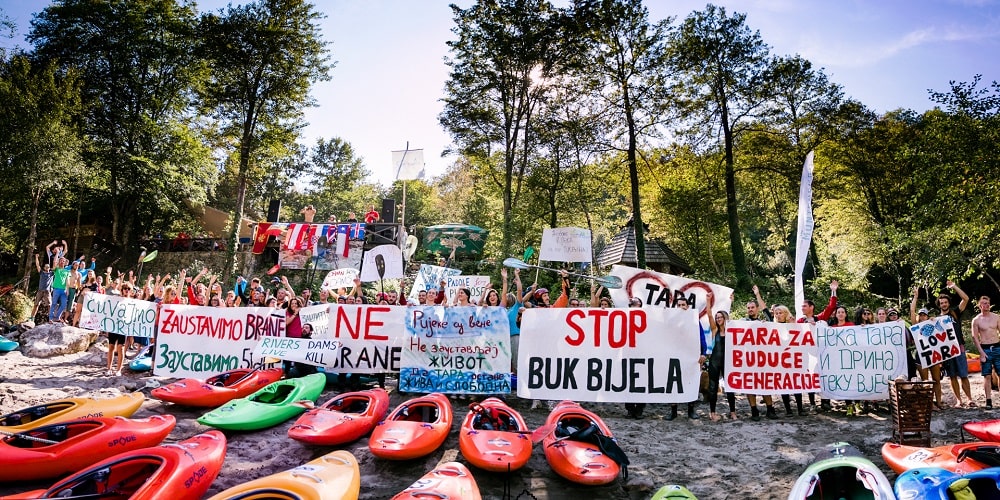
Photo: Katja Jemec
Stay informed
We closely follow international public finance and bring critical updates from the ground.
Key facts
- Capacity: 118 MW
- Part of the ‘Upper Drina’ complex, along with the 44 MW Foča and 43 MW Paunci plants.
- In July 2017, a memorandum on the project was signed with China National Aero-Technology International Engineering Corporation (AVIC-ENG).
- As of September 2025, no financing appears to have been secured.
Key issues
- Hydropower plants on the upper Drina would wreck the key habitat for the Danube salmon, classified as vulnerable globally and endangered in the EU.
- A new environmental impact assessment procedure started in 2024 but looks set to exclude most of the cumulative impacts of planned dams in the area
- A legal dispute is ongoing on whether the Republika Srpska entity needs to obtain state-level consent to issue concessions for the project.
- Lack of information available to the public on the project’s feasibility.
Background
The river Drina is formed by the confluence of the Montenegrin rivers Tara and Piva at the border with Bosnia and Herzegovina (BiH), in an area popular for rafting and angling.
The Buk Bijela hydropower plant is planned on the Drina within BiH, with its reservoir stretching 11 kilometres upstream to the Montenegrin border.
A larger version of Buk Bijela has been disputed since the 1970s due to its impacts on the protected Tara canyon in Montenegro – both a UNESCO World Heritage site and part of the Durmitor National Park.
The current version is being pushed by Elektroprivreda Republike Srpske (ERS), a public utility owned by the Republika Srpska entity. It would still be extremely damaging, especially as the Foča and Paunci hydropower plants are planned further downstream as part of the same complex. A fourth plant, the 44 MW Sutjeska plant, was also planned but has been abandoned.
Legal challenges on environmental permitting
Buk Bijela has repeatedly been challenged by civil society organisations and the Republic of Montenegro, due to Republika Srpska’s attempts to move forward with the project on the basis of an old and inadequate EIA.
After decisions by UNESCO and the Espoo Convention, and a mediation process led by the Energy Community Secretariat, in 2024 a new EIA process started. However, the screening study shows that Buk Bijela’s impacts will be assessed on their own in the main study, not in combination with the other plants in the Upper Drina complex. And some of the other plants planned in the area will be excluded from the cumulative impact assessment section of the EIA, undermining the whole point.
The Federation of Bosnia and Herzegovina entity and civil society organisations have questioned whether a new EIA process should be starting at all, as constitutional issues remain unresolved.

Constitutional court challenge
In December 2020, 24 Parliamentarians from the state-level Parliament of Bosnia and Herzegovina announced they had submitted a request to the BiH Constitutional Court to examine the Republika Srpska government’s decisions to issue concessions for Buk Bijela, Foča and Paunci.
They claimed the decisions breached the constitution, as it prevented the state-level institutions from being able to manage state property – in this case a river forming part of the country’s boundary. They also argued that previous decisions of the Constitutional Court had been breached, which found riverbeds and river water to be public goods and state property.
On 16 July 2021, the Constitutional Court made a partial decision, finding that a dispute regarding the decision by Republika Srpska to issue the concessions exists, and ordering the Commission for Concessions of Bosnia and Herzegovina to resolve the matter within three months. However, due to issues regarding the composition of the Commission, as of September 2025 the issue is still pending.
Chinese companies interested
Republika Srpska signed a memorandum on construction of the project with China’s AVIC-ENG in July 2017. But it was reported in 2023 that three other Chinese companies – Dongfang, Sinohydro and China Energy Engineering Corporation had submitted offers to build the project, in a closed procedure without a call for tenders. Later in the year, local media reported that the companies were concerned about the project’s constitutional issues and as of early September 2025, no contracts appear to have been signed.
The European Bank for Reconstruction and Development and the World Bank have both confirmed that they will not finance the project. A 2021 World Bank report found a number of deficiencies in the environmental impact assessment (EIA) for the project and proposed a complete redesign.
Drina – the key habitat for the Danube Salmon
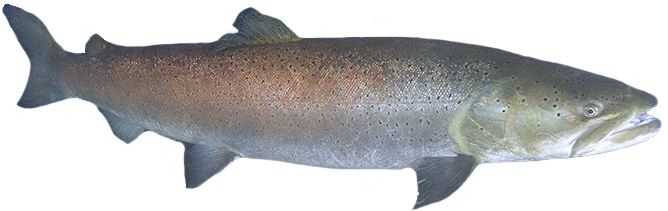
The river Drina constitutes the most significant habitat for the Danube Salmon (Hucho hucho) in terms of habitat length. Over the last 100 years Hucho hucho has undergone a massive decline. It is now found only in a few of southeast Europe’s cleanest rivers. This fish is highly sensitive to low oxygen and moderate levels of pollution and is a good indicator for river health. Overall, the IUCN considers it ‘vulnerable’, and in the EU ‘endangered’. Dams are one of the main current threats which impact the species, their prey and habitat.
Hucho hucho is protected under Annex III of the Bern Convention and Annex II of the European Union Habitats Directive as a species of community interest whose conservation requires the designation of special areas of conservation. This means that, if the river was in the EU, the stretches of importance for the Danube Salmon, including the upper Drina, would almost certainly be in the Natura 2000 network of protected areas and definitely under the EU Water Framework Directive – which virtually forbids projects that degrade the good ecological status of water bodies. So this project would be unlikely to be allowed.
A 2024 report by scientists from the BOKU University in Austria underlined the appalling impacts the Buk Bijela dam would have on the Danube Salmon’s migration, together with dams on its tributaries that would prevent spawning. Three plants are already under construction on the Bistrica river, which ‘will result in a significant or total loss of the spawning area’, according to the scientists. The Ćehotina tributary is also important for the Danube salmon’s reproduction, but is threatened by hydropower development as well.
[There must be] no hydropower development, including micro-hydropower in rivers holding self-sustaining populations of Danube salmon.
Freyhof et al. in the Hucho hucho in the Balkan region report
Latest news
The damage from Slovenia’s Mokrice dam won’t stop at the Croatian border
Story | 27 May, 2026Slovenia’s state-owned Hidroelektrarne na Spodnji Savi (HESS) has for two decades been trying to build the controversial Mokrice hydropower plant on the river Sava. But poor quality environmental studies have been repeatedly quashed in court by the Slovenian Native Fish Society, and a recent transboundary assessment’s claims that the impacts will stop at the Croatian border are far from convincing.
Read moreObstacles pile up for the Dabar hydropower plant in Bosnia and Herzegovina: Time to rethink the whole Upper Horizons complex
Story | 14 May, 2026When the Republika Srpska authorities signed contracts with the China Eximbank to finance the Dabar hydropower plant at the end of 2021, it seemed like the first and largest part of the Upper Horizons complex was a done deal. Today, more than four years later, obstacles are piling up for this controversial project, providing a much-needed opportunity to rethink the whole idea.
Read moreDon’t look, don’t find: Buk Bijela’s ‘environmental impact assessment’
Story | 2 March, 2026Bosnia and Herzegovina’s Upper Drina hydropower scheme would turn 30 kilometres of this iconic river into stagnant reservoirs and cut a key Danube Salmon habitat into pieces. Its largest dam would be the 118-megawatt Buk Bijela, first proposed in the 1970s but repeatedly scuppered due to its impact on Montenegro’s Tara Canyon. Now a new environmental assessment is out for public consultation, but it’s being more than economical with the truth.
Read moreRelated publications
Comments on the Nenskra supplementary environmental and social studies
Policy comments | 15 January, 2018 | Download PDFThe revised supplementary studies for the Nenskra project fail to properly perform a cost/benefit analysis. It lacks an assessment of the energy efficiency alternatives , the environmental externalities , the opportunity costs and even an economic inte
Six reasons for not financing the Nenskra hydropower project in Georgia
Briefing | 5 December, 2017 | Download PDFThis briefing outlines the main issues with the Nenskra hydropower project shortly before both the European Bank for Reconstruction and Development and the European Investment Bank will decide on financing the project.
Nenskra HPP poses possible threat to Georgian biodiversity hot spot
Briefing | 4 December, 2017 | Download PDFIn January 2016 the Georgian government decided to exclude from the Bern Convention’s candidate Emerald Site “Svaneti 1” all territories that are part of the valleys of the Nenskra and Nakra rivers which are relevant for the construction of the Nenksra

