Fossil gas
Fossil gas is the new coal. Although often labelled ‘natural,’ fossil gas is a major driver of the climate crisis. There is no more room for new investments in fossil gas projects if we are to avert the worst impacts of the climate crisis and set a path towards decarbonisation.
Stay informed
We closely follow international public finance and bring critical updates from the ground.
Key facts
- Methane is a greenhouse gas 86 times more potent than carbon dioxide over a 20 years period.
- Even after the 2015 Paris Agreement financial institutions have been pumping billions into fossil gas projects.
- The European Investment Bank committed to stop financing fossil fuels, gas included, from the end of 2021. It remains the exception among international financial institutions.
- In 2018-2020, gas made up over 75% of multilateral development banks’ known fossil fuels investments.
- In May 2021 the International Energy Agency warned there is no more room for new investments in fossil gas if the world is to limit global warming to 1.5 degrees.
Key issues
- Fossil gas is a potent greenhouse gas emitted throughout the supply chain, not only when burnt for energy production. Major international bodies warn fossil gas must be curtailed to slow the climate crisis.
- The fossil gas industry is plagued with corruption, and gas imports create reliance on authoritarian regimes.
- Despite the myriad problems with this fossil fuel, international financial institutions keep pouring billions in public money into gas projects and companies.
Background
Fossil gas is part of the problem, not the solution
Even though scientific evidence shows fossil gas is a significant driver of global warming, countries and financial institutions still consider fossil gas as a part of the solution in addressing climate change as a so-called bridge fuel.
In 2018 the Intergovernmental Panel on Climate Change (IPCC) pleaded for a quick reduction of emissions globally and a rapid switch to carbon-free energy systems to to prevent the planet from warming by more than 1.5 degrees above pre-industrial levels.
Fossil gas releases dangerous levels of greenhouse gas emissions – not just due to the CO2 emissions during combustion but also because of the methane emissions that occur in the supply chain, from extraction to distribution. These emissions are heavily unreported and have yet to be addressed by regulators and industry.
Methane is a greenhouse gas that is, in the short period of twenty years, 86 times more potent than carbon dioxide and has already driven more than a quarter of global warming to date.
If we are to slow climate change, methane is the strongest lever and reining its emissions would complement necessary measures to reduce carbon dioxide emissions.
A May 2021 report from the International Energy Agency report rightfully dismissed the idea of fossil gas as a transition fuel. It concluded that new investments in fossil fuels extraction must end and a radical reduction in fossil fuels, including gas, is needed over the next decade if we are to reach the Paris Agreement’s aim of limiting global warming to below 1.5°C.
Investing now in fossil gas would be the nail in the coffin of climate change. Such investments would delay the inevitable energy transformation, making it even costlier and more cumbersome in the next decades. Other solutions that are both economically and technologically feasible already exist and can be implemented.
LATEST PUBLICATION
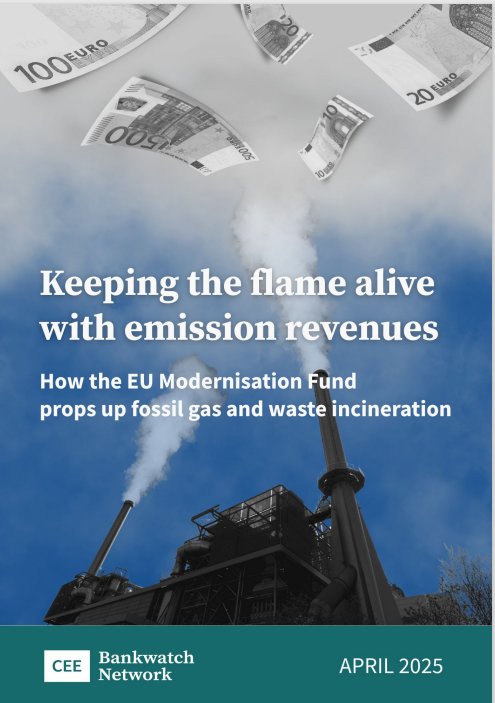
Keeping the flame alive with emission revenues: How the EU Modernisation Fund props up fossil gas and waste incineration
Launched in 2021, the Modernisation Fund was designed to channel EU emissions trading revenues into energy transition investments in 13 lower-income member states. However, Bankwatch’s analysis reveals that this climate fund has spent between EUR 4.2 billion and EUR 6.8 billion on a range of dirty energy infrastructure – from biomass heating and waste incinerators to gas-fired power plants. The bulk of this investment is in Romania, the Czech Republic and Poland.
The report also highlights the lack of support for several critical areas, including energy communities and just transition in post-coal regions.
Overall, this first-of-its-kind analysis demonstrates the lack of transparency that characterises the operation of this important climate fund.
For more on our work on the Moderniosation Fund, see here: Time to fix the Modernisation Fund: Stop climate money for dirty energy.
Fossil gas is a dirty business
The issues with fossil gas are not limited to its wrecking effects on climate change.
The fossil gas industry’s business model, through its practices, suggest that the continued profitability of these companies is achieved in significant part through bribery and other corruption. These same companies often play a central role in planning, assessing and projecting regions’ future energy needs in a way that primarily serves their own interests. Continued interference by oil and gas companies has also weakened institutions and policies put in place to mitigate climate change.
The remaining gas reserves are mostly concentrated in the Persian Gulf, Central Asia and Russia. This means that gas importing countries, including the EU which is heavily reliant on gas imports, are dependent on undemocratic and politically unstable regimes, with a proven track record of human right abuses.
Some of the areas where sizable fossil gas investments are planned, such as southeastern Europe and Central Asia, are among those most vulnerable to climate change. If these countries are planning to address and adapt to climate change, those fossil gas projects will become stranded assets in the next decades, well before the end of their financial life, thus leaving those countries once again far behind and increasing the costs of their inevitable transformation of energy systems.
Financial institutions pour billions into fossil gas
Financial institutions are struggling to kick the fossil fuel habit. Since the 2015 Paris Agreement, the public financial institutions have been supporting fossil fuels companies with billions of euros.
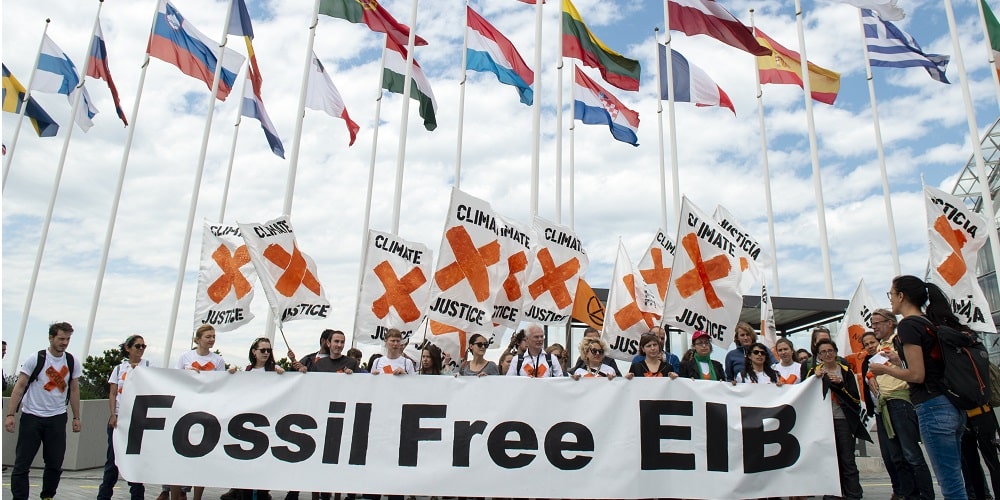
The European Investment Bank (EIB) was the first multilateral development bank that recognized it was time to stop financing gas. Following a strong campaign by an international coalition of NGOs, the EIB agreed on a new energy lending policy that stops financing fossil fuel projects from the end of 2021. But other multilateral development banks (MDBs) still need to follow suit.

The European Bank for Reconstruction and Development (EBRD) has clear mission statements on supporting the transition towards clean energy. Yet, several Bankwatch reports showed that the Bank’s financial support for fossil fuels remained steady throughout 2010-2019, the warmest decade on record.
In the early 2000s the EBRD was considering investing in the USD 20 billion Sakhalin-2 oil and gas development in the pristine area of Sakhalin Island, Russia. But eventually, in 2007 the Bank decided not to engage, in part due to the protest campaign of local indigenous communities and international NGOs that contended the project would have adverse impacts on Sakhalin’s people and environment.
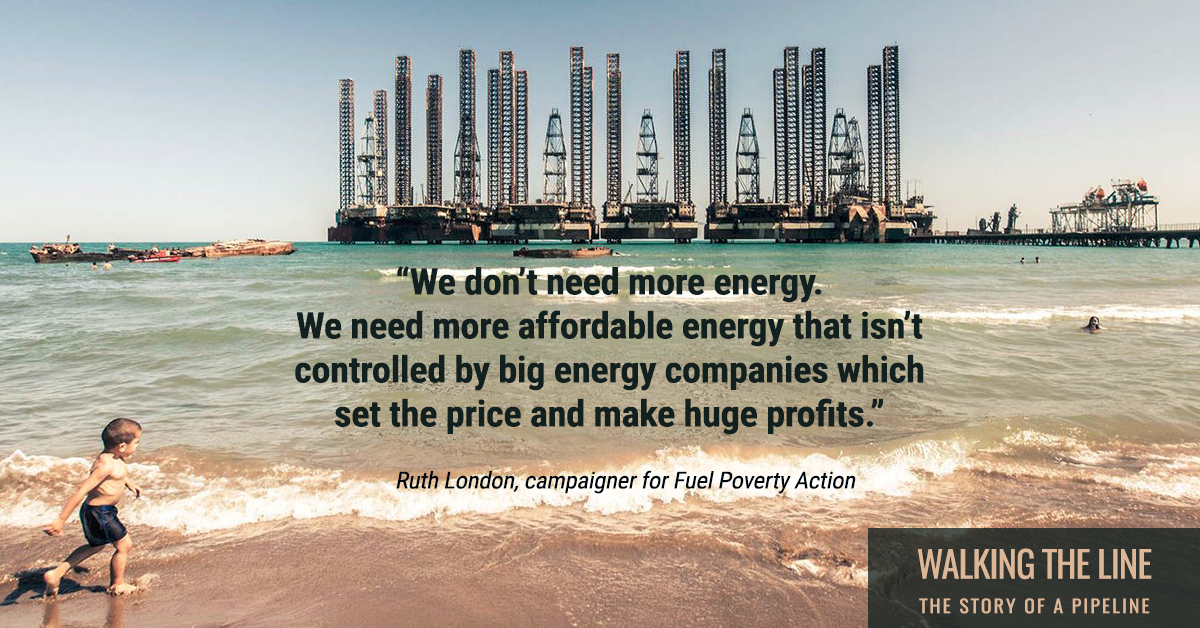
European MDBs’ latest fossil fuels adventure was the Southern Gas Corridor, a system of mega-pipelines to bring fossil gas from Azerbaijan to Europe. This massive project has simultaneously been boosting Azerbaijan’s dictatorial regime and causing upheaval in local communities along the pipelines’ routes in Turkey, Greece, Albania and Italy.
The pipeline project received unprecedented financial support from both the EBRD and the EIB. In addition to earlier EBRD investments in the Southern Gas Corridor, in the period 2014-2018 the EBRD extended over USD 450 million to the Azerbaijan gas field (Shah Deniz II) and more than USD 1 billion into the Trans Adriatic Pipeline (TAP) and the Trans Anatolian Pipeline (TANAP).
New investments into fossil gas will lock economies into the current system of fossil fuels dependency and will have a detrimental effect on the much-needed transformation of energy systems.
Latest news
Romania’s energy crisis exposes faltering gas strategy as battery storage surges
Blog entry | 30 September, 2026Romania’s energy crisis has laid bare the risks of relying on delayed gas projects to replace coal power. Meanwhile, battery storage has been developing much faster and is already providing much-needed flexibility. Even a state-owned coal company with designs on a gas power plant is now pursuing battery storage instead.
Read moreRomania prepares to launch 1.1 GW gas-fired turbines next month
Bankwatch in the media | 29 September, 2026Romania’s Mintia gas-fired power plant is set to launch with an initial capacity of about 1.1 GW next month, increasing to 1.7 GW early next year, the country’s energy ministry told Montel on Monday. CEE Bankwatch Network last week criticised Romania’s focus on new gas capacity, arguing that battery storage was developing faster and could provide flexibility to the power system.
Read moreRomania’s gas strategy falters as battery capacity surges – NGO
Bankwatch in the media | 29 September, 2026Romania’s battery storage capacity has expanded rapidly and is already providing grid flexibility, while the ongoing energy crisis has exposed the country’s failings in focusing on delayed gas projects, NGO CEE Bankwatch Network said on Friday.
Read moreRelated publications
The great energy trap: An evaluation of the economic viability of replacing coal with gas in large power plants in Bulgaria
Report | 14 March, 2024 | Download PDFThis report analyses several scenarios for replacing the existing coal capacity at Maritsa East and Bobov Dol with new gas-fired units. It looks at the implications of these projects becoming financially viable, including the investments required, possible state aid, and the electricity costs for households.
North Macedonia must ditch its unrealistic gas plans and cut to a clean energy future
Briefing | 15 February, 2024 | Download PDFThis briefing explains why the international community must not be complicit in creating stranded assets or increased gas lock-in in North Macedonia.
Cutting off the pipeline from REPowerEU to the fossil gas industry
Briefing | 27 July, 2023 | Download PDFIn May 2022, the European Commission, in response to the energy crisis, launched the REPowerEU plan – a set of measures aimed at ending the EU’s dependence on Russian fossil fuel imports by 2027. The plan emphasises the diversification of gas and oil supply sources, the replacement of fossil fuels with renewable energy sources by accelerating Europe’s clean energy transition, and the reduction of energy consumption, primarily gas, in the EU. Yet despite its ambitious scope, the plan excessively prioritises the interests of the fossil fuel industry.

