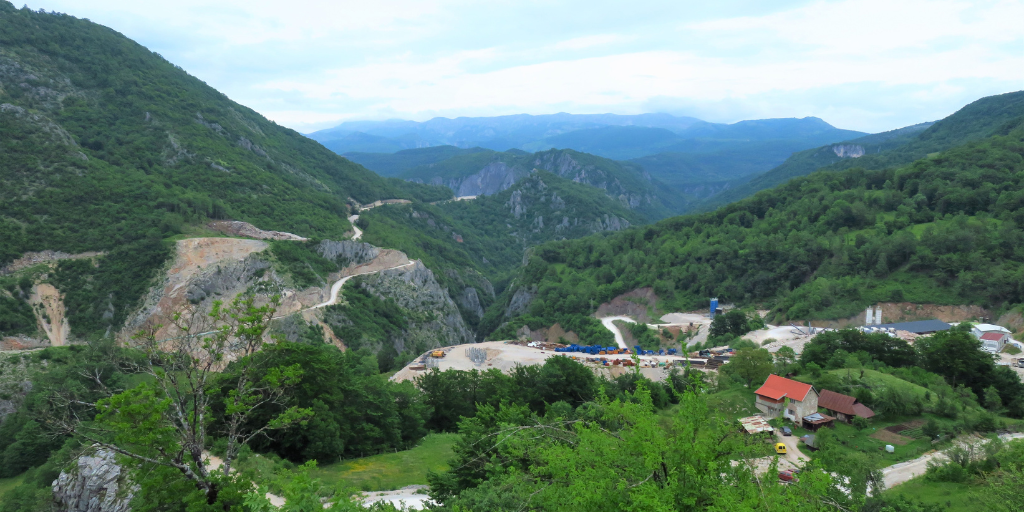
A 35 MW hydropower plant was completed in 2024 on a pristine section of the Neretva river at Ulog. Seven more plants are also planned further upstream.
Stay informed
We closely follow international public finance and bring critical updates from the ground.
Key facts
Project promoter: EFT – HE Ulog d.o.o, a subsidiary of the EFT Group (Ulog) and MHE Marvel d.o.o. (HES Gornja Neretva)
Installed capacity: 35 MW
Lead contractor: Sinohydro, China
Financing: Ulog: Reportedly, EFT’s own funds; No information available for Marvel’s plants.
River: Upper Neretva
Protected areas: Gornji tok Neretve Emerald Site
Other key risks: Geological – landslides
Key issues
– The Ulog project was completed in 2024 and seven more plants are planned in an Emerald site.
– The terrain appears unstable – two workers were killed by landslides in 2013.
– People downstream in Konjic fear that earthquakes could cause flooding.
Background
The EFT Group’s 35 MW Ulog plant, with a 53-metre high dam, was built by China’s Sinohydro and completed in 2024. A series of seven smaller plants is also planned further upstream by local company Marvel d.o.o. and would turn most of the upper course of the river – a section of about 38 kilometres – into a series of dams, pipes and reservoirs.
Risky construction
Work on the Ulog plant started for the first time in 2013, but in July that year, two fatal incidents took place and works stopped. On 4 July, a worker from the Prijedorputevi company was killed by a rock breaking off a cliff face while building access roads. Only four days later on 8 July, another worker from the same company was also killed by a rockslide, and another worker taken to hospital. After this, the works were put on hold while more research was done, but in 2017 the project was redesigned with the dam slightly further downstream. It remains to be seen whether the new design will be any safer.
People living downstream fear that the operational phase of the plant will also put them in danger, as the location where the plant is being built is where a landslide in 1934 caused the biggest floods in the history of Konjic. According to local people, the landslide blocked the Neretva, which then burst through, sending a massive wave downstream.
Neretva - one of the most biodiverse rivers in Europe
The projects are also subject to international legal challenges under the Bern Convention and Energy Community Treaty, as the Bosnia and Herzegovina authorities failed to protect the upper Neretva – part of the Convention’s Emerald Network – by permitting hydropower development along its entire length.
Although the environmental impact assessment studies for the Ulog project and the other Upper Neretva hydropower projects identified several significant species such as otters and crayfish being present, the government of the Republika Srpska Entity concluded, without any evidence, that these projects would not have a negative impact on the environment and could be implemented.
In July 2022, the first Neretva Science Week, organised by the Center for Environment together with Riverwatch and Euronatur, identified 1300 species living on the upper Neretva, of which 24 were new for Bosnia and Herzegovina, and eight species were new to science.
High-risk investments
Considering the rich biodiversity downstream above Konjic, including marble trout, the endangered soft-mouthed trout, white-clawed crayfish, kingfishers and endemic invertebrates, the impact on the Federation of BiH is a major concern.
As of October 2025, the other seven plants are not moving ahead significantly.
Latest news
The damage from Slovenia’s Mokrice dam won’t stop at the Croatian border
Story | 27 May, 2026Slovenia’s state-owned Hidroelektrarne na Spodnji Savi (HESS) has for two decades been trying to build the controversial Mokrice hydropower plant on the river Sava. But poor quality environmental studies have been repeatedly quashed in court by the Slovenian Native Fish Society, and a recent transboundary assessment’s claims that the impacts will stop at the Croatian border are far from convincing.
Read moreObstacles pile up for the Dabar hydropower plant in Bosnia and Herzegovina: Time to rethink the whole Upper Horizons complex
Story | 14 May, 2026When the Republika Srpska authorities signed contracts with the China Eximbank to finance the Dabar hydropower plant at the end of 2021, it seemed like the first and largest part of the Upper Horizons complex was a done deal. Today, more than four years later, obstacles are piling up for this controversial project, providing a much-needed opportunity to rethink the whole idea.
Read moreDon’t look, don’t find: Buk Bijela’s ‘environmental impact assessment’
Story | 2 March, 2026Bosnia and Herzegovina’s Upper Drina hydropower scheme would turn 30 kilometres of this iconic river into stagnant reservoirs and cut a key Danube Salmon habitat into pieces. Its largest dam would be the 118-megawatt Buk Bijela, first proposed in the 1970s but repeatedly scuppered due to its impact on Montenegro’s Tara Canyon. Now a new environmental assessment is out for public consultation, but it’s being more than economical with the truth.
Read moreRelated publications
Six reasons for not financing the Nenskra hydropower project in Georgia
Briefing | 5 December, 2017 | Download PDFThis briefing outlines the main issues with the Nenskra hydropower project shortly before both the European Bank for Reconstruction and Development and the European Investment Bank will decide on financing the project.
Nenskra HPP poses possible threat to Georgian biodiversity hot spot
Briefing | 4 December, 2017 | Download PDFIn January 2016 the Georgian government decided to exclude from the Bern Convention’s candidate Emerald Site “Svaneti 1” all territories that are part of the valleys of the Nenskra and Nakra rivers which are relevant for the construction of the Nenksra
Communities in Chuberi and Nakra, Georgia, address financiers of Nenskra hydropower plant
Advocacy letter | 23 November, 2017 | Download PDFIn this letter, communities affected by the Nenskra hydropower plant in Georgia, explain the project promoter’s inadequate engagement with locals and ask the international financial institutions to stop considering financing the project. More than 100

