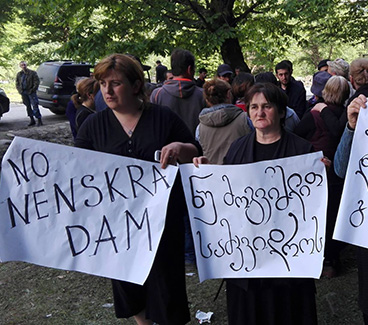
Eight arrested in protest against Georgian dam
May 24, 2016 | Read more
Protests against large dams in Georgia’s Svaneti mountains have led to confrontations with police. Locals are losing patience over the protracted consultation process on the project.
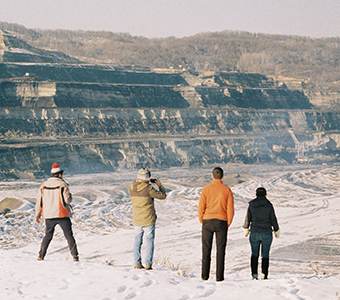
After months of protests and the people in Runcurel, a small town in Romania that is to be swallowed by a lignite mine, have finally received positive news from the Romanian government. During a meeting with Bankwatch Romania and Greenpeace Romania, the Minister for Energy Vlad Grigorescu confirmed that the government will do more to protect locals and their houses. Read more background in our photo story
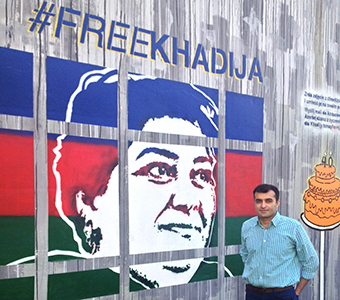
Happy birthday, Khadija!
May 24, 2016 | Read more
A graffiti in Warsaw marks the upcoming birthday of imprisoned Azeri journalist Khadija Ismayilova.
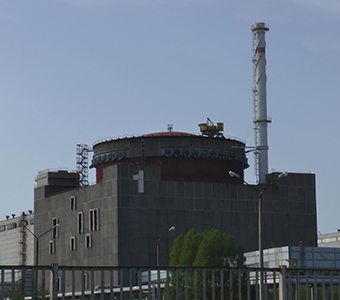
Three decades after Chernobyl, nuclear power remains a mainstay of Ukrainian energy supply. Despite persistent safety problems, the Ukrainian government has approved lifetime extensions for four of its 15 nuclear units since 2010, and two more could be greenlighted later this year. What is more, Ukraine’s nuclear sector survives in part thanks to European support. The EU needs to stop supporting Kiev’s risky nuclear energy programme.
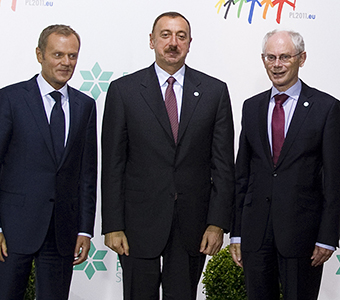
No security for Europe from the Southern Gas Corridor
May 16, 2016 | Read more
With an ownership structure heavily influenced by Azerbaijan, the European Commission’s flagship energy project may end up being a costly piece of infrastructure that does not increase Europe’s energy security but offers a tool for political leverage to the authoritarian Aliyev regime.
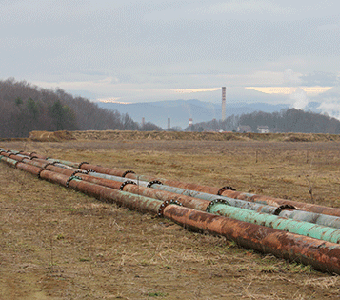
In spite of an updated construction contract for a new unit at the Tuzla coal-fired power plant, the project’s economic feasibility remains a puzzle with missing pieces.

